On January 5, 2025, I am invited to attend a Buddhist monk ordination. I have witnessed ordinations before, but this is the first time I will be participating from start to finish as an invited guest, rather than just a passing spectator. It is a great honor for me.

Dr. Kenneth, a professor at Payap University’s Peacebuilding faculty, is one of the Nai Than (นายทาน) of this ordination, meaning he financed and sponsored the ceremony. Sponsoring an ordination is a meritorious act for the benefactor. Wanting to share his merits with the Payap community, Dr. Kenneth invited Dr. Rey, Aye, a student from Arakan in Myanmar, Sam, a former Filipino student, Dawitt and me members of the Peacebuilding faculty’s community of friends, to accompany him. Together, we traveled to Ta Pong village, about twenty kilometers south of Chiang Mai.
Tornthep is a novice monk at the temple in Ban Ta Pong, where Dr. Kenneth resides. He comes from a Karen ethnic village and moved closer to the city to attend classes at the Buddhist school of Chedi Luang.

As we arrive at the Ta Pong temple, the ceremony has just begun. The Viharn is filled with people, mostly women and men dressed in traditional Karen attire. The monk leading the ceremony calls the ordination sponsors to come forward and light the candles on the large chandelier placed in front of the main Buddha statue.
We are in the Viharn (วิหาร), the prayer hall within the temple grounds where devotees can come to pray and listen to the monks’ sermons.


A baisri (บายศรี)—an arrangement made of carefully folded banana leaves forming a conical structure adorned with jasmine flowers—is placed at the center of a table. A cotton thread connects it to the Buddha. Tornthep, the young novice about to be ordained, sits holding one end of the white cotton thread in his joined hands, while the monk sitting in front of him holds the other end of the sacred thread, which establishes a connection to the Buddha through the baisri.
The monk then recites a very long exhortation in Kham Muang (คำเมือง), the local language. The text is highly poetic; although I can’t understand much of it, I can feel the beauty of the language. He offers guidance to the young man—advice that will serve him in his future monastic life, much like an older brother speaking to his younger sibling.
This is followed by the Offering to the Community (kan thawai than kae chumchon – การถวายทานแก่ชุมชน) ceremony, held on the steps of the Viharn. The Nai Than of the day present eggs, rice, and blankets to the underprivileged and the elders of the community. This ceremony reflects the importance of collective merit and sharing.

Then, a group of dancers performs a Lanna dance—a way to celebrate the departure of the young man who is about to leave his family and community behind for monastic life.
After the photo session, we go to eat. The monks receive the finest dishes and are seated in an air-conditioned room, while the rest of the community makes do with a bowl of noodle soup outside. As guests, we had the privilege of dining with the monks. I thoroughly enjoyed the local cuisine, which I love so much.

I take advantage of this informal moment to talk with Tornthep. He is a student at the Buddhist school of Chedi Luang. He explains to me that he has reached the age of 20 and can no longer remain a novice. He wants to continue his studies and has chosen to follow the monastic path because it is the traditional route that the elders before him have taken.
He introduces me to another novice, only slightly younger than him, who is taking the same courses and will become a monk next March. As our conversation unfolds, I realize that this novice lives in a temple in the city and knows one of my friends who used to be a monk there. (The monastic world is small.)
Tornthep’s parents, a farming couple, offer organic vegetables from their own production to those attending the ordination as a token of gratitude for their presence. I get the impression that donations play a central role in this day.

The ordination of a son as a monk is a great honor for parents in the Buddhist tradition. It is seen as the ultimate spiritual offering. The community considers that the parents have raised a virtuous and respectful child, capable of dedicating part of his life to the teachings of the Buddha, thus accumulating merit, or Boon (บุญ). According to popular belief, this could even guide them toward Nirvana in a future existence.
We leave the temple to head to the neighboring village’s temple, Wat Rong Khum. The reason is that there is no ordination hall at Wat Ta Pong. The ordination hall, or ubosot (อุโบสถ), is a building similar to the Viharn but reserved for the use of monks. It is rare for laypeople to enter, and even more so for women. Today, we are asked to remain outside.


We witness the moment when young Tornthep enters the Ubosot, where the chief monk, Chao Awat (เจ้าอาวาส), is waiting for him. Seated on a sort of throne before the Buddha, the community of monks is arranged on both sides. Tornthep kneels before the chief monk and, by extension, before the Buddha.
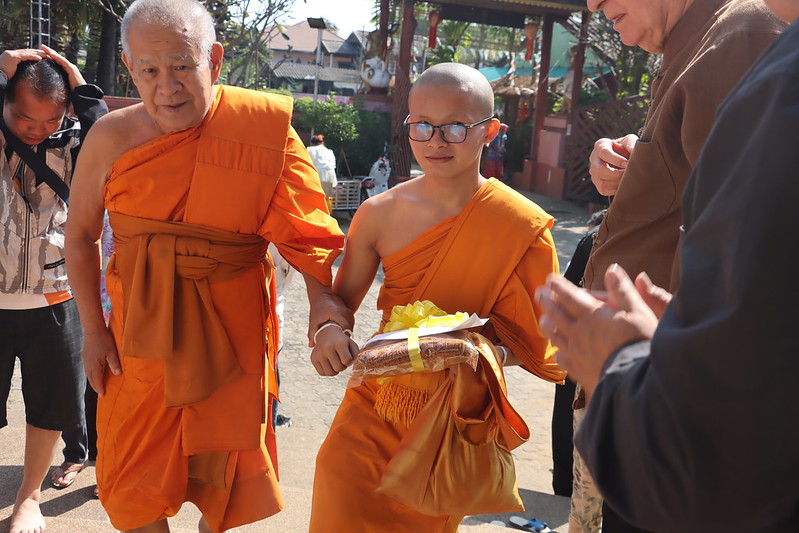
From outside, we observe the ceremony through the doorway, which lasts about an hour. When he emerges, he is now a monk. Holding his alms bowl, Bat (บาตร), he receives offerings from the community, who stand in a line on either side as he passes.

The community gathers once again in the prayer hall, the Viharn, with the monks seated to the side. The community leader delivers a long speech, after which the 15 monks who served on the ordination committee receive offerings.
Monk Tornthep then takes the microphone and expresses his gratitude in Thai, Karen, and English.
As a special gesture, the chief monk presents a mala (มาลา) to the foreign guests—meaning us. This is the Buddhist equivalent of a rosary, a string of 108 wooden beads used for reciting mantras.
A final blessing is chanted, and as everyone steps outside, the ceremony comes to an end.


text and pictures © Frederic Alix, 2025
 Salaween.blog
Laisser un commentaire