Why this investigation ?
Since last year, my co-author Alma and I have been conducting research on the role of women in the society of ancient Lanna. In this region, we have noticed signs of an implicit matriarchy—a social structure where women, particularly mothers, play a central role in the family and the transmission of power. As we document legends and historical figures, one name catches my attention: Malika.
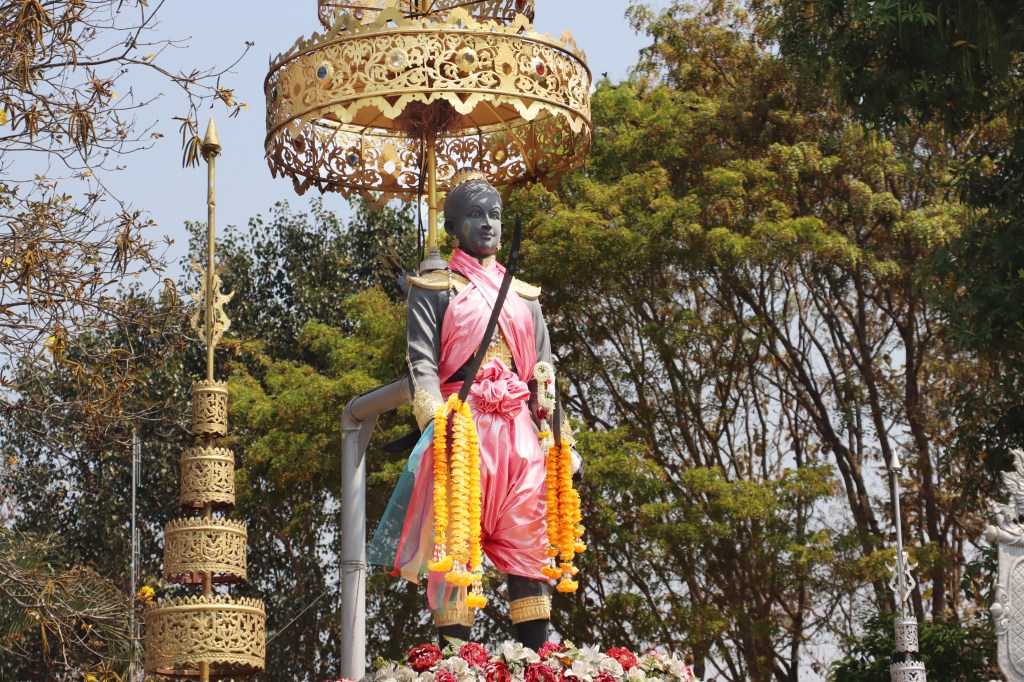
« Born in 1588, the Year of the Dragon, Malika was the daughter of the King and Queen of Fang. She ruled over the region that still bears her name today. »
Fang: A Forgotten Queen?
Fang is a town located over 100 kilometers north of Chiang Mai. According to several local accounts, a sovereign named Malika once ruled here. Yet, there is no mention of her in history textbooks, and no academic work seems to be dedicated to her. How could a queen—supposedly so important that an entire district still carries her name—be absent from official records? Has legend overshadowed reality? Did she really exist?
1. First Investigation – Online Accounts
Faced with this academic silence, I turn to another source: the internet. Soon, I come across Thai-language blogs mentioning Wiang Malika, literally « the City of Malika, » now known as Mae Ai. With the help of my trusted online translator, I dive into these digital narratives.
Online blogs are the modern versions of folk tales, where everyone contributes to shaping the collective story. Several writers from the region recount a similar tale: a wise queen who ruled, founded a city, and left her mark on local history. One detail fascinates me—Malika is said to have formed an army of women.
As different accounts align, the credibility of the myth seems to strengthen. Yet, nuances emerge: some describe her as a warrior queen dressed as a man, while others portray her as a protective mother.
But the internet has its limits. No books or academic articles confirm these digital testimonies. If I want to learn more, there is only one solution: travel to Mae Ai. There, on-site, I can cross-check the stories, interview locals, and perhaps uncover the true history of Queen Malika.
I pack my bag, place it in my motorbike’s storage, grab my phone for notes, and keep my camera within reach. The investigation begins.
2. First Stop: The Monument in Fang
After several hours on the road from Chiang Mai, I finally arrive in Fang. North of this small town, an imposing monument is dedicated to Malika’s parents, King Jao Fang and Queen Sam Piu. Several temples in the Burmese-Shan style stand in this area, just a few dozen kilometers from the Myanmar border. The statues are placed on municipal land, separate from the temples but connected to them by walls with open gates.
Upon arriving at the site, I discover two majestic statues of the royal couple standing side by side, each topped with a single-tiered golden umbrella. This detail is significant: it symbolizes their status as honored figures—not of the highest nobility—but also highlights their equality, a rare feature in royal iconography, where the man is often depicted with a higher rank than his wife.

Next to it, a sanctuary houses a second representation of the royal couple, this time dressed in silk and adorned with sparkling jewelry. The atmosphere is more intimate, and despite the tiled walls, it invites respect and spirituality. I take a moment to observe people making offerings and saying prayers. In a display case, I notice numerous donated tiaras, ornaments, and handbags for the queen.

I ask a couple why they came to make an offering to the statues this morning. They simply reply that it’s because they have the day off.
The space in front of the monument is designed to host traditional ceremonies. This is where dances and narrative songs are performed in honor of Jao Fang and Sam Piu, preserving the memory of this royal lineage and their daughter, Malika. I once watched a YouTube video showing dancers and musicians recounting the story of this family through music and movement, a family that left a lasting mark on the region.

On an informational panel, I read this part of the story:
« While she was pregnant, Malika’s mother dreamed of a white elephant carrying jasmine flowers. This dream inspired her to name her daughter Malika, which means ‘jasmine.’ At the same time, she was troubled by the actions of the king of Fang’s chief concubine. During an offering ceremony at the statue of Buddha, the concubine carelessly lit the candles, causing them to fall and burn the statue’s mouth. When Malika was born, she was of radiant beauty but bore a mark—a cleft on her lower lip, reflecting the injury inflicted on the burned statue. »
« At the age of 18, while Lanna was under the rule of the Burmese king of Taungoo, her father built a fortified city north of Fang and gifted it to his daughter, asking her to continue the struggle for independence. This city was named in her honor: ‘Wiang Malika’ (City of Malika).”
What is in the official history:
From the 16th century onwards, the kingdom of Lanna came under Burmese rule after the fall of Chiang Mai in 1558. For more than two centuries, Lanna’s kings were vassals of the Taungoo (and later Ava) court, required to provide tributes and troops.
3. The Citadel of Mae Ai
I get back on my motorbike, and about twenty kilometers later, I arrive in Mae Ai. Google Maps tells me to take a left turn in 200 meters. A large sign confirms the direction: the public hospital and the monument of Queen Malika. I turn, the road climbs the hill, passes by the hospital, and I park my vehicle near a small hut where a soldier stands guard. He watches over the entrance to the military camp but also the statue of the queen, erected on what was once her citadel, Wiang Malika.

The first monument dedicated to Malika is located here, funded by the public hospital’s budget. Perched high above, the statue gives the impression that she is still watching over the region and her army. To reach it, one must climb a staircase, flanked halfway by a sacred tree and two spirit houses containing the Queen’s weapons. Next to them, a pillar honors her horse. This may seem like a small detail, but honoring a mount signifies that its owner was elevated to the rank of a near-deity.
When I reach the top, I find Malika standing under a golden three-tiered umbrella—a superior royal symbol. Since her parents are depicted with only a single tier, this demonstrates that she earned her legitimacy through her own merits.
She wears white silk trousers, a sign of her devotion to the teachings of the Buddha. However, as I browse through other photos and videos, I notice that she is sometimes dressed differently, always in vibrant silk. – On my second visit, she will be wearing pink.

I take my time photographing the statue from every angle, carefully reading the explanatory plaques. It almost feels as if she is telling me her story herself. All around, inscriptions carved into stone or wooden plaques contain prayers addressed to the spirits associated with her. Behind her stands the entrance to the military camp.
« The citadel was primarily inhabited by women. Uninterested in courtly life, Queen Malika became known for her martial skills and combat expertise, particularly in archery. She trained and led an army of warrior women who defended the city against punitive Burmese attacks. Queen Malika ruled her kingdom with unwavering determination, refusing to ever marry. »
I notice a middle-aged woman approaching. She kneels, holding flowers between her clasped hands, recites a prayer, and then places her offering at the foot of the statue. With my limited vocabulary, I naively ask her about her visit. She explains that she lives in Mae Ai and regularly comes to pay homage to the Queen, whom she considers a protector. She also mentions that every April 18th, the locals organize a grand ceremony in Malika’s honor. Monks and officials attend, while women perform traditional Lanna dances, accompanied by orchestras and songs recounting Malika’s story. On this occasion, participants pour water over the statue and lay jasmine garlands at its feet.

Curious to learn more, I ask the on-duty soldier if there are any other sites dedicated to Malika. He points me toward a road winding north, in the direction of Myanmar. After a few kilometers on a steep path, I come across a sanctuary where several spirit houses stand side by side. These are the guardian spirits of the city. Few tangible remnants remain here, so I patiently read through all the names, but Malika is not mentioned. Perhaps the soldier misunderstood me, or there is another statue I have yet to find.
A Large Village
The modern town of Mae Ai is essentially limited to a main road following the highway, with little development beyond a single block in depth. Beyond this artery, Mae Ai becomes a large village nestled on the hillside, surrounded by lush landscapes. Its homes are mostly individual houses, scattered among flourishing gardens and rice fields stretching between different local communities. The Mae Ai River meanders peacefully through the valley, bringing freshness and life to the region.
I pause for a moment by the river and sit at the water’s edge. I recall the story of Malika and her tragic rendezvous.
« Her strength and courage on the battlefield contrasted with her shyness in interactions with men. A famous episode in her life tells of a meeting with a young man by the river. Embarrassed by her cleft lip and overwhelmed by timidity, she could not lift her face and began to weep. This event gave the river its name, Mae Ai, which means ‘shy river.’ After this episode, the locals began calling Wiang Malika by the name Wiang Mae Ai, which can also mean ‘City of the Shy Mother.’”

« All accounts agree that Malika felt comfortable only in the presence of women. »
As I wander through a neighborhood of houses, I notice a large shelter that seems to house a spirit. I approach and see a portrait of Malika inside. This shelter is dedicated to her. It occupies a plot of land like a home. In the neighboring houses, I see a sanctuary dedicated to the spirits linked to the Queen. She is present everywhere.
4. The Spiritual Dimension – Wat Phra That Pu Chae Temple
I head toward a monastery perched on another hill, from which a spring trickles down in a shimmering stream. This is Wat Phra That Pu Chae. I found a document on Mae Ai’s official city website mentioning a connection between this temple and Malika’s story. The site is renowned for its ancient chedi and a legend surrounding a miraculous spring.
The path leading up winds through tall trees with enormous leaves. Halfway up, I notice several small houses scattered around, dedicated to the protective spirits of the area. Upon arriving at the temple, I notice that the prayer hall has an unusual layout: its entrance faces the chedi—an uncommon configuration, likely dictated by the geography of the site.

The interior of the prayer hall is empty, with only the Buddha sitting in silent majesty. I walk around the chedi, reading the inscriptions and photographing every detail. Then, I notice the shadow of a monk emerging from a kuti (monastic dwelling). I step in his direction, hoping to catch his attention.
We exchange greetings before he asks me what has brought me here. He then tells me about the mysterious spring that flows beneath the temple’s chedi—a sacred water said to have healing properties. This spring, he recounts, has only been seen once, appearing suddenly before vanishing again into the depths of the earth. However, the water is visible as it emerges further down the hill below the temple.
He also tells me about the charitable foundation within the temple grounds, dedicated to rehabilitating people suffering from alcohol and drug addiction. Since I’m a bit slow to connect the dots, it doesn’t immediately occur to me to link this initiative to the healing spring.
« Malika used a hill to the west of the citadel as a defensive base. She knew that this hill housed a sacred spring with healing properties. During the war, she would apply betel leaves to the wounds of her warriors and immerse them in the sacred water to heal them. After the war, the queen came to practice Dhamma on this hill. During her meditations, she had a vision in which a revered monk advised her to build a stupa on the hill to purify her karma. She then had a stupa erected to house Buddha relics, which became known as Phra That Pu Jae. »
This healing vocation still resonates today, as the temple now hosts a foundation dedicated to rehabilitating people suffering from alcohol and drug addiction.
As I leave the temple, I take one last look at the chedi and the discreet miraculous spring, which, like Malika’s story, continues to shape Mae Ai.
5. Malika’s Legacy at Mae Ai School
After my visit to the temple, I decide to explore another key location: Mae Ai Wittayakom Public School. This school has incorporated Malika’s image into its identity—it uses the Queen’s likeness as its emblem and even minted a commemorative coin in her honor to mark an important anniversary.
Upon arrival, she is impossible to miss: Queen Malika’s statue stands prominently at the entrance of the campus. The area surrounding the monument was recently renovated, with new plantings and redesigned pavement, all inaugurated in June 2024.
A guard watches over the school entrance. I explain that I am interested in Queen Malika and would like to take some photos. He simply responds, « OK, » before disappearing.

Teachers from Chiang Mai and beyond have confirmed to me that not only is Malika’s story not included in the national school curriculum, but they also had no idea who Malika was.
However, I spoke with two friends who attended school in Mae Ai. Both shared with me that Malika is well known in Mae Ai and Fang, and that her story is taught to children at school thanks to the statue on campus and the ceremonies dedicated to her.
I read on the school’s official website that each year, teachers organize a ceremony in front of the statue, funded by their own donations. In 2021, when a new principal took office, his first act was to pay homage to the school’s spirit house before offering his respects in front of Queen Malika’s statue—demonstrating the importance of this figure in local culture.
This visit makes me realize that Malika’s legacy is not confined to legends and temples. Through the school, her memory endures and continues to inspire new generations. As I leave, I wonder how many children, passing by this statue every day, grow up with the image of a strong and benevolent queen—a protector of her people and a spiritual guide.
« Queen Malika ruled the city with wisdom and peace for 40 years, until her death at the age of 58. Her reign brought prosperity and security to the city, and she trained women to become warriors, ensuring the city’s protection against invasions. »
As the sun begins to set behind the mountains, I leave Mae Ai. My investigation into Malika is coming to an end, but her story continues to live on in the hearts of the people of this corner of Thailand.

Conclusion
This investigation has allowed me to grasp the importance of popular memory in shaping history. Through oral narratives, I have discovered how thin the line is between myth and reality, and how these stories, passed down from generation to generation, shape the identity of a region. While official history chooses what to remember and what to forget, local legends continue to exist in the memories of the people, bearing witness to a past that refuses to completely fade away.
But this exploration has also revealed a broader dynamic: the erasure of female figures from official history. In Chiang Mai, Queen Chiraprapha, despite having pacified a crisis-stricken Lanna—resolving two armed conflicts peacefully—at a time when no male heir was willing to take the throne, is often mentioned only as a mere transitional queen. After her, another regent queen, installed by the King of Taungoo, was erased even more brutally—to the point where even her name has been lost to history. Then came Malika, whose memory has completely vanished from official Thai records, despite remaining a significant figure in local history. These forgotten destinies show that women played a far more active role than traditional narratives suggest, and highlight the importance of restoring a voice to those who shaped history from the shadows.

Epilogue
Under Burmese rule, King Fang Udom Din attempted to free his city by defying the authority of Taungoo. Despite fierce resistance, Fang was besieged for three years, plunging the population into famine and despair. Seeing the inevitable outcome and refusing to surrender, the king and Queen Nang Sam Phiu chose to sacrifice themselves together by jumping into the sacred well of Bo Sao Wa. Moved by their courage, the Burmese king ordered his troops to spare the inhabitants before withdrawing, thus ending the direct military occupation of Fang. Lanna remained a peaceful vassal of the Burmese kings until the 18th century.

The well is located at the foot of the statues. Pilgrims coming to pay homage to the royal couple tie a piece of cloth to the fence.
At the entrance of the nearby sanctuary, a mailbox is installed with the inscription « Love Post ». Could there be a romantic legacy that has survived the tragic fate of this couple? This could very well be the starting point of a new investigation.

text and photos @ Frédéric Alix, 2024 et 2025


 Salaween.blog
Laisser un commentaire