The Mon people are among the oldest indigenous peoples of mainland Southeast Asia. Located in the central plains of Thailand and southern Myanmar, they developed as early as the 6th century a remarkable civilization known as Dvāravatī. This term, literally meaning “the kingdom of gates” in Sanskrit, conveys the idea of a place open to exchanges, both a passage and a cultural crossroads. Open to Indian influences and maritime trade networks, the Mon later played a decisive role in transmitting Theravāda Buddhism.
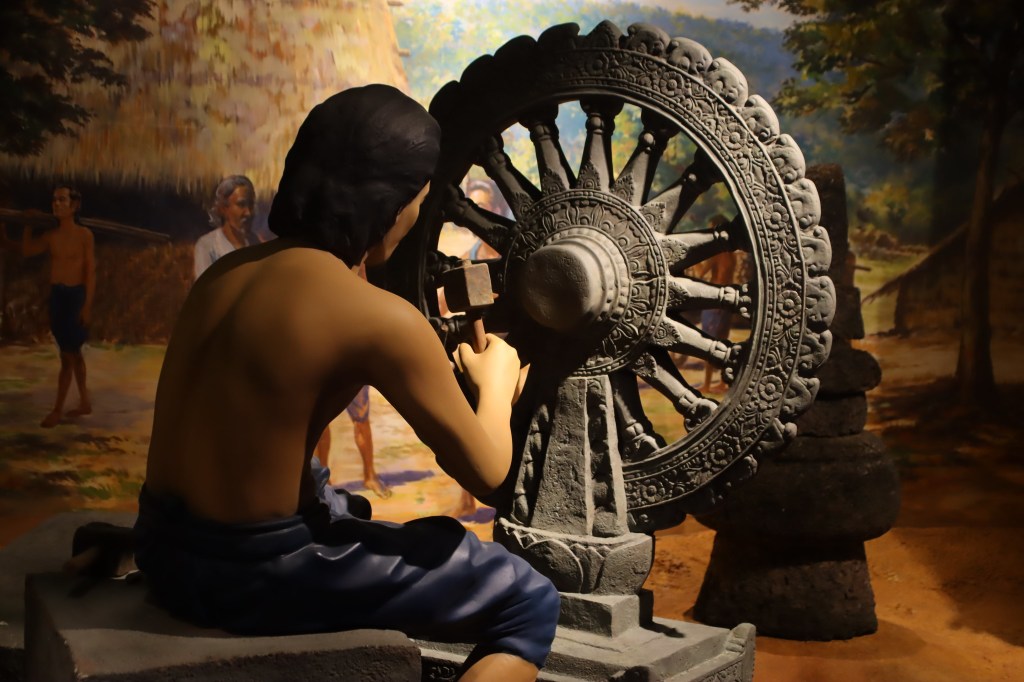
I. The Mon Civilization of Dvāravatī
The Mon people are considered the indigenous inhabitants of the central plains of Thailand and southern Myanmar. Their city-states were independent, ruled by local chiefs, but often under the suzerainty of the Khmer Empire of Angkor, which exerted strong cultural, religious, and artistic influence. The Khmers spread monumental architecture, Hindu and Mahāyāna Buddhist iconography, and certain administrative practices, without imposing direct military control.
Within this context, the Mon civilization of Dvāravatī (6th–11th centuries) developed fortified cities, Buddhist sanctuaries, and an original culture, where irrigated agriculture, refined craftsmanship (beads, pottery, metalwork), and trade formed the pillars of the economy.


II. The Mon Cities of Dvāravatī in Thailand
Among the cities of Dvāravatī, Lavo (Lopburi) stood out as a major political and cultural center, while Nakhon Pathombecame an important Buddhist site, with its impressive stupas. Si Thep and U Thong, real commercial hubs, connected the central plains to neighboring regions. Khu Bua, near Ratchaburi, illustrates a prosperous Mon community, living from agriculture and craftsmanship, but especially integrated into trade networks leading to the Gulf of Thailand.

Phimai, further to the northeast, illustrates the gradual integration of Mon territories into the Khmer Empire. Built on a Mon-Dvāravatī foundation, it became in the 11th century a religious and administrative center of Angkor, renowned for its large Khmer temple oriented toward the imperial capital.

III. The Mon Centers in Lower Burma
In southern Myanmar, the Mon enjoyed relative independence. Thaton, Pegu (Bago), and Martaban (Mottama) were active ports facing the Andaman Sea, benefiting from rich exchanges with India and Sri Lanka. According to tradition, these cities belonged to the mythical territory of Suvaṇṇabhūmi, the “Land of Gold,” famed for its wealth and its role as a religious and cultural crossroads.

IV. The Turning Point of Theravāda Buddhism
How did the arrival of Sinhalese missionaries and the Tripitaka in Thaton provoke a spiritual and political revolution, transforming Mon governance and leaving a lasting influence on major neighboring kingdoms like Bagan, but not Angkor?
Since the 3rd century BCE, Sri Lanka has been the guardian of Theravāda Buddhist traditions, and its missionaries have traveled across Southeast Asia to spread their faith.

From the 10th century, a decisive turning point occurred with the arrival of Sinhalese monks from Sri Lanka. They brought the Tipiṭaka (sacred texts of Theravāda Buddhism) as well as new monastic practices, triggering a quiet revolution. Temples became centers of knowledge, religious dissemination, and political legitimacy. Local chiefs and kings began to base their authority on Buddhist morality, or “good governance,” rather than solely on animist cults or Hindu and Mahāyāna influences.
While Angkor remained attached to Brahmanism and Mahāyāna Buddhism, the kingdom of Bagan in Burma seized the opportunity to adopt this new religious legitimacy. In 1057, King Anawrahta conquered Thaton, taking with him the manuscripts, relics, and learned Mon monks, thus ensuring the spread of Theravāda throughout Burma. This event marks the gradual integration of Mon cities into a political and religious network dominated by Bagan.

V. Mon Legacy

Some Mon cities had a special destiny. Lavo (Lopburi) sent Princess Cāmadevī to found Hariphunchai (Lamphun), the first northern Mon Theravāda kingdom in Thailand. Hariphunchai became a model for later Thai kingdoms, notably Lanna and Sukhothai, which also adopted Theravāda Buddhism.
Others, like Si Thep or U Thong, disappeared as political entities, but their archaeological remains today testify to the cultural and religious richness of this civilization. The Mon remained at the heart of trade networks linking India, Sri Lanka, the Malay Peninsula, and China, yet their political autonomy faded with the expansion of Bagan and later the Thai kingdoms.
Gradually, the Mon were absorbed into the ethnic and cultural fabric of the region. Today, they survive only as a minority, mainly in southeastern Myanmar, but their legacy — temples, religious traditions, art, and the spread of Theravāda Buddhism — remains a foundational pillar in the history of Southeast Asia.

Conclusion
The Mon civilization, grouped under the term Dvāravatī, was one of the first major cultures in mainland Southeast Asia. It skillfully absorbed Indian influences, traded with the maritime world, and, above all, transmitted Theravāda Buddhism, which would profoundly shape the destiny of Burmese and Thai kingdoms. Although the Mon were gradually absorbed by more powerful neighbors, their religious and cultural heritage endures: they were civilization bearers, linking the central plains of Thailand, Lower Burma, and the Indian Ocean to a vast network of spiritual and commercial exchanges.
Text and photos ©Frédéric Alix – thank you


 Salaween.blog
Laisser un commentaire