Right before his death, the Buddha said to his disciples, « Be a light unto yourselves. Do not rely on any other refuge » (Mahāparinibbāna Sūtra, Ricard, 2003). These words encourage each person to follow their own spiritual path, without depending on statues or sacred objects.
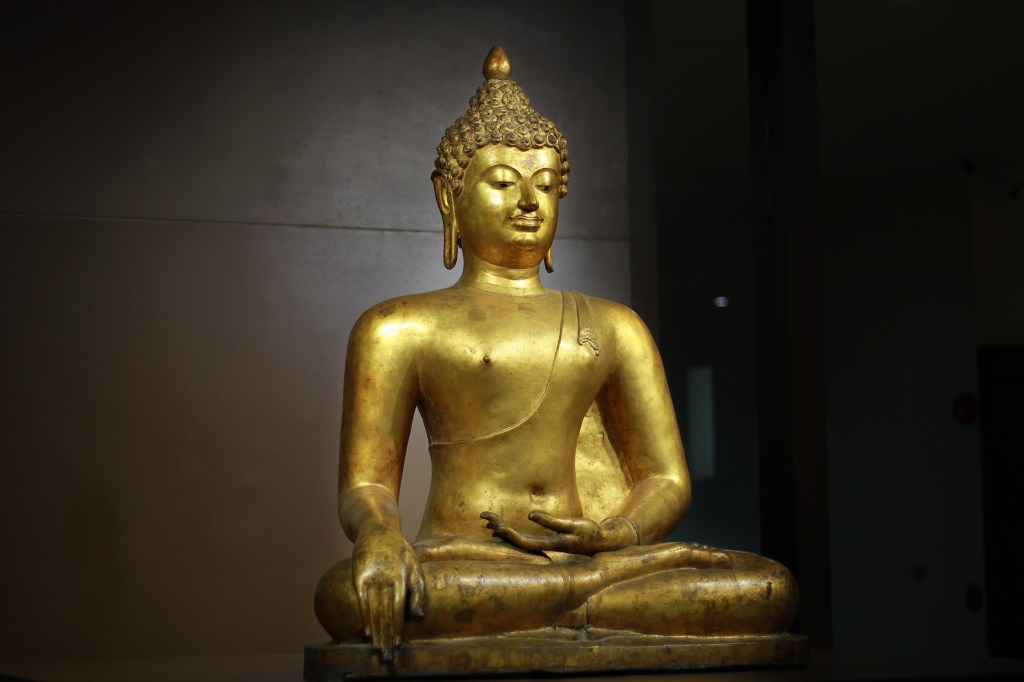
For a long time, the Buddha was represented only through symbols. It was only several centuries later, under the influence of Greco-Buddhist art, that his first human statues appeared, giving a new dimension to devotion.
1. Before Statues: The Reign of Symbols
In the earliest Buddhist traditions (3rd–1st century BCE), particularly within early Buddhism and the emerging Theravāda, the Buddha was not depicted in human form. Instead, aniconic symbols such as the Dharma wheel, the Bodhi tree, footprints, or the empty throne were used. This reluctance to depict him figuratively reflected the belief that the Buddha, having attained nirvāṇa, transcended any material representation, and portraying him would have been reductive, even disrespectful (Wikipedia, n.d.).

2. Mahāyāna and the “Temptation of the Image”
From the 1st century BCE to the 1st century CE, Mahāyāna Buddhism, flourishing in northern India, expressed a strong desire to make the teachings more accessible, bringing devotees closer to the Buddha and bodhisattvas through visual and symbolic means. The regions of Gandhāra and Kashmir were in contact with major Persian empires. These exchanges may have introduced Iranian concepts into Mahāyāna: dualistic cosmologies of light and darkness, salvific figures echoing the bodhisattva guiding all beings, and perhaps paradisiacal depictions inspiring Amitābha’s Sukhāvatī (Keown, 2013).
How the Greeks Influenced the First Human Images of the Buddha
At the same time, the Greco-Bactrian and Indo-Greek kingdoms (3rd–1st century BCE) had a major artistic impact. After Alexander the Great, Greek dynasties settled in Bactria and Gandhāra, notably under the reign of Menander I (Milinda). In these regions, Buddhist art was transformed: the Buddha was represented in human form for the first time, with a style inspired by Greek statues of Apollo—realistic drapery, idealized faces, halos—giving rise to what is now called Greco-Buddhist art (Encyclopaedia Britannica, n.d.).

This new imagery accompanied the rise of Mahāyāna, which emphasized veneration and closeness to the Buddha and bodhisattvas. Statues became both objects of prayer and educational and devotional tools, making the teachings more tangible for followers. This shift also marked a distinction from Theravāda, where the aniconic tradition remained predominant for a long time, while Mahāyāna established itself as a separate movement, developing its own imagery (Foucher, 1917).

3. The Khmers and the Sacralization of the King
This development spread to Southeast Asia. Among the Khmers, particularly under the reign of Jayavarman VII (12th century), Mahāyāna Buddhism took on a distinctive form: the king sought to reinforce his authority and had himself depicted in the very features of the Buddha or Avalokiteśvara, the bodhisattva of compassion. Here, imagery played a major political role, transforming the king into a living embodiment of wisdom and compassion. The sovereign was not merely a protector of religion but became its earthly expression (Chandler, 1992).

Jayavarman VII used royal Buddhism to sacralize his authority: through a politically engaged Mahāyāna, he identified with the bodhisattva Avalokiteśvara, transforming his relationship with the people into a vertical bond in which the sovereign appeared as a spiritual figure to be revered. Although the Buddha is not considered a god, this strategy illustrates how religion could legitimize royal authority while emphasizing Buddhist virtues (Higham, 2001).

4. Theravāda and the Late Adoption of Buddha Images
Theravāda kingdoms (Sri Lanka, Burma, and later Thailand) remained faithful to the original teachings of the Buddha, preserving the symbolic tradition for a long time. From the 4th–5th centuries onward, under the influence of Indian currents (notably Gupta art) and cultural exchanges with Central Asia, statues gradually became prominent. In Sri Lanka, from the Anurādhapura period and especially between the 8th and 12th centuries (Avukana, Gal Vihara), Buddha images became central in sanctuaries and religious life (Siriweera, 1994).

However, the political role of these images differs sharply from the Khmer model. Here, the king is not equated with the Buddha. The ruler’s legitimacy rests on a moral principle: he must embody the Dhammarāja, the “just king,” guarantor of the Buddhist law (Dhamma). The sovereign presents himself as the Buddha’s servant and protector of the monastic community and the people. This legitimacy is conditional: a king who violates Buddhist morality—governing cruelly or breaking the Dhamma—can lose his moral mandate and be challenged or even overthrown (Swearer, 2004).

Conclusion
- The idea of representing the Buddha in human form arose from the encounter between Mahāyāna Buddhism and Greek culture, particularly in Gandhāra, giving rise to Greco-Buddhist art.
- Among the Mahāyāna Khmers, the king appropriated the sacred image by giving his own features to the Buddha, appearing to the people as a living deity.
- Among the Theravāda Sri Lankans, and later in the emerging Tai kingdoms, the image eventually became central, but in a very different framework: the king did not identify with the Buddha, instead presenting himself as his servant and protector.
- Thus, from India to the forests of Southeast Asia, the image of the Buddha not only transformed art and religion but also shaped two opposing conceptions of royal authority: one divine, the other ethical.

BIBLIOGRAPHY
- Chandler, D. (1992). A history of Cambodia. Westview Press.
- Encyclopaedia Britannica. (n.d.). Gandhara art. Encyclopædia Britannica. https://www.britannica.com/art/Gandhara-art
- Foucher, A. (1917). L’art gréco-bouddhique du Gandhāra. Paul Geuthner.
- Higham, C. (2001). The Civilization of Angkor. University of California Press.
- Keown, D. (2013). A dictionary of Buddhism (2nd ed.). Oxford University Press.
- Ricard, M. (2003). Le Bouddha, l’histoire d’une vie. Seuil.
- Siriweera, W. I. (1994). History of Sri Lanka: Volume II. University of Colombo Press.
- Swearer, D. K. (2004). The Buddhist world of Southeast Asia (2nd ed.). SUNY Press.
- Wikipédia contributors. (n.d.). Aniconisme dans le bouddhisme. Wikipédia. https://fr.wikipedia.org/wiki/Aniconisme_dans_le_bouddhisme

 Salaween.blog
Laisser un commentaire