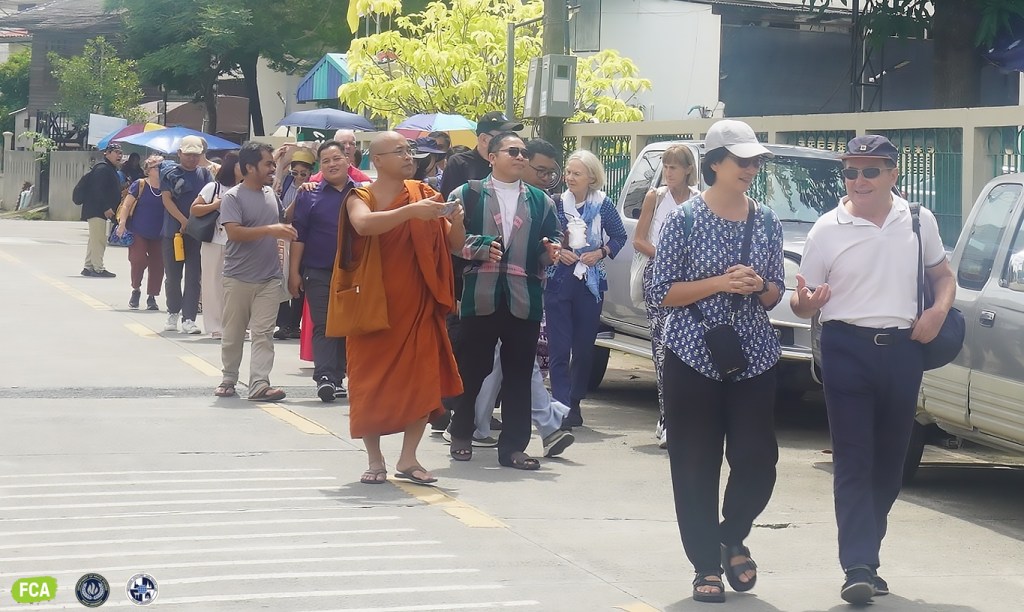
Saturday, September 13, 2025, 8:10 AM. On the forecourt of First Church, the sweepers are busy at work. I arrive a little early, alone in front of the Protestant church near Nawarat Bridge. Through the office window, Pastor Boontawat, the senior pastor of the church, spots me and opens the door with a smile. With warm words, he hands me a small bottle of water—a kind reminder that even pilgrimage organizers need comfort… and hydration.
And then, the ballet begins. First, a few scattered participants arrive, then a message from Dr. Rey on Messenger: « We’re coming! » In the distance, three songthaews—those iconic red pick-up trucks of Chiang Mai—appear in a line, packed with professors and students from Payap University’s Peacebuilding department. Here they are! In the blink of an eye, the church steps come alive with greetings, laughter, and backpacks. A Buddhist monk in saffron robes, an Anglican pastor in a pink cassock, a Catholic priest in traditional Chin minority attire, university professors in civilian clothes, and students of all backgrounds, including several LGBTQIA+ individuals. The interfaith pilgrimage can begin.

I had the pleasure—and the slight dizziness—of coordinating this day. The basic idea? A bit crazy, I admit: walking through the Wat Ket neighborhood and connecting six places of worship from different faiths. In January, we tested the concept in the Changklan district with about fifteen participants and a warm atmosphere. But this morning, surprise: we’re nearly sixty! The local communities responded far beyond my expectations, and to my great regret, I had to turn people away after a flood of enthusiastic messages. « Sorry, we’re full! »—a phrase I hadn’t planned for in my improvised organizer’s script.
The Hajj pilgrim goes to Mecca, the Camino pilgrim to Santiago de Compostela, and the Via Francigena leads to Rome. But our pilgrimage? It doesn’t lead anywhere. No final destination, just the essential: the journey itself. Why? Because in Chiang Mai, we do as the Chiang Mai locals do: a local tradition involves visiting nine Buddhist temples in a day to accumulate merit. We adapted the recipe: we visit different faiths in turn : Protestant, Muslim, Bahá’í, Anglican, Buddhist, and a Chinese shrine. Today, diversity is on the menu: « wok(e) » is nothing less than the most common kitchen utensil around here because it helps prepare excellent dishes!

First stop on our pilgrimage: First Church.
Founded in 1868 by the American missionary couple Daniel and Sophia McGilvary, this Protestant church marks the starting point of our journey. Senior Pastor Khun Boontawat welcomes us warmly and simply into the heart of his church. Between smiles, he shares stories of his youth, fighting in the Philippine jungle for greater social justice. He explains the importance of speaking up to defend one’s rights: « I protested to push Chiang Mai to provide more public green spaces for its residents, » he confides. A message that resonates particularly well in a Protestant church!
After these words, he concludes with a blessing prayer for our eclectic group of pilgrims. I turn around and see our Buddhist monk standing in quiet reflection beside a Christian and an atheist.

Masjit At’Taqwa
After a ten-minute walk through the neighborhood streets, we arrive at At’Taqwa Mosque, a place of worship for Chiang Mai’s Muslim community.
Built in the late 1960s by Chinese Muslim families and others from diverse backgrounds, this mosque also houses Chiang Mai’s first Islamic school, making it a true community hub.

Ajarn Pam is waiting for us in front of Al’Taqwa Mosque, wearing her hijab. She has just finished teaching an English class to the children at the school. Seeing us arrive in such large numbers, she exclaims, « I think you’re the biggest group of visitors I’ve ever had here! » Inside, the mosque is buzzing with life: children reciting texts aloud, some sitting on mats, others in classrooms with their teachers. The energy is palpable, almost contagious.
Pam leads us to the large prayer hall, simple and unadorned, as tradition dictates. We settle onto the mats in respectful silence. She explains that the faithful gather here five times a day for prayer. Since it’s not prayer time, we won’t be able to join in a collective prayer. Instead, she will pray for us as an exception. She puts on her prayer garments, turns toward Mecca, and begins her prayer. You can feel her deep immersion in her faith. An unexpected phenomenon occurs: as we watch her in silence, all our gazes converging on her, it’s as if we are praying through her. A moment of shared grace, where she becomes, for a brief time, the bridge connecting us to the spirituality of Islam.

Before we leave, Pam reminds us that the mosque is open to everyone, « just as a home should be to its guests. » « But like any courteous visit, it’s best to ask for permission before entering and to be guided by someone who knows the place, » she adds kindly.
We then cross over to explore the mosque’s affiliated school—a place of learning where children, often from modest families, are welcomed free of charge. Some even live there as boarders, benefiting from an educational and communal environment that supports them daily.

Lunch time
We resume our walk through a peaceful residential neighborhood, lined with a few international private schools. Our destination: Green O’Clock Garden, where we’ll have lunch. It’s only 11 a.m., though. But since Buddhist monks must finish their meal before noon, we decided to adopt this rule for our group today. On the menu: a vegetarian meal—the perfect solution so everyone, regardless of their faith, can eat while respecting their beliefs.

Bahá’í in the Garden
Now it’s time for a moment of sharing with the Bahá’í community, one of the youngest religions in the world. Without clergy or formal hierarchy, Bahá’ís organize themselves into local communities and often gather in their homes to pray and share moments of fellowship.
When planning this pilgrimage, I had imagined us meeting at the home of two Bahá’í friends, Diana and Tim, who live in a large condominium nearby. Unfortunately, they are currently in Canada. But no matter! Members of the Bahá’í community welcome us with guitar songs, their lyrics—sung in English, Chinese, and Thai—celebrating peace and unity. A simple yet profound moment, where music brings us into communion.

All Saints Church
We take a path through the trees in the garden, and now we arrive at All Saints Church, an Anglican church founded in 2013 for Chiang Mai’s English-speaking community.
Today, we are welcomed by Father Iain Baxter. He explains that this church was born from a simple desire: to offer a space where everyone, without exception, feels warmly welcomed. Here, Christians of all ages and backgrounds gather, straight, lesbian, gay, transgender, united by an open faith and traditional Anglican liturgy.
Spirituality is lived as much through prayer as through action.
But inclusion does not stop at the church doors. The community is engaged in concrete actions: supporting the Youth Charity Foundation, which provides a safe home and quality education for over forty underprivileged children; helping trans people relocate safely to Thailand through transACTIONrefuge; and assisting refugees from Myanmar.
Father Iain Baxter kindly offers us a Eucharistic celebration, inspired by the Sunday liturgy (in a slightly shorter version). The church’s children’s choir illuminated the gathering with their songs, bringing a special light to the moment of communion. Christa, a pastor at the church, then presided over Holy Communion. Those who wished could come forward to receive the bread and wine, symbols of grace and unity in faith. The atmosphere was both reverent and warm, true to the spirit of All Saints: a living faith, celebrated with joy and respect for all.

The sun has definitively defeated the gloom. I may have prayed a little too passionately for the rain to stay away, now it’s so hot it’s almost unbearable.
Wat Ketkaram
We’ve now arrived at Wat Ketkaram, the historic heart of this neighborhood, which even lent it its name. This Buddhist temple, at least five centuries old, is a cornerstone for the local Buddhist community. Dedicated to those born under the sign of the Dog, it also houses a small museum filled with everyday objects from times past, precious traces of generations gone by. The restoration isn’t quite finished yet, so we can’t explore everything today.

We enter the viharn, the prayer hall open to all, and request a blessing from the monk, following Buddhist tradition.
But the monk present is surprised—almost startled—to see us arrive as a large group. I had notified the temple of our visit a few days earlier, and another monk had assured me we would be welcome, even in such numbers. « It’s a common practice here, and the temple often hosts much larger groups than yours, » he had told me. My mistake? Not confirming that the information had been passed on to today’s monk.
Fortunately, after a moment of hesitation, the monk agrees to bless us. We sit before him, and he begins the customary prayers before sprinkling us with holy water using a rakkhang, a branch dipped in sacred water, symbolizing purification and protection. I make a mental note for next time: we should arrive with physical offerings, not just a donation envelope.


The Buddhist temple is next to the Sikh temple, the Gurudwara. Some of us already know it well. I had to make a choice and couldn’t include it in today’s journey—next time!
Finally, we cross the bridge over the Ping River to reach the other side, in the Warorot neighborhood, where we continue our walk. At the end of the bridge, a group of overzealous walkers nearly leads us astray in the labyrinth of the large covered market. We have to shout for them to turn back!

A local Chinese Shrine
We are arrived in front of the Pung Tao Gong Shrine. Here, the deity is not known in mainland China: Pung Tao Kong is a unique figure, born from the very history of the Chinese migrants who settled in this area. He is not a god brought from the Chinese pantheon, but a local creation.
Khun Cynthia helped me prepare this visit; she is waiting for us at the entrance, and I introduce her to us pilgrims.
As we enter, our eyes are immediately drawn to the two statues, simple but powerful, placed in the center of the wall facing the entrance, like Buddhas in the temples: Pung Tao Kong and his wife, Mae Tao Kong.
A local woman tells me with quiet pride: “They are our ancestors.”
This couple does not represent distant gods, but the mythical founders of the Chinese community of Warorot, the first migrants who settled here generations ago.

The welcome is warm. While handing out bottles of water, they invite us to sit down.
About fifty chairs have been arranged in the shrine, facing the jars for incense. Brightly colored dragons give us serious looks as we pause before each statue of the many Chinese deities. The president of the foundation and the committee members have prepared a welcome speech—I did not expect such a formal reception.
The president speaks to us about the shrine. He does not go into detail—modesty or lack of time? No matter, his message is clear: he speaks of the importance of the guardian deities, and of the various festivals that mark the year, all celebrated to collect donations in order to give them to those most in need.
This community shrine embodies a tradition where giving is not only about gaining merit by honoring the founding ancestors, but also about weaving a living network of solidarity, turning devotion into a concrete act of mutual help.
A week after our visit, Khun Cynthia passes on a message from the foundation: we are all invited to attend the annual distribution of donations to the poor the next day at 2 p.m. She adds that our presence would be a great honor for them.

A huge thank-you to Khun Cynthia for organizing this visit, and to Khun Tom, whose translations made our dialogue possible.
Historical First Church
This is the last part of the walk. We cross the Nawarat Bridge and the busy street to reach the small wooden church. Here we are back at First Church, where everything began… and where everything ends, as it is written in Matthew: “the first shall be last.”
Founded in 1868 by the American pastor Daniel McGilvary and his wife Sophia—two guiding figures, but without statues, only a cross in its most Protestant simplicity—this wooden church stands at the heart of the Chiang Mai Christian School campus. It is about 200 meters from the new church where we started this morning. A place full of history: here is where it all began, and here is where we close the circle.

The welcome here also went far beyond my expectations. Even after a day already full of sports activities with their students, the teachers from the Foreign Languages Department took the time to receive us with a solemnity that deeply moved me. They understood, better than I had hoped, the importance I wished to give to this historic visit. After a short word of welcome from a teacher, the school pastor led a collective prayer, followed by the showing of a film recounting the history of First Church.

Because this church, modest in appearance, is a giant in Chiang Mai’s educational heritage.
From this foundation nearly 150 years ago came the very first girls’ school in the north, Dara Academy, still active today. Soon after, the boys’ school Prince Royal’s College was founded in the same neighborhood, followed by the first Western-style medical clinic—now the McCormick Hospital—and later the region’s first private university, Payap University, founded in 1974.
A powerful moment to close our pilgrimage.
Let us honor all those who, through their commitment, served the communities of Chiang Mai : Daniel and Sophia McGilvary, founders of First Church; the builders of Al’Taqwa Mosque, eager to offer a place of prayer and education; the first Bahá’í couple, who came from Iran carrying a message of unity; the pioneers of All Saints, determined to create an inclusive and welcoming church; the monks of Wat Ket, keepers of the Buddhist tradition; and the mythic couple of the first Chinese migrants, who today inspire acts of community care.
Each, in their own way, left a mark on this city—not through monuments, but through action. Their personal traces may not always be visible, but their spirit lives on. Our walk ends here; may the inspiration of these encounters guide our steps and actions, tomorrow and the days after.
Thank you all!
Thanks to Payap University, the Peacebuilding Faculty, and especially Dr. Rey and Dr. Ly, who brought this slightly crazy day into the semester program supported by Finn Church Aid.
The photos in this post are the work of many: Ye, May, Frédéric, and Finn Church Aid.
Text written by Frédéric Alix.
 Salaween.blog
Laisser un commentaire