A Bridge over the Chao Phraya
One morning in 1662 in Ayutthaya, capital of Siam. A group of monks in saffron robes walks along the Chao Phraya River, alms bowls in hand. Slightly behind them, a group of Spanish Franciscan monks, barefoot or wearing sandals, walks slowly, carrying cloth bags over their shoulders. The townspeople stand in front of their houses, placing offerings of rice and fruit both in the bhikkhus’ bowls and in the Franciscans’ sacks. A Buddhist monk even invites these foreigners to visit his temple. In this cosmopolitan capital, two traditions greet and recognize one another.
This scene, far from the usual story of missionary enterprises, reveals a genuine interreligious dialogue based on equality. At a time when Europe justified its actions through a “civilizing mission,” the Franciscans and the Buddhist monks of Ayutthaya created a space of exchange where encounter transcended doctrinal barriers and rested on mutual respect. The richness of this story lies in its reversal of roles: Westerners who came to teach ultimately found themselves receiving more than they gave.
Eva M. Pascal describes this encounter in Missionaries as Bridge Builders in Buddhist Kingdoms: Amity amid Radical Difference (2019). A specialist in interreligious dialogue, she shows how, in the seventeenth century, the meeting between Franciscans and Buddhist monks went beyond doctrine to become an experience of mutual respect.

I. Encounter in Ayutthaya
European Catholic missionaries, established in the Philippines after the Spanish colonization of 1565, had made Manila a major missionary center in East Asia by 1571. From there, they extended their influence toward China, Japan, Indochina, and neighboring kingdoms (Pascal, 2019). In this context, in 1662, a group of Spanish Franciscans left Manila and settled in Ayutthaya, the capital of Siam, in the Portuguese quarter of Ban Protuket. They founded a church on the banks of the Chao Phraya River, facing the Japanese village—a site that remained active until the city’s partial destruction in 1767 (Ayutthaya Historical Research, 2011).
For the Franciscans, dialogue with the Buddhists could not rely on theology, given the immense cultural distance. Their exchange was built on daily life and the shared observation of spiritual practices such as monastic discipline, voluntary poverty, mendicancy, chastity, and renunciation. The monks opened their temples and invited the missionaries into their living quarters, recognizing in them spiritual counterparts (Pascal, 2019).
The people of Ayutthaya also saw these foreigners as close to their own Theravāda monks—their simple robes, communal life, bare feet or sandals, and alms-collecting practices made them visibly similar. In return, the inhabitants generously offered them rice and fruit — a gesture of deep significance in Theravāda Buddhism, where almsgiving is one of the highest meritorious acts. Thus, the Franciscans came to be regarded as true “fields of merit,” on par with the monks themselves (Pascal, 2019).
The Lesson of Poverty
This shared ascetic spirit was especially evident in the Franciscans’ admiration for the Buddhist monks, who accepted only offerings in kind and rejected money. They saw in them a living embodiment of evangelical poverty — sometimes more authentically practiced than within their own order, where strict observance of poverty was often debated. “They lived in total poverty, for they avoided money completely, appearing as perfect incarnations of poverty” (Pascal, 2019).
The missionaries — who had originally come to instruct — found themselves face to face with an exemplary embodiment of their own ideals. The Franciscans thus became spiritual learners. Their intention to educate was transformed into a humble act of deep reception.
II. A Global Crossroads
In the seventeenth century, Ayutthaya reached its apogee. Founded in 1351, the city was a crossroads of Asian trade, thriving on rice, teak, spices, and precious metals. Portuguese, Dutch, English, Chinese, Japanese, Indian, and Persian merchants all gathered there. European Christian missions — Portuguese, Spanish, and French — established themselves, navigating between competition, diplomacy, and dialogue. Within this setting, the meeting between Franciscan and Buddhist monks stands out as a moment of spiritual exchange, far from any logic of conquest.

III. The Colonial Contrast
This story stands apart from the usual colonial narratives.
Paternalistic colonization can be defined as an enterprise that sought to “elevate” dominated populations by placing them under tutelage in the name of a civilizing mission. The French presence in Indochina in the nineteenth century illustrates this pattern: the Vietnamese were portrayed as a “childlike” people whom France had to “civilize” and educate through a unilateral project (Brocheux & Hémery, 2001). Similarly, from 1571 onward, Spain imposed on the Philippines the reducciones system, gathering inhabitants into controlled villages to “protect” and “educate” them, regarding them as “souls to be saved” (Ileto, 1998). These enterprises, justified by the “civilizing mission,” stand in stark contrast to the equal encounter that took place in Ayutthaya.

Conclusion
The story of the Franciscans in Siam shows that a mission can be an act of transformative exchange, not conquest. Sent with the implicit goal of teaching — and perhaps preparing political influence — they remained true to their religious principles and were spiritually enriched through contact with the Other. This encounter demonstrates a simple truth: where colonial paternalism imprisons within hierarchy, genuine dialogue transforms both sides. The choice is not between civilizing and abstaining, but between dominating and exchanging.
Colonization in Siam never succeeded, yet Franciscan presence endures; the later French mission, which gave rise to the Church of Saint Joseph in Ayutthaya, still stands as testimony today.
During the reign of Phra Narai (1656–1688), Catholic missionaries were granted true freedom of worship; the Treaty of Louvo (1685) allowed them to preach throughout the kingdom and exempted Catholics from Sunday labor.
In the nineteenth century, Rama IV (Mongkut, 1851–1868) reaffirmed this tolerance by proclaiming in 1858 freedom of religion for all communities, including Christianity and Islam (Streicher & Hermann, 2019). This religious freedom continues to this day in modern Thailand.

Epilogue
To end this story on a lighter note, one may recall an architectural curiosity that illustrates, in its own way, Siam’s cultural dialogue: Wat Niwet Thammaprawat, south of Ayutthaya, built entirely in a European Gothic style, complete with spires, stained glass, and flying buttresses, much like a Christian church. Yet inside, it remains an active Buddhist temple, where monks conduct their traditional rites.
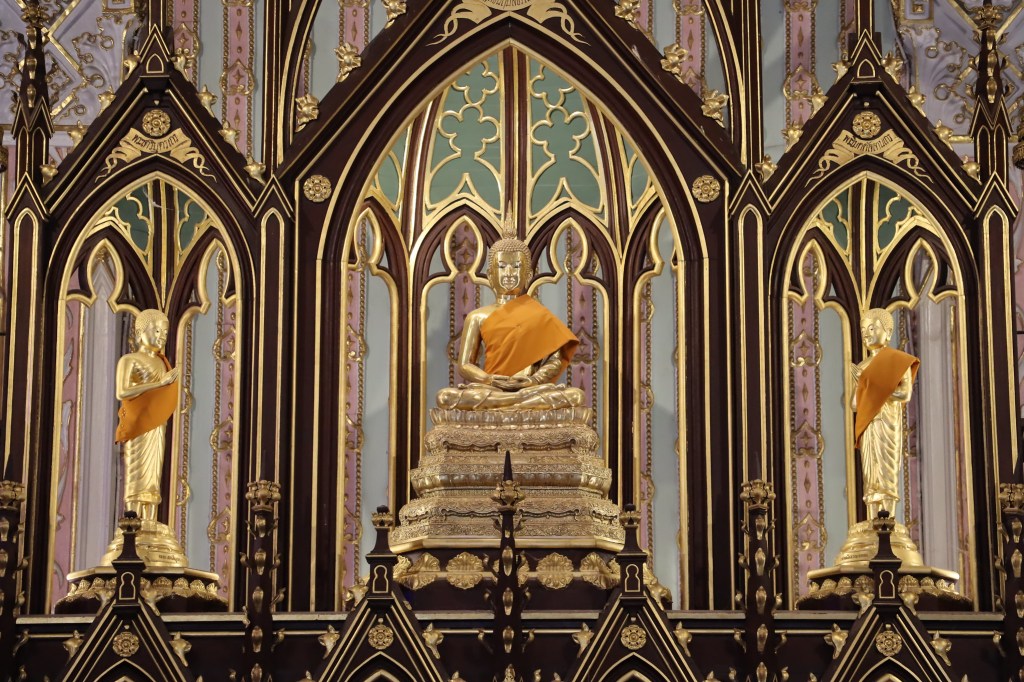
Commissioned by King Chulalongkorn (Rama V) in 1876 to serve as the royal temple for the Bang Pa-In Palace, it was completed in 1878. The Italian architect Joachim Grassi, one of the first European architects employed by the king, designed the building in neo-Gothic style, with stained-glass windows and a Gothic altar. The temple’s appearance closely resembles a Christian church, except that the main image is that of the Buddha rather than a cross (Wikipedia contributors, 2025). A delightful reminder that Siam could transform foreign influences into creative exchange.
Bibliography
- Ayutthaya Historical Research. (2011, février). Historical Sites: Franciscan Church. Ayutthaya-History.com. Retrieved [date d’accès], from https://www.ayutthaya-history.com/Historical_Sites_FranciscanChurch.html
- Brocheux, P., & Hémery, D. (2001). Indochina: An Ambiguous Colonization, 1858–1954. University of California Press.
- Ileto, R. (1998). Pasyon and Revolution: Popular Movements in the Philippines, 1840–1910. Ateneo de Manila University Press.
- Pascal, E. M. (2019). Missionaries as bridge builders in Buddhist kingdoms: Amity amid radical difference. Missiology: An International Review, 47(1), 65-74. https://doi.org/10.1177/0091829618814836
- Streicher, R., & Hermann, A. (2019). ‘Religion’ in Thailand in the 19th Century. In Multiple Secularities: Beyond the West, Beyond Modernity (pp. 123–139). Brill.
- Wikipedia contributors. (2025, August 13). Wat Niwet Thammaprawat. Wikipedia, The Free Encyclopedia. Retrieved September 18, 2025, from https://en.wikipedia.org/wiki/Wat_Niwet_Thammaprawat
Text and photos ©Frédéric Alix, 2025
 Salaween.blog
Laisser un commentaire