This pilgrimage is the third we have co-organized with Payap University and Dr. Rey. The previous two, in January and September 2025, had led us through Chiang Mai, connecting Buddhist temples, Christian churches, mosques, and more, to walk together in religious diversity. The last one had gathered nearly 60 people over 5 kilometers in the Wat Ket district. But this time, we are answering a different call: to highlight the voices of women in spirituality and to anchor our approach in the stories of local people.
This Friday, February 13, I am already here at Wat Suttajit in Doi Saket, long before the scheduled meeting time of 9 a.m. My motorcycle, parked in the shade of a yang na tree, seems to be resting. I needed this silence before everything begins. This day holds very deep meaning for me. This pilgrimage is an answer. An answer to those who tell us that we only visit places marked by Western missionaries and led by men. Today, we will listen to something else: the voices of local women, heirs to traditions as ancient as religion itself.
The air is still cool, but I know the heat will come very soon. Around me, Wat Suttajit has already been awake for a long time, since the days of these nuns, called bhikkhunīs, begin at 4 a.m. with meditation. No golden chedi, no crowds—just a peaceful forest, a still pond, and simple buildings, almost unassuming, as if they are part of nature.
The first songthaews arrive, filled with Payap students. Their curious faces scatter, exploring the place. They photograph what I had never taken the time to notice: wildflowers, reflections in the water, and especially the singha, those guardian lions sculpted in the local style, watching over the temple entrance.
Then the cars arrive: professors and friends, Catholics from Focolare, Sikh-Hindus, and Bahá’ís. Finally, the motorcycles of the students, those who wanted to come on their own, helmets in hand and smiles on their faces. Hans, the German YouTuber, globetrotter and curious about the world’s religions, always ready to capture the moment, has already started filming. I see girls proudly posing for photos in front of the image of a female monk at the entrance. The group naturally gathers in a circle. So, I take the floor to deliver my welcome message. I’m a little emotional because I’ve dreamed of this day for a long time.
A temple of Women
« We are not in an ordinary temple. Here, there are no monks, but nuns—Theravada bhikkhunīs—fully ordained women, just as in the time of the Buddha. They are not modern feminists. They are the heirs of a tradition founded by the Buddha himself when he ordained Mahāpajāpatī Gotamī, his aunt, and then five hundred other women. A tradition that nearly disappeared but lives on here, today. »
I evoke the image of the four-legged chair, the one that struck me during my first encounter with the bhikkhunīs. « Buddhism rests on four supports: monastic monks and nuns, laymen and laywomen. Remove just one leg, and the balance wavers. It’s a balance that’s 2,500 years old. »
Offerings Are an Exchange
We laypeople never come empty-handed to a temple. We receive something spiritual, and in return, we offer something material. It’s an exchange: the monastics share their wisdom, and we support them—through donations, food, or even time to help.
Before coming, we asked the nuns what they truly needed. There was no question of bringing symbolic offerings that would go unused. A week earlier, they gave us a precise list: brushes, cleaning supplies, cocoa powder. This plastic bag, filled with everyday items, contrasts with the traditional offering baskets. But these are the material needs for the coming days.
Crossing the Temple
We walk through the temple in silence. On the faces of the participants, I see smiles, a kind of fullness. We pass by the Bodhi tree, its branches stretching toward the sky, and the statue of the Buddha sitting beneath it. In this temple inspired by the philosophy of Ajahn Chah and the forest monasteries, these natural representations matter more than imposing brick and cement structures. Some lightly touch the branches, as if to capture a blessing.
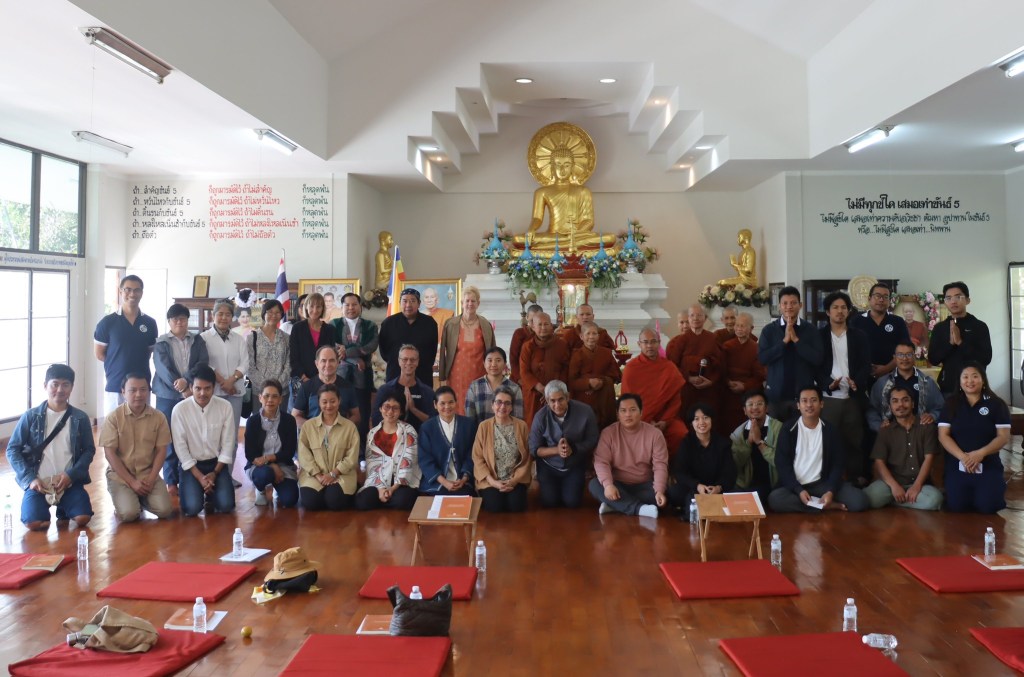
We remove our shoes under the watchful eyes of the community dogs lying near the entrance to the prayer hall, the viharn, and climb the steps leading to the room where the bhikkhunīs await us. Seated in rows on either side, facing images of the Buddha, their saffron robes and serene faces welcome us. The day can begin.

Ceremony with the Bhikkhunīs
Everything had been prepared with care. Punnyasiri Bhikkhunī had wanted to know the group’s expectations. My answer was simple: to observe, to participate in a spiritual moment in the pure tradition of the temple—prayer, devotion, meditation, or blessing—and, if luck allowed, to see our questions find answers. « We can learn from books or in class, but we wish to learn in the field, as observers. » My wish was taken more seriously than ever before.
In the center of the room, square cushions were arranged in rows, with chairs behind them for those unable to sit on the floor. A chanting book was placed in front of each seat, with texts in Pāli accompanied by translations in Thai, English, and Chinese. Beside it, a sheet bearing a different quote or teaching for each person and a small bottle of water. Never before, in all my pilgrimages, had we been received with such attention to detail.
On the sides, slightly elevated, the bhikkhunīs occupied the āsanas, the seats reserved for monastics in the viharn. Behind them, in the same line, the sikkhamānā and sāmaṇerīs—novices and postulants for full ordination—were also seated on āsanas.
A Bhikkhu Among Us
Among our students was a young monk from Mandalay. In accordance with tradition, he was led to a raised seat, separate from that of the nuns, positioned in a way that respected his status while avoiding creating too stark an asymmetry with the bhikkhunīs. The nuns came to greet him, bowing before him. On his initially surprised face, I could see responsibility dawning, as if he suddenly measured the weight of his presence. He who had likely wanted to blend into the anonymity of the participants now had to fulfill a role from which he could not escape.
We had all taken our places; local retreatants had sat among us. This arrangement reflected both the monastic hierarchy and the delicate balance: monastic women leading the ceremony, a monk invited, and laypeople united in listening.
Feminine Chanting
The chanting began, rhythmic and steady. We were shown the pages—no time for hesitation—and for over twenty minutes, the voices of the bhikkhunīs filled the space without interruption. For the first time, the group could fully follow the ceremony, thanks to the translations. The Buddhists joined their hands in a wai; the others followed as best they could, but all were immersed in the moment. The words, chanted in Pāli, carried teachings on impermanence, compassion, and liberation. This was not a performance but a living practice, a direct transmission. We were all plunged into the deep meaning of these chants: invoking the presence of the Buddha, cultivating wisdom, purifying the mind.
Around the room, I observed the faces of the participants—all were focused and serene. Later, one participant confided in me that she had heard, for the first time, chanting performed solely by women’s voices. « Hearing the voices of monastic women was like discovering these texts from a new angle, » she told me.
When the final words were spoken, Punnyasiri Bhikkhunī, a slight smile on her lips, announced that the time had come to listen to the personal testimony of one of the nuns. Silence fell, attentive.

The Testimony of Ongsudhari Bhikkhunī
She begins by joining her hands and closing her eyes, speaking aloud a prayer to her spiritual guides. Then, in a calm voice, she shares her journey.
Born into a family where Buddhism was lived daily, Ongsudhari Bhikkhunī felt from an early age the desire to understand and transmit the teachings on the end of suffering and liberation from the cycle of rebirths. « I was fortunate to meet Ajahn Chah, » she confides. « His teaching fascinated me with its radical simplicity: a stripped-down life, centered on the essential. »
It was this encounter that sealed her decision: to live these principles fully, not only for herself but to share them. « Becoming a monastic was both a personal commitment and a service to others. »
Eighteen years ago, after three years as a sāmaṇerī (novice) here at Suttajit Temple, she went to receive bhikkhunīordination in Sri Lanka and returned to live in this temple.
Ongsudhari Bhikkhunī then describes the rhythm of their days, rooted in the discipline of the forest (Thudong), inspired by Ajahn Chah:
4:00 AM: Meditation in the silence of dawn.
4:30 AM: First collective chanting, where voices rise to bring the teachings to life.
A second meditation session follows, before the nuns leave for the alms round (pindapāta) at 6:00 AM. « We walk through the streets of neighboring villages, receiving what is offered to us. One vegetarian meal a day, before noon, as the Buddha taught. »
The rest of the day is devoted to study, manual work, and the practice of mindfulness in every gesture.
The monastics do not live withdrawn from the world. On the contrary: the temple welcomes visitors and responds to their expectations, for the monastics are at the service of the community and provide the spiritual help they need.
« Here, we follow the original teaching of the Buddha: no rituals to chase away demons, no superfluous ceremonies. Just the continuous cleansing of body and mind, to attain liberation. » She emphasizes this difference: « Every temple, every community chooses its own path. We have chosen simplicity, closeness to the ancient texts. » Questions follow, one after another…
Another Bhikkhunī Speaks
« The reasons that bring us here are as varied as we are ourselves, » begins another with a peaceful smile. For Punnyasiri Bhikkhunī, the turning point came from a deep realization: « What mattered most in my previous life were my children. But one day, I understood that they did not belong to me. That they had their own path to trace. This realization, rather than causing me pain, was a liberation. And it was this inner freedom that led me here, toward monastic life. »
As the monastics explain that it is through this path of renunciation that they hope to break the cycle of reincarnations and attain nirvana, a question arises from the audience: « And the laity? Can they, too, achieve this, or is this liberation reserved for monks? »
The response comes with a smile: « Of course, it is possible. But the more precepts one follows, the more one trains in mindfulness and detachment, the greater the chance of attaining this state of purity. For the laity, the path is the same, but it is walked amid the obligations of the world. The essential is not status, but perseverance. »
Personal Note (Not Expressed During the Meeting)
In Southeast Asia, it is common for families to place their young children in monasteries as novices (sāmaṇera or sāmaṇerī), hoping to offer them a better life: education, food, and a higher social status.
Yet, the terms bhikkhu (for men) and bhikkhunī (for women) literally mean « beggars » in Sanskrit. A striking irony: how can becoming a beggar be considered an honor?
However, for many young boys from disadvantaged families, becoming monks is a means of upward mobility, allowing them to occupy a respected place in society.
But for most women who choose ordination, it is not about comfort or status. Quite the opposite. First, they are not officially recognized by the Thai clergy, which means they do not obtain the same status as male monks. Moreover, many of them have had brilliant careers at the top of society—executives in large companies, graduates, doctors—and yet, they decide to abandon everything to embrace this life of radical simplicity, total dependence on the generosity of others. This choice represents a huge leap, a renunciation of everything society usually values: material security, prestige, recognition.
Becoming a « beggar » is an act of courage. A commitment to live in the rawest truth, without a safety net, without illusion. And perhaps that is where the true meaning of honor lies.
The Photo Session and Departure
After the traditional group photo session, the participants mingled with the monastics. I saw exchanges between everyone. Some asked if they could buy the remarkably well-presented chanting book (published by the Nirotharam bhikkhunī monastery, of which Suttajit is a part). We took our leave of Suttajit; I could see that some would have stayed longer. Then, I had to announce to the pilgrims that we would not truly be walking today, since we preferred to spend more time in the places we visit. We got back into our vehicles and, in single file, made our way to the neighboring village.

A Stop in Luang Nuea Village, Doi Saket
A traditional Buddhist temple. Its banyan tree placed outside facing the entrance, as per Lanna tradition. A small café welcomes us and gives us the key to the community hall located across the street. We can take our midday break here.
We settled into the « community hall »—a fenced shelter with plastic chairs, but that day, it felt like a palace to us.
Our monk couldn’t wait; he had to eat before noon, so he sat at the table before us. I noticed his status aroused envy among those who were hungry. While participants ordered their drinks, accompanied by a few others, we arranged chairs around a table in the community hall.
We got comfortable. Now it was the turn of the Catholic women to speak to us.
Testimony of Sister Arun
Sister Arun, Thai and of Karen origin, grew up in a Catholic family. From childhood, the church’s songs and music deeply touched her. « It was like a calling, » she confides. She felt God guiding her toward a consecrated life, and she became a sister within the Congregation of the Mission of the Sacred Heart of Jesus and Mary.
Her life is structured around prayer—one hour each day—and reading the Bible. For her, the Eucharist is at the heart of her faith: « In the bread and wine, I feel the living presence of Christ. This presence gives me the strength to live, an energy that carries me beyond myself. »
Her congregation is based in Chiang Mai. « We welcome those who have lost their dignity, those rejected by society. Here, they find a new family. » She teaches sewing, serves the most disadvantaged, and manages a home for those in need. « Our bishop guides this mission, but it is love that unites us. »
For nearly 30 years, she has devoted her life to this vocation. She draws inspiration from these biblical words she reads to us: « God anointed Jesus of Nazareth with the Holy Spirit and with power. He went about doing good and healing all who were under the devil’s oppression, for God was with Him. » (Acts 10:38) We received this reading as we had received the Buddhist chantings earlier in the day.
« My mission on earth is to continue this work of healing and kindness, for the good of all, » she concludes, her eyes shining with conviction. « This is what gives meaning to my life. »
The Airplane That Becomes a Cross
Sister Arun then distributes A4 sheets to us. On each, a Thai word: « love, » « joy, » « peace, » « patience, » « compassion, » « kindness, » « faithfulness, » « gentleness, » « self-control. » She gives us instructions to make an origami. When we realize we’ve made paper airplanes, we’re all ready to launch them, eager, when suddenly she counts: « One… two… three… » But instead of making them fly, she gently tears the ends of her airplane, then carefully unfolds it. « Do as I do, » she encourages us.
A silence falls. Tearing these papers, even partially, feels almost painful. Yet we obey. And when we unfold our sheets in turn, the magic happens: the paper takes the shape of a Christian cross, with the word inscribed at its center.
A wave of surprise and admiration spreads through the group. Some smile; others are left speechless. « Faith is not a fleeting flight. » Sister Arun, without another word, has just given us an unforgettable lesson: the essential does not fly away; it reveals itself and remains.
Her teaching talent lies in this: transmitting, with disarming simplicity, what touches the heart directly.
« Every morning, I recite my first vow, » she confides. « It reminds me that we all carry within us the potential to be Jesus. »These words sound like a promise: to live as He lived—in humility, service, and boundless love. We applaud.
The Testimony of Khun Monthira
Unlike Sister Arun, Khun Monthira had never heard of Christians during her childhood. Her parents were Buddhist, like most Thais.
« As a teenager, I knew nothing of God. Twenty-five years ago, everything changed. »
Her life was marked by cruel losses, trials that gave her no rest. By chance, her Catholic aunt allowed her children to attend a Catholic school, all expenses paid. One morning, after taking her children to class, Monthira passed by the church. There, she heard a song, sat at the back, and listened. « A voice told me: ‘Go see that priest.’ » The priest gave her a book to read.
Monthira dared to challenge God and asked for signs of His existence. Miracle or not, the signs came true one by one. She was baptized. « Yes, I truly believe in You. »
Her life rebuilt itself. She remarried and lived what she calls « the most beautiful years of my life. » When new trials came to disrupt her life, she clung to her faith. Then she made a promise: « I will dedicate the rest of my life to serving God. »
Today, six years later, Khun Monthira ends her story, her voice trembling. We applaud, moved. Her faith did not erase suffering, but it gave her a reason to endure it.
Lunchtime Break
Then we ate. The small café that kindly welcomed us struggled to keep up with 35 drink orders arriving all at once. As the organizer, I apologized. We enjoyed the village’s calm, though the sun was strong. A little after 1:00 PM, we hit the road again.
The rice fields rolled by, golden under the midday sun. I regretted that we lacked time to walk, but the smiles of the participants, pressed against the windows of the songthaews, made every detour worthwhile.

Arrival at Gurudewa Ashram: Between Saffron and Devotion
Four kilometers further, we find ourselves before the Gurudewa Ashram, or Wat Hindu, as it is called in Thai. Many of us notice the statue of Guru Ji at the entrance—the woman who leads this ashram. It is not a serious statue, though; its features remind me of Japanese cartoons, a contrast that brings a smile. The monastics, all dressed in saffron robes, welcome us with touching kindness: drinks made from longan and sweets are offered, evoking memories of my travels in India. The afternoon heat is strong, but an air-conditioned room awaits us like an oasis.
At exactly 2:00 PM, we are guided to the hall of devotions (pūjā mandir). Before entering, we must purify our right hand with holy water—« the pure hand for offerings, » we are told. Once settled, Guru Ji makes her entrance. She greets Dr. Rey with a warmth that instantly breaks the ice, then takes her place on her singhāsana (traditional seat), similar to that of the Buddhist nuns from the morning. Here, she is a guide, but also an embodiment of the divine, a channel between the faithful and the sacred.
The members of the community then come forward one by one to prostrate themselves before her in dandavat prāṇām—not on their knees, but with their entire bodies stretched out on the ground, foreheads to the earth, hands joined toward her. « Danda-vat, » a Sanskrit word, literally means « like a stick »—a total submission. We visitors respond with a collective namasté, hands joined between the heart and the face.

A Community with a Feminine Face
The ashram is mixed, but men are in the minority. Dr. Swamini Shivaveshvarananda Gurudeva, whom we can call Guru Ji, leads this ashram. She was ordained in India and took full vows. She is assisted by Sannyāsini Ambika, an ordained monastic but not in total renunciation, who is authorized to lead the most important rituals. The other members—sannyāsins (monastics who have taken partial or full vows) and devotees (devout laypeople)—all wear saffron, like the Buddhists. Some women have their heads covered, a sign of respect (or marital status?). Unlike Buddhist or Christian monastics, most can marry, except for Guru Ji, who is celibate by vow.
The Purification Ritual
Guru Ji first receives the tilak, a red powder traced on her forehead, symbolizing the third eye. Then, each person drinks or pours Ganga Jala (water from the Ganges) over their hands, « to invite the goddess Mā Ganga within us, » she explains. This gesture cleanses the body and soul before prayer.
Once the purification is complete, we turn toward the altar. At the center stands a linga (symbol of Shiva), topped with a statue of the god. At the back of the room, in the place of honor, is the goddess Durga (Durga Mā). To the left, Ganesha(the elephant-headed god, remover of obstacles); to the right, Skanda (son of Shiva, god of war). Shiva also has his own space, facing the main altar, but it is only used for special ceremonies. This arrangement is typical of Shaivite temples, where the linga is the sacred heart.
The Ceremony Begins
We are asked to turn toward the deities on our left. The pujaris (ritual priests) blow into shankha (conch shells), their deep sound marking the beginning of the chants. Prayers rise, repeated in chorus:
« Om Shri Rāmaya Namah » (salutations to Rama, avatar of Vishnu).
« Om Namo Nārāyanaya » (praise to Vishnu, preserver of the universe).
« Om Gam Ganapataye Namah » (for Ganesha).
The pujaris perform the ritual gestures: they open the altar curtains, place flowers and incense, and ring the ghaṇṭā (bells) and shankha. The incense fills the room, and we are invited to approach and breathe in its blessings.
The Moment of Devotion
Guru Ji remains seated on her throne, watching as the priests perform the rituals. The sacred phrases resonate, offerings of flowers and incense are presented, and we are all deeply moved to participate in this ceremony. At the end, a wisp of incense envelops us.

Guru Ji: A Feminine Path Between India and Thailand
When the time for exchange comes, a question burns on our lips: « How did you become Guru Ji? » She smiles, as if she had already answered this question a hundred times.
« I was ordained in India after years of studying Hinduism in ashrams. First, I became a sannyāsini—a renunciate, devoted to knowledge and service. But my calling was different: to extend the wisdom of Hinduism guided by women, here in Thailand. »
Guru Ji is one of the few to hold the title of swamini in Thailand, ordained according to the traditional rules of India. Most Hindu women here are priestesses (pujarini) or teachers.
« Our ashram follows a path that combines rituals, scriptural study, and social engagement. We show that spiritual guidance can be embodied by women while remaining faithful to traditional principles: simplicity, respect for nature, and openness to interfaith dialogue. »
To best answer our questions, Guru Ji has written down certain themes for us and sends us the document electronically.
The Feminine Power in Tantrism: Shakti, the Creative Energy
The Tantric period celebrates Shakti, the divine feminine energy, as the central force of the universe. In this tradition, women—whether yoginis (spiritual mistresses) or goddesses like Kālī or Tripurā Sundarī—embody this cosmic power. The Kularnava Tantra summarizes it thus:
« Śivaḥ śaktyā yukto yadi bhavati śaktaḥ prabhavituṃ / Na cedevaṃ devo na khalu kuśalaḥ spanditumapi »
— « Shiva can only create the universe when united with Shakti. Without Her, He cannot even move. »
This quote illustrates the essential: Shiva (pure consciousness) and Shakti (active energy) are inseparable. The yoginis, as Matsyendranāth (founder of the Nath tradition) taught, emphasize the importance of transmitting knowledge of Kundalini—this latent feminine energy within each being—and guiding toward awakening. Tantrism thus reminds us that liberation comes through the balance of forces: without Shakti, there is no manifestation; without Shiva, there is no consciousness. Women are not only venerated but recognized as essential guides on the spiritual path.
Sacred Music: A Bridge Between Worlds
At Dr. Rey’s request, Guru Ji turns to a harmonium placed near her. Her fingers brush the keys, and a lively melody fills the room. Voices rise. Cymbals (manjira) and drums (mridangam) join in, creating an almost physical vibration.
I can’t help but think of the morning psalms of the bhikkhunīs chanting in Pali. In one way or another, sacred texts are recited, and their vibrations bless us. There is the same desire for transmission, to make the sacred accessible.
Conclusion: Restored Balance
The bhikkhunīs of Wat Suttajit, heirs to a 2,500-year-old lineage, Sister Arun and Khun Monthira whose Christian faith transformed suffering into service, or Guru Ji, a pioneer of feminine Hinduism in Thailand, do nothing different from their male counterparts: transmitting texts, leading rituals, guiding souls. At the dawn of the great traditions, there was no separation between genders—the first female disciples of the Buddha or the Vedic rishikas attest to this. Today, by listening to them, we have not celebrated feminism but recognized an essential complementarity: the one that restores the original balance of spiritualities. For without them, the four-legged chair wobbles, and it is all of humanity that loses its footing. Their place is not a concession but the restoration of an obvious truth: awakening, whether Buddhist, Christian, or Hindu, has always needed both wings to fly.
Thanks to Payap University, the Peacebuilding Faculty, and especially Dr. Rey, who brought this day into the semester program supported by Mennonite Central Committee.
Thank you to all the students for your thoughtful participation, for embracing the program with openness, and for your insightful reactions. Thank you to the participants from diverse faith traditions (Sikh, Hindu, Baha’ï, Christians) and especially to Sister Arun and Khun Monthira.
A heartfelt thank you to the Bhikkunis of Suttajit Ashram, and to Guru Ji and the members of Gurudewa Ashram for responding so earnestly to my requests and for your warm hospitality.
Oh! And a special thank you to « Klim Café » Aroma in Luang Nuea for welcoming us at lunchtime.
A personal thank you: This day will stay with me as one of the most meaningful. Today, the balance between genders was restored.
Photos et texte : Frédéric Alix, 2026
 Salaween.blog
Laisser un commentaire