This wasn’t my very first trip to Asia, but my second. In 2001, I had already been to Thailand and felt something very strong, a kind of pull toward the East. But Sri Lanka was not quite the same. In October 2002, the country seemed to be just emerging from a long civil war between the Sinhalese and the Tamils, which had begun in 1983. A ceasefire had been signed just a few months earlier, in February 2002. They said it was finally calmer, but the atmosphere remained tense.
My friend Bruno and I had booked a trip through a travel agency: a charter flight, a stopover in the Maldives without even leaving the plane. From the window, I saw those tiny islands for the first time, scattered like pearls on a turquoise ocean. Rings of white sand, transparent lagoons, boats that seemed to float in the sky. It was magical, we caught a glimpse of the Maldives.
Colombo, everyone out
Upon arrival in Colombo, we were transferred by bus to a large hotel in Kalutara, a coastal town south of the capital. Kalutara is a long beach lined with coconut trees and, at the time, massive concrete hotels with enormous pools and flavorless international buffets. From the first evening, I knew it wasn’t for me. The hotel was too big, too artificial. We had been warned: « Don’t go out, it’s dangerous. » But I hadn’t come to stay locked up.
« Don’t go out, it’s dangerous »
We wandered through the small town. I wanted to eat in a local restaurant, a simple place where the customers looked at us in surprise, as if two foreigners had gotten lost. Bruno thought it was dirty. I loved it. We discovered a giant turtle in a stream flowing between the houses. As we watched it, two men came and took it, thanking us. I imagine the turtle ended up in a soup.
Everywhere, people asked us which hotel we were staying at. And when we answered, they spoke to us in a few words of German. We realized that each hotel specialized in hosting tourists of a single nationality. They showed us the hotel for the French and the hotel for the British. All were surrounded by high fences, several meters tall, impassable except from the beach.

The Discomfort of the Tourist Beach
We walked along the beach, but the atmosphere was heavily uncomfortable. From our first steps on the sand, street vendors accosted us, their insistent voices and pressing gazes following us like a shadow. Further on, near the palm trees, almost entirely naked local women and men made explicit gestures toward us. Their presence, in broad daylight, was both obscene and desperate.
Prostitution in Broad Daylight
What shocked me the most was discovering, on this postcard-perfect beach, unambiguous scenes of prostitution aimed at tourists. Quick exchanges, clear gestures, bodies available like merchandise for a few rupees or a meal. The country’s misery seemed to have clustered there, right in front of the white walls of international hotels, begging for survival with what little they had left, as if they had crossed the threshold where hunger and despair outweigh all pride.
Don’t misunderstand me: it’s not prostitution itself that revolts me. It’s a profession I respect. What chilled me was the downfall of an entire people, forced to sell themselves as a last resort.
An Invisible and Brutal Border
I remember one scene in particular: a local man had come a little too close to the beach area « reserved » for hotel guests. In an instant, two uniformed employees intercepted him. Without a word, they grabbed him by the arm and pushed him toward the exit. The violence of this gesture, as quick as it was mechanical, chilled me. The border was clear: on one side, the white sand of postcards and the aligned lounge chairs; on the other, a raw and pitiless reality.
Meanwhile, German tourists lay calmly on their towels, sunbathing or sipping cocktails, indifferent to what was happening before their eyes. Their tranquility was almost obscene. They could « rest their ears on their lounge chairs. »
No, this was not the
Sri Lanka I wanted to discover.
Escape in Third Class
The next day, I insisted on leaving. The hotel made us sign a waiver: « We are not responsible if you get kidnapped. » We took our bags and went to the small train station. First train to Colombo, in third class. I don’t know why we chose third class, maybe second class was full. It didn’t matter: the journey followed the coast, waves crashed against the rocks, fishermen pulled in their nets, children ran along the tracks. It was already an adventure, and I loved it.
In Colombo, as soon as I left the station, I wanted to get lost in the streets. It was colorful and vibrant, but without the chaos of India that I would discover later. Even in its capital, Sri Lanka seemed cleaner, almost richer. The seaside was calm, with fishermen and families enjoying the breeze. Here and there, you could still see rusty old cannons, remnants of Portuguese, Dutch, and British fortifications. I didn’t know that one day, this seaside would be filled in to build Port City Colombo, a « gift » from the Chinese to Sri Lanka. Today, the view is gone: the sea has been pushed back by hundreds of hectares of landfill, new constructions, and giant projects in the Chinese concession. Only the southern part of Galle Face Green still exists, preserved, with its old-time atmosphere, but in 2002 the view was still open to the infinite Laccadive Sea.

Kandy in the Hills
Then, we took the train to Kandy. The journey was magnificent: rice fields, hills covered in vegetation, villages where people waved at us. In Kandy, we looked for a guesthouse using the Guide du Routard. We climbed a hill and knocked on a door. A family welcomed us and showed us a tiny room that opened onto a terrace. No privacy, but a real home, not a hotel. They offered us tea, overly sweetened and scented with cinnamon.

The next day, I wanted to see the Temple of the Tooth, that sacred place where a relic of the Buddha is kept. Upon arrival, men blocked our way: « No entry without a guide! » I smiled, turned around, and we sat down in the grass. We watched families pass under a sacred elephant, a kind of blessing. The children were laughing, and the women were so beautiful in their colorful saris. Later, we returned to the temple, and this time, no one stopped us. I took a few photos, my hands trembling with emotion.


Another day, we decided to visit an elephant center, about fifty kilometers away. We negotiated the trip with a tuk-tuk, and the journey through the mountains was splendid. The elephants, those peaceful giants, fascinated me. On the way back, the rain started pouring so hard that the driver stretched a tarp around his little vehicle to protect us. We were soaked, but happy.

A Time for Caution
In October 2002, the ceasefire between government forces and the Tamil Tigers (LTTE) was still very recent, signed only in February of the same year. Yet, the region north of Kandy, particularly around Sigiriya, remained tense. Despite the agreement, risks persisted: unexploded ammunition still littered certain areas, and venturing off the beaten path was strongly discouraged. Local authorities and travel agencies warned against « stray bullets » or incidents linked to the residual presence of armed groups. Even though calm seemed to be returning, caution was necessary, especially for tourists like us, unaccustomed to navigating a country marked by decades of conflict. We had been clearly told: « North of Kandy, better to avoid. » No one wanted to risk a stray bullet or an unfortunate military checkpoint ruining a trip.
Ella, Lost in the Hills
Next, we headed to Ella, a village recommended by the Guide du Routard. The train passed through endless tea plantations. The tea bushes, low and dense, formed a kind of green sea of sensual waves. And then there were those immense trees, the kukulmas (eucalyptus or acacias, I don’t remember), planted to prevent erosion and provide shade. Their verticality contrasted with the rounded hills, creating an almost surreal landscape. I remember the journey was long, and the train wasn’t fast. We were probably the only foreigners in those cars. I sat for a while on the floor in front of the open train door. An elderly man, who likely couldn’t afford a seat, was also sitting there, his legs on the train steps, and we spent a moment observing each other.


In Ella, we found a guesthouse on the hill, run by a Sinhalese couple who were constantly arguing. It was rather embarrassing to hear them, but the view was breathtaking: from our room’s window, we could see the valleys, and perhaps even the sea, far in the distance. One morning, we followed village women carrying laundry in baskets. They were going to wash their clothes in the river. Walking along the tracks, we discovered a huge waterfall. I almost killed Bruno when I asked him to step back for a photo, it happened like in a movie : he took a step backward and fell into the void several meters below. Miraculously, he got away with just a few scratches.


Near Ella, there was also a small temple nestled under a rock. Schoolchildren in blue and white uniforms were visiting it that day. They were singing, fooling around, and smiled at us.
The simplicity of the Buddha’s features and the orange and blue tones of the stone statues in what looked like a cave struck me. Even today, after visiting thousands of Buddhist temples, I still remember those colors and that unique cave-like atmosphere!


The call to travel was heard
It was there, looking at this landscape, that Bruno said to me: « I’d like to travel the world with a backpack. I want to take a sabbatical year. » I think I replied without hesitation: « Yes, that’s my dream too. » We didn’t know how to organize it, because deep down we were both quite homebodies, but we started talking about it. A year later, in late November 2003, we left.
That day, in the hills of Ella, Sri Lanka, we decided to change our lives. I didn’t know that this change would be so profound. Today, in 2026, I’m still in Asia. Bruno returned to Bern in 2005, but I never found my old life again. In a few days, I’m going back to Sri Lanka.
But let’s go back to October 2002…
While visiting this temple carved into the rock, we talked with a young couple of independent travelers, like us. They had come from Sigiriya and climbed the famous rock. « We were advised not to go, but we had no problems, people are lovely everywhere! » I felt a pang of jealousy. I would have loved to go there, despite the warnings. But we continued on our way. I knew that one day I would climb Sigiriya (though I’d have to wait 24 years to do it).
The monsoon
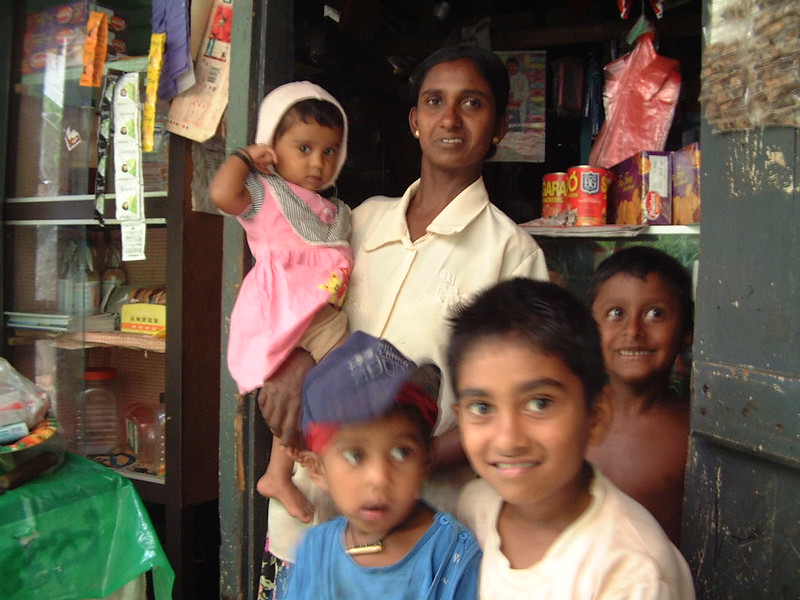
Every day between five and six in the evening, it would start raining. Not a light drizzle, but torrents of water pouring down without warning. It was the rainy season, and every evening we were caught off guard like amateurs. We took refuge in front of a house. Without hesitation, the family opened the door for us and offered chairs, glasses of tea, and endless smiles. There was no way to communicate, but there’s a human language that needs no words.
Bouncing on the Roads by Bus
The next day, we had been shown the bus stop. No trains went further south, so we got on an old bus. We had two seats, but very quickly the vehicle filled up and passengers pressed against each other. A woman handed me her bags, and I placed them on my knees, squeezed between standing passengers in the aisle. The bus jolted along the potholed road, people got on and off laughing, and a guy collected fares shouting. At a crossroads, we were told we had arrived. The bus was taking another direction. We got off, a little lost.
Bruno looked around and found everything « too dirty » to eat. I asked every bus that stopped if it was going to Uda Walawe National Park, where you can see wild elephants. No bus wanted to take us, even though the road was the only one and they were clearly heading that way. I pulled out my map, unfolded it wide, and boarded the next bus by force. They tried to make us get off, but I played dumb. « I’m not moving until we get there. » Standing at the front near the driver, I followed the route on my map. When I thought we had arrived, we got off. We paid the normal fare, but the bus conductor didn’t look happy. Maybe they weren’t allowed to take tourists? Maybe we were among the first foreigners to venture this way.
Fascination with Wildlife
We found a guesthouse without difficulty, and the next day we visited the national park by jeep. I saw herds of wild elephants, entire families, parents protecting their young. I watched these animals that I love so much with deep, almost childlike joy.

Galle, the Shadow of a Past Where the Future Lingers
Then we took the road to Galle. In 2002, the city was just a sleepy old Portuguese fort, untouched by mass tourism. The cobblestone streets, quiet, bore the traces of a flourishing past: houses with tired facades, fishermen busy mending their nets under the sun, children running along the ramparts. I was surprised to discover a well-established Muslim community in the landscape. Everything here seemed suspended between history and melancholy, as if time had slowed down.
Two years later, in December 2004, as the coasts of the Indian Ocean were devastated by a deadly tsunami, I thought of Galle with dread. Those quiet streets, those fishermen, those children playing near the ramparts… I don’t know why it was the images of Galle that immediately came to mind when the tsunami struck. All of that must have been swept away by the waves. It haunted me for a long time. That sleeping city I had passed through without knowing it was also vulnerable.


Return to Tacky Luxury
Finally, we took the train back to Kalutara and spent our last night in our « tacky luxury bunker hotel. » A mix of kitsch and popular comfort, but after all, that was the charm of travel—accepting even what you don’t want to see. Before leaving, we paid the bill. Because while the food buffets were all-you-can-eat, our many cocktails were not, and I had to admit that I, too, was enjoying the tacky luxury like a colonist of the new century.
Ah! One more anecdote.
I think it was the last day in Kalutara. I had wanted to visit the big Buddhist temple in the small town. But as soon as our silhouettes appeared, a man came forward and forcefully improvised himself as our guide, showed us the temple in five minutes flat, and then held out his hand for his fee. A few moments later, as a tuk-tuk was taking us back to our hotel, I paid the fare, but several bank notes fell from my wallet without my noticing. The driver’s friend picked them up and, with a few words, thanked the deities for making money fall at his feet. I was stunned, but the two accomplices were already leaving, dancing.
Text written based on my notes from 2002 and my memories in January 2026
A few days after finishing this writing, I returned to Sri Lanka.

Frédéric Alix, text 2026, photos 2002
 Salaween.blog
Laisser un commentaire