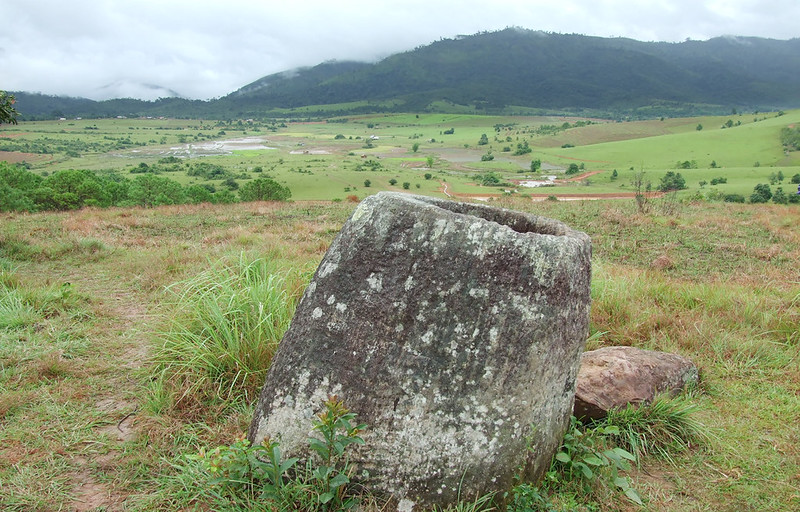
ACT III – Lankapura, the Sacred Sanctuary of Buddhism
or how an island of « demons » became the guardian of the Dharma.
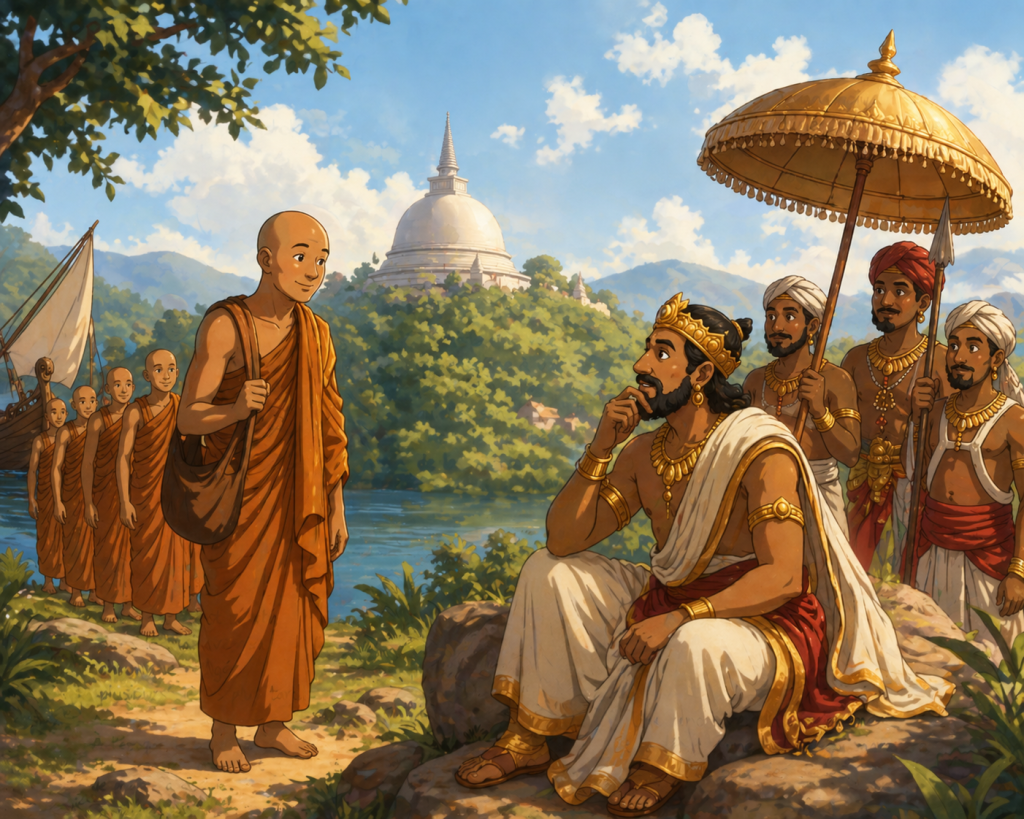
PROLOGUE – THE CONVERSION THAT CHANGED THE FACE OF ASIA
India, 261 BCE. After the Battle of Kalinga.
The soil is still red. Not from laterite, no — from blood. A hundred thousand dead on the battlefield, a hundred and fifty thousand deported, and a king walking through the devastation wondering why he doesn’t feel victorious.
That king is Ashoka Maurya, master of an empire stretching from Afghanistan to Bengal. A man who, until that very morning, had the unfortunate habit of resolving diplomatic problems with war elephants. He called himself Chandashoka — Ashoka the Cruel.
But in 261, something breaks.
A Buddhist monk named Upagupta crosses his path. He doesn’t tremble before the emperor. He asks for nothing. He simply says: « The true sovereign does not count his conquests. The true sovereign counts the tears he has dried. »
Ashoka could have had him executed. He invites him into his palace.
This is the beginning of a conversion that will change Asia.
Ashoka doesn’t become Buddhist overnight. Emperors, like sincere conversions, need time. He studies, he reflects, and above all, he has his thoughts carved onto rocks and pillars — because in those days, emperors didn’t write books, they engraved their remorse in stone. Practical, it lasts longer, and impossible to blame the copyist of future editions — the original is kept, any alteration would be visible.
On the battlefield of Kalinga, Ashoka carves his regrets for posterity onto a rock:
« At the sight of this destruction, my heart was deeply moved. Remorse overwhelmed me.
For the conquest of a previously unconquered country entails the death, deportation and destruction of entire peoples. And this now weighs on me. »
This awakening transforms his way of ruling, placing justice and the well-being of his subjects at the heart of power.
« I repent. And I now turn to the Dharma, so that all my subjects may live in peace. » (Ashoka, Edict of Kalinga, c. 260 BCE)
And so Chandashoka, Ashoka the Cruel, became Dharmashoka, Ashoka the Protector of the Dharma.
For Ashoka, this philosophy of just governance transcended the borders of his empire — it had to be shared. But sending his rocks and columns would have been difficult.
As for the sacred texts, the Buddha himself had forbidden writing. Thus, everything he had taught two hundred years earlier had been memorised and transmitted orally, from master to disciple.
In 247 BCE, Ashoka assembled at Pāṭaliputra (present-day Patna) the Third Buddhist Council. For weeks, hundreds of monks recited the texts to ensure they all shared the same version, to clarify the teachings, and to unify the Dharma.
At the close of the debates, the venerable Moggaliputta Tissa declared:
« The Dharma is now purified and unified. It can be shared with the entire world, so that all beings may benefit from it. »
And so Ashoka decided to send nine missions to the four corners of the known world. Not to conquer, not to colonise, but to share these ideas, this path. To Greece, to Egypt, to Burma… and to the island of Lanka.
For Lanka, Ashoka makes a decision that speaks volumes: he sends neither a civil servant nor a second-rank monk. He sends his own son, Mahinda.
SCENE 1 — THE KING’S SON AND THE SEA
Port of Tamralipti (Bengal), around 247 BCE.
MAHINDA, 32 years old, is a man who could have been a general, a minister, or simply the crown prince of an empire. Instead, he shaved his head at 20 and donned the saffron robe. He now stands at the edge of the dock, looking at the sea with a somewhat dubious expression.
Beside him, his sister SANGHAMITTĀ, an ordained nun, scholar, and visibly more at ease with adventure than her brother.
MAHINDA (contemplating the ocean): Lanka is three days’ sailing if the wind is favourable.
SANGHAMITTĀ: And three weeks if you fall ill on the boat.
MAHINDA: Father is sending us to preach non-violence to people the Ramayana calls demons.
SANGHAMITTĀ: Demons have souls too. It’s even written in our texts.
MAHINDA: He could have sent me to Greece. I’ve heard the Greeks have excellent philosophy and are very gifted at making statues.
He boards. The sea is capricious, but he arrives.
SCENE 2 — THE ENCOUNTER AT MIHINTALE
(…or: how interrupting a hunting party changes the course of history)
Hill of Mihintale, Lanka, full moon of the month of Poson, around 247 BCE.
DEVANAMPIYA TISSA is a good king. According to tradition, he is the heir of Vijaya. Not a genius, not a conqueror — a good king, which is already something. He governs the kingdom of Anuradhapura, maintains peace with India, while consolidating his authority against the other kingdoms and principalities of the island, notably in the north where Tamil populations live. He compensates for his administrative virtues with a consuming passion for deer hunting.
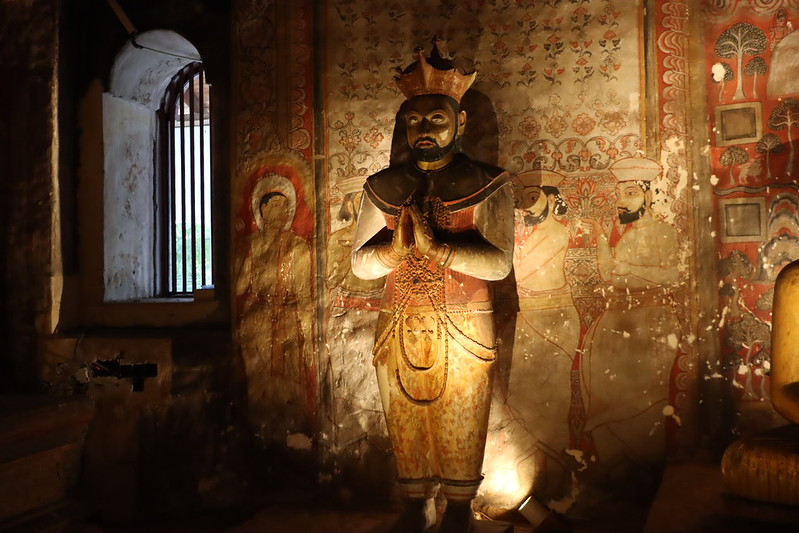
That morning, he has been tracking a deer since dawn on the sacred hill of Mihintale. His bow is drawn. The deer is in his sights. And then…
A man rises from the bushes. A man with a shaved head, in a saffron robe, perfectly still, looking at the king with the slightly irritating serenity of someone who fears nothing.
TISSA (lowering his bow, suspicious):
Who are you? Man or spirit?
MAHINDA:
Neither, great king. I am a bhikkhu, a monk. Son of Ashoka, king of kings of India, and servant of the Dharma.
TISSA:
The son of Ashoka? (pause) …How many days by boat?
MAHINDA:
Three days. One of which was particularly uncomfortable.
TISSA (not quite sure how to handle a prince-monk who has fallen out of his bushes):
And… what do you want, exactly?
MAHINDA:
I would like to ask you a question. (He points to the fleeing deer.) Do you see that animal?
TISSA: Yes, I see it.
MAHINDA: Do you know why it flees?
TISSA: Because it fears my bow.
MAHINDA: And what if I told you that fear, like suffering, has a cause… and that it can cease?
(Silence. Tissa lowers his bow.)
TISSA: You speak like a philosopher.
MAHINDA (smiling):
I speak like a man who watched his father, an emperor, weep on a battlefield. Ashoka understood that true victory lies not in conquest, but in the conquest of oneself. Would you like to hear his story?
This is how the Mahavamsa (« The Great Chronicle » of Sri Lanka), a text written in the 5th century CE, records the first intellectual joust between Mahinda and Tissa: a series of questions on the nature of reality, permanence, and suffering. The king, far from being stupid, answers well. Mahinda recognises in him a mind ready to receive the Dharma. He tells him the story of his father Ashoka’s transformation. « He saw the horror he had caused. A hundred thousand dead, cities reduced to ashes. His heart broke. He embraced Buddhism, proclaimed edicts of peace, and became Dharmashoka, the king who protects the Dharma. »
Mahinda explains the principles of good governance his father had adopted:
« A king must rule with compassion, justice and non-violence. He must protect his subjects as a father protects his children. Ashoka sent missions to spread these teachings, and I am here to speak to you of them. »
Tissa, moved by this account, feels his heart open. But a king must remain on his guard.
TISSA (sarcastic):
« So then, monk, your Buddha is a great master. I am the king of Anuradhapura. If I convert, will your emperor father send armies to tell me how to govern? Will Lanka become a province of India? »
MAHINDA (smiling):
« O king, look around you. Do you see soldiers in the trees? Warships on the horizon? No. The Dharma does not travel with swords but with words, with seeds… and with open hearts. »
TISSA (sceptical): « And if I refuse? »
MAHINDA (gently): « Then you will remain Tissa, the hunting king. But you will have missed a chance to become a better version of yourself. »
TISSA (quietly): « And if I say yes… What changes, concretely? »
MAHINDA (stepping forward):
« Everything. And nothing. You will keep your throne, your lands, your people. But you will rule by Raja Dharma — the law of the just king. So you will lose your demons. Those that drive you to kill, to dominate, to fear.. Only… » (He gestures toward the sky.) « …the peace of the wise. »
After a moment of reflection, he lays down his bow and declares: « I want to follow this path. Show me how. »
Thus, beneath the hill of Mihintale, King Tissa converts to Buddhism, marking the beginning of a new era for Lanka.
SCENE 3 — THE PLANTING OF BUDDHISM
(The oldest tree in the world whose exact age is known)
Anuradhapura, a few weeks later.

Tissa did things grandly. The king offered land for the first temples, ordered the construction of monasteries, and decreed that the Dharma would henceforth be the law of the island. But the event that will live in memory forever is the arrival of Sanghamittā.
Mahinda’s sister, bhikkhunī and scholar, disembarks with eleven other nuns. In her hands, she carries a treasure: a cutting from the Bodhi tree, the mother tree itself, the very one under which the Buddha had attained enlightenment five centuries earlier at Bodhgaya. At that time, the Buddha was not yet represented by statues — his presence was honoured through symbols: a tree, a stupa, a wheel. But what Sanghamittā brings is not merely a symbol — it is a living branch, with its roots and leaves, transported in an earthenware pot, cared for with an attention that any modern botanist would recognise as perfectly reasonable.
The crowd has gathered around the pit dug in the red earth of Anuradhapura. Sanghamittā kneels, hands joined. Then, in a clear voice:
SANGHAMITTĀ: May the roots remember where they come from.
May the branches carry within them the memory of those they have sheltered,
As the Buddha found his light there and offered his shade to all beings,
May the shade of this tree shelter all who sit beneath it,
Without asking where they come from… nor who they were.
She takes a handful of Indian soil, brought from Pataliputra in a sealed pot, and places it at the bottom of the pit. Then, delicately, she sets the young tree inside. A heavy silence falls.

AN OLD MAN (clearing his throat, sceptical):
Very pretty, all of this… But we’re planting a foreign tree in foreign soil, and everyone weeps? I wonder: are we not going to be cursed again?
HIS NEIGHBOUR (gravely nodding):
You are right to be wary. We remember Rāvaṇa — he too wanted to dominate nature, dominate the gods… And look where that led us. The Rāmāyaṇa has saddled us with a reputation as demons for centuries. Then came the Tamils, with their ships trading our pearls and spices… and their own gods. And after that, Vijaya, that banished prince who betrayed us to seize the throne. (He sighs.) We are a people of the earth. We know what it feels like when things are forced.
A WOMAN (stepping forward, firm voice):
But this time, it is not a conquest. It is a gift. A tree that has witnessed Enlightenment. A soil that has drunk Ashoka’s tears. (She turns to Sanghamittā.) And these bhikkhunīs have not come to takeanything from us. They have come to give us a path.
(A long silence. Then, one by one, the onlookers kneel. Some touch the earth. Others close their eyes. The tree is there, fragile, yet already at home.)
Anurādhapura becomes the new spiritual Lankapura.
The teachings of Mahinda and Sanghamittā do not merely convert a king. They launch a tradition. Under Tissa’s impetus, thousands of Lankans begin to follow the Dharma. Mahinda and Sanghamittā become the founders of two monastic lineages that will shape the history of Buddhism for centuries.
Mahinda lays the foundations of the Monks’ Saṅgha. Sanghamittā founds the first order of bhikkhunīs in Lanka. As the Buddha himself had intended, women could access full ordination and study his teachings on equal terms with men.
And now, let us talk numbers — or rather, let us try.
Mahinda, upon his arrival at Mihintale, ordains 60 bhikkhus, including members of the royal family. King Tissa himself does not become a monk: he remained an upāsaka, a devout layperson, but no less committed for that.
The Mahavamsa speaks of thousands of Lankans converted within weeks, 12,000 bhikkhus ordainedin the year following Mahinda’s arrival, and 500 nuns in the same period. Numbers that smell of an official press release. The reality? Nobody knows. But Buddhism held — with or without statistics.
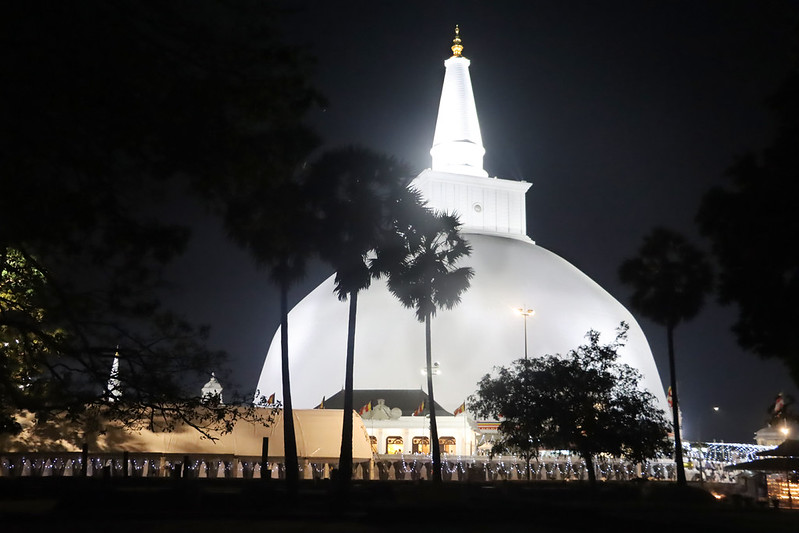
The First Council of Lanka
(Anuradhapura, 247 BCE)
King Tissa convenes the first Buddhist council of Lanka. The monks recite the texts, clarify the rules of the Vinaya, and seal their commitment: « The Dharma must be one, like the tree we have planted, »declares Mahinda. Thus Lanka becomes the guardian of Buddhism, while India has already begun to turn away from it.
India forgets, Lanka remembers
(A few centuries later…)
In India, dynasties change. The Brahmins reclaim power, and Buddhism retreats. Its monasteries are abandoned, its monks scattered. But in Lanka, the flame continues to burn. The monks keep watch. The bhikkhunīs transmit. And the Bodhi tree grows, indifferent to history’s storms.

SCENE 4 — THE INK THAT DOES NOT DRY
Aluvihara, Matale, around 29 BCE.
(Two hundred years have passed. Mahinda and Sanghamittā have long since died, honoured as saints. Buddhism has taken root in Lanka with a depth that even its founders might not have imagined.)
(In Lanka, a civil war has nearly devastated the island. King Vaṭṭagāmaṇi Abhaya, after fifteen years in exile, has just reconquered his throne. And the monks have realised something terrifying: if the teachings remain only in memories, they will disappear with those who carry them. India has already begun to forget.)
In the caves of Aluvihara, at Matale, five hundred monks assemble. Before them: palm leaves, metal styli, black ink. Around them: damp rock walls, trembling oil lamps.
They are about to write the Tipitaka — the « Triple Basket », the entirety of the Buddha’s teachings — for the first time on a medium other than human memory.
MONK 1 (young, sceptical, arms crossed):
Why engrave on leaves what is already engraved in our minds? We have spent our lives learning these texts by heart. And now we write them down like civil servants?
OLDER MONK (without lifting his eyes from his leaf, a slight smile):
Because minds, my son, have an unfortunate tendency to disappear. Between wars, famines, kings who change their minds… and monks who end up as tiger food, a memory is quickly lost. And besides, a severed head recites rather poorly.
MONK 1: Here in Lanka, we don’t forget! We recite, we debate, we transmit…
OLDER MONK (setting down his stylus, grave gaze):
Ah, do you think today’s young people memorise as they once did? And their children after them? (He taps the palm leaf.) India has forgotten. The Mahāsāṅghikas over there add texts as if they were recipes, and one day they will call it the « Great Vehicle. » We, the Sthaviras, remain faithful to what the Buddha truly said. So we write. Not to replace human memory, but to save it from knives, wild beasts… and future inventions.
MONK 1 (sighing, thoughtfully):
« But why didn’t we think of this sooner? »
ELDER MONK (smiling):
« Because the Buddha forbade it, my young friend. At his passing, he made it clear: his teachings were to be memorized, internalized, lived… not written. So we began organizing councils, reciting the texts together to preserve them. »
MONK 1 (shocked, wide-eyed):
« Forbidden? But wasn’t he afraid his teachings would disappear? »
ELDER MONK (shrugging):
« He taught impermanence… »
MONK 1 (still shocked):
« Are we going to disobey the Buddha?! »
ELDER MONK (shrugging, amused):
« Perhaps it takes a first step toward materialism… » (picking up his stylus, with a theatrical sigh):
« We write for future generations. Because we live in troubled times. The Dharma can no longer depend solely on humans… » (He looks up, suddenly serious.) « What we set down here will be the Buddha’s original voice. Not an interpretation, not an addition… the very heart of the teaching. One day, it will be called Theravāda – the Way of the Elders. »
The rustling of styli on palm leaves lasts for months.

What these monks produce in the caves at Aluvihara is the Pali Tipitaka, the version of the Buddhist texts that will later be transmitted throughout the world, adopted by Thailand, Myanmar, Cambodia and Laos over the coming centuries. The version that survives to this day. Lanka saved the memory of the Buddha’s words that India had nearly lost. The island of Lanka had become a sanctuary, the library of Buddhism.
EPILOGUE
Mihintale. The same rock. An evening of the full moon in 2026.
Let us imagine (this is theatre — we can do as we please) that Mahinda and Sanghamittā meet once more on the hill where it all began. The centuries have no hold on legendary spirits. The author of this text is seated before them, writing in his notebook as they speak.
MAHINDA (gazing toward Anuradhapura, discernible in the plain):
In India, the Dharma is a river that men seek to dam — they have nearly dried it up.
Here, it flows from our peaks and nourishes the whole island.
SANGHAMITTĀ (looking north, toward the sea and invisible India):
They were afraid we were planting something foreign.
MAHINDA: And we planted something universal.
SANGHAMITTĀ:
They nearly killed the Buddha in India.
In Lanka, they put him into writing.
The full moon of Poson rises over the island.
Somewhere in Anuradhapura, a two-thousand-year-old tree gently stirs its leaves.
It needs no applause.
It grows.
Beneath its branches and around it, bhikkhus and bhikkhunīs chant the texts that are still learnt by heart, even now that there are books, and explain the teachings to the faithful who have come from far away.
End of Act III

Footnote for the fastidious:
The dates cited are those retained by the Theravada tradition and the Lankan royal chronicle, the Mahavamsa (written in the 5th century CE). Some modern historians shift them by a few decades — but the tree itself is very much there: the author of this text has seen it and touched it with his own eyes.
Text and photographs: © Frédéric Alix, 2026
I began this project of telling the history of the island of Lanka in a hybrid form, between theatre and prose screenplay. This story will probably have 7 or 8 acts.
 Salaween.blog
Laisser un commentaire