Tales of the Lawa People (2) – A Myth-Inspired Fictional Account
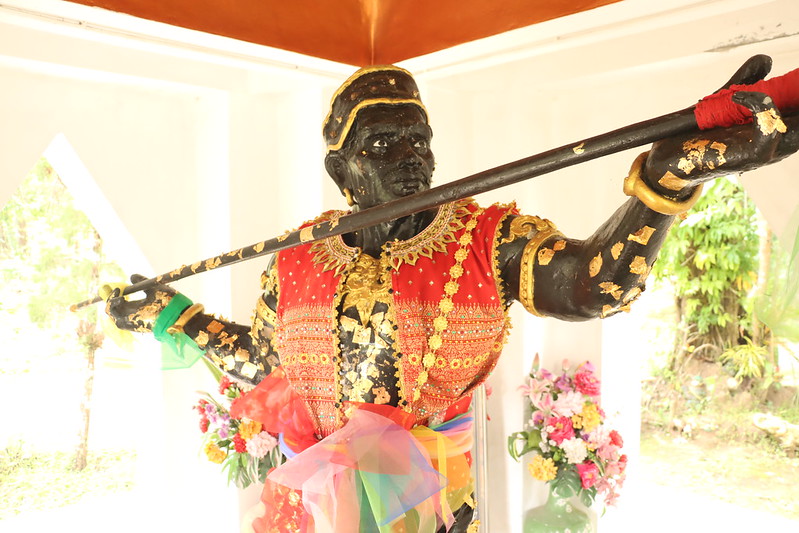
I am Vilanka, chief of the Lawa, lord of the mountains, protector of the forests, and guardian of our people for generations. You may have heard my story through the words of the victors, twisted by their pens and their intentions. But today, it is my voice you will hear.
I lived in the 7th century of your era. I can tell you the story of my life, but I cannot write it down. We once had a writing system—our stories were inscribed on buffalo hides. That was our library. But a hungry dog devoured it all. Our written tales disappeared, and no one ever knew how to write them again. So today, I entrust the story of my life to this tree, which will pass it on to the other trees, and I hope that my name will be heard in centuries to come.
The Hermit Suthep and the Orphan Girl
It all began when the hermit Suthep took in an abandoned child. We know Suthep well—he spends all his time in his cave on the mountain. With his long beard and hair, his thin body (because he claims that feeding the spirit is more important than feeding the stomach), he is always dressed in a panther’s skin. He spends so much time meditating on his mountain that, I tell you, one day that mountain will bear his name.

So the solitary hermit Suthep couldn’t take care of the girl himself; he sent her down to the plains, to the Mon people. He would have been ashamed to entrust her to us—though he speaks of detachment, he has his pride, and he wanted his adopted daughter to be raised in a civilization.
You know, the people of civilization—they look down on us.
Suthep is a Lawa son like me. He studied Buddhism, but he is a child of the land of our guardian spirits, Pu Sae and Ya Sae, just like all of us. Our ancestors were cannibals, headhunters, and at the same time guardians of the forest and of the mountain springs. In fact, I’ve been to his cave—it’s right next to a magnificent waterfall that gushes from the mountain.

We had forgotten all about that adopted child. And when that visionary went to lay down a seashell in the plain and had city walls built in the exact shape of that shell—only a thousand times larger—we thought his plans were becoming more and more absurd. But then the girl returned, traveling by river, bringing with her 500 monks and 500 artisans from Lawo, the capital of Mon civilization.
Queen Cāmadevi
Suthep announced that his adopted daughter would become Queen of the city of Hariphunchai, whose fortifications followed the exact shape of the seashell.
I was told that Nang Cāmadevi, the new queen of Hariphunchai, was so beautiful that her presence made our mountains echo. But what interested me far more was the ancestral bond she carried with my people, the Lawa. Born on our lands, taken in by Suthep, she carried our heritage within her—even if she had been raised in the Mon culture and had grown distant from our traditions.
I knew that this queen, who had come to Hariphunchai with her monks and artisans, was seeking to unify the territory. For our people, her marriage to me would have been a natural alliance—the restoration of ancestral order. So I sent her a messenger, bearing gifts and my proposal.
Her response was a dagger to the heart.
“I do not want him,” she said. “I have never seen him, but I do not even wish him to touch my hand.” Her words, conveyed by her messenger, were filled with scorn—not just for me, but for my entire people.

The Founding Tale
You see, Queen Cāmadevi, with all her Mon refinement, her rituals timed to the second, and her laws carved in stone—she fails to grasp one essential truth: my people, the Lawa, have a history. Not a history locked away in golden manuscripts or revered sutras. No, a much older history, carved into the sides of our mountains and told by the trees and rivers.
Take the tale of King Sammutiraja. A lesson Queen Cāmadevi would do well to reflect upon.
Long ago, the king of the plains sent families up into the highlands to tend goats. These people, simple farmers, were faced with a problem: on those steep slopes, they couldn’t grow the irrigated rice of the valleys. Hunger threatened them, and with it, despair.
But guess who came to their aid? Not a noble, not a scholar, not even a monk. No—it was monkeys… and goats. Yes, those same creatures the queen herself looks down upon.
The monkeys, with their wild wisdom, told the goats to go down into the valley and eat as much rice grain as they could. Which they did. Then, climbing back up the mountain, they defecated—and in doing so, they scattered the seeds. Those seeds, now hardier, adapted to the mountains.
And so, thanks to monkeys and goats, the people learned to farm in harsh lands. They survived. More than that—they thrived. That is the story of my people, the Lawa.
But what does Queen Cāmadevi retain from this story? Nothing. Or worse—a mockery. To her, we are merely a “degenerate” people, speaking a language she says resembles that of monkeys. She scorns what she cannot understand. She refuses to see the wisdom of animals, the intelligence of nature. We, the Lawa, were born of the mountains, shaped by the forest. We know how to survive where her rituals are useless. And of course, our skin is darker than theirs—because we work under the sun.
The Spear and the Hat
My blood boiled, but I chose to respond with a challenge. I sent a messenger to tell her that if I could throw my spear from the summit of the Doi, all the way to her city of Hariphunchai, she would have to accept me. Cāmadevi, cunning as she was, accepted the challenge, thinking the distance would make it impossible.
I climbed to the summit of the Doi, accompanied by my men. My first attempt fell just short: the spear struck just outside the walls of Hariphunchai. I saw her then, growing uneasy. She had not expected me to come so close.

That’s when her cunning came into play. She sent me a gift: a turban woven from her undergarments. “Wear it,” she said, “as a symbol of my respect for you.” Naively, I accepted it—I was even pleased that she had thought to give me a gift—and I tied it around my head before throwing my spear a second time. But the cloth, imbued with her female pollution, as their beliefs would call it, sapped my strength. The spear fell at the foot of the mountain.
An Inevitable War
I no longer had a taste for anything. I had lost the challenge, but that was nothing compared to the sorrow I felt from having been deceived. They say I sent my army—but in truth, my warriors went on their own. I was devastated. They descended from the mountains to take Hariphunchai by force. But Cāmadevi had prepared her sons to defend the city. Mounted on a royal elephant, they led their troops with remarkable skill.
My men fought with great courage, but the numerical advantage and strategy of Cāmadevi eventually overwhelmed us. My soldiers retreated. We were definitively defeated.
The Final Legacy
Perhaps it wasn’t a total defeat. My two daughters were married to the two sons of Cāmadevi, finally uniting our peoples by blood, as I had hoped—but in a different way. Thus, our lineages were joined, and the heritage of the Lawa lived on in the generations to come.
Do you remember the relic that the Buddha himself entrusted to our ancestors, Pu Sae and Ya Sae? It still rests beneath the stupa of Doi Kham. And see how things turned out: it is now the sons of Cāmadevi who watch over that sacred sanctuary and honor our origins and our spirits. Isn’t that what I truly wished for, deep down? That our memory, our heritage, would endure. I can only be satisfied: our mountains still echo with the names of my ancestors, and the prayers of future generations will always carry a part of our story—the story of the Lawa.
Broken Heart
I am Vilanka, and this is my story. A story of pride, of respect, and of the struggle to preserve the soul of my people in a changing world.
I died of grief. Inconsolable. I had lost all will to live. That’s how it was.

Funeral
Ah, my funeral! Allow me to tell you about this farce, for who else but I, Vilanka, can do it with such verve? Picture the scene: Khun Luang Vilanka, fallen sovereign but proud, deceased of a broken heart. And so they decided to carry me to the summit of Doi Pui so that, even in death, I might gaze over Hariphunchai. Noble idea, isn’t it? Wait for the rest.
My body, carefully wrapped in a bamboo coffin (not very royal, I admit, but well, we do what traditions allow), was supposed to travel with dignity. But no, dignity was apparently not on the program that day.
The bearers, well-intentioned but completely disorganized, chose a longer path because a funeral procession cannot cross a stream. I swear, on the day of my funeral, no one drank a drop of water. My procession had to pass through a place overrun with giant vine lianas. Don’t ask me how, but these good people forgot where they were going, who they were, and most importantly, that they were carrying a dead king on their shoulders. Result? Some went under the vines, others over, and the musicians playing cymbals (the famous Swa) and bells (Deng) got so intoxicated by their music that they turned into stone. Yes, my glorious funeral orchestra was transformed into ridiculous rocks now called Pha Swa and Pha Deng. Thank you very much!
Then, as we climbed the summit of Doi Pui, my coffin had the brilliant idea to lose its lid. Yes, blown off by the wind like a dead leaf! Can you imagine? My final journey and there I was, exposed like a common fish at the market. They named the spot Kiew Maew Plew in memory of this picturesque episode. Literally: “the neck of the lid (Maew) blown by the wind (Plew).” Poetic, isn’t it?
But that’s not all! Once at the summit, these geniuses decided that the best way to bury me was to overturn my coffin and roll me like a sack of rice into my makeshift grave. This charming moment gave birth to the place known as Doi Kwam Long, or “the mountain of the overturned coffin.” And of course, because nothing is simple, they declared that my coffin had turned to stone. Why not, after all? If my cymbals became rocks, why shouldn’t my coffin receive the same treatment?
And so, dear listeners, this is how my funeral turned into a burlesque theater worthy of the greatest farces. Today, tourists and pilgrims visit the temple of Doi Suthep, worship a relic of the Buddha, and camp on the slopes of Doi Pui, never suspecting that they tread upon the stage of my posthumous misadventures.
But rest assured, I, Khun Luang Vilanka, still watch over it all. Transformed into a spirit feared to this day, I watch, I listen, and I quietly laugh at the irony of my death. For the mountains of the Lawa still whisper my name.

Text and photos : © Frédéric Alix, 2024
This text is part of a series of three stories about the Lawa. In the next story, a rabbit will share its apocalyptic vision of the future.
Previous story: The Peace Accords of the Lawa Land
Two spellings are possible for our hero’s name:
Vilanka (วิลังคะ) : [wi-lăng-khá] : smoother and more commonly used in spoken language.
Viranka (วิรังคะ) : [wi-răng-khá] : can be chosen if one wants to emphasize a Sanskrit origin, where « vira » often means « hero » or « valiant. »
Bibliography :
- Nimmanahaeminda, Kraisiri. (1967). The Lawa guardian spirits of Chiangmai. In the Journal of the Siam Society 55.
- Ongsakul, S. (2005). History of Lan Na. Chiang Mai: Silkworm Books.
- Penth, H. (2004). A brief history of Lanna: Northern Thailand from past to present. Chiang Mai: Silkworm Books.
- Rhum, M. R. (1987). The cosmology of power in Lanna. Journal of the Siam Society, 75, 91–106.
- Satyawadhna, C. (1991). The dispossessed: An anthropological reconstruction of Lawa ethnohistory in the light of their relationships with the Tai (PhD thesis). Department of Anthropology, Research School of Pacific and Asian Studies, The Australian National University, Canberra, ACT.
- Wichienkeeo, A. (2006). The Lua of Lanna: A study from Lanna archives. In C. Satyawadhna, Community rights in Thailand and Southeast Asia (Project code RDG4210014V12, pp. 165). Thailand Science Research and Innovation.
- Wyatt, D. K. (2003). Thailand: A short history. New Haven, CT: Yale University Press.
- Young, G. (1962). The hill tribes of northern Thailand. Bangkok: The Siam Society.
- สุรพล ดำริห์กุล. (2567). เมืองประวัติศาสตร์เชียงใหม่ คุณค่าอันโดด. กรุงเทพฯ: เมืองโบราณ.
Pr. Suraphon Damrihkul, La ville historique de Chiangmai, valeur universelle exceptionnelle.


Laisser un commentaire