Did shadow theatre originate in India or China? Perhaps both after all, trade between these two ancient powers dates back millennia. Halfway along the maritime route connecting them, we find Wayang Kulit, its Javanese counterpart. Today, I’d like to introduce you to Thailand’s own tradition.
In Thai, the word หนัง (nang) originally means « leather. » Since the puppets were made of leather, shadow theatre came to be known as nang (หนัง). In the 20th century, when cinema was introduced to Thailand, it too adopted the name nang(หนัง), as it is also a spectacle of light projected onto a screen.
Today, Thailand has two distinct but related shadow puppet traditions: Nang Talung (หนังตะลุง), from the southern province of Pattalung, and Nang Yai (หนังใหญ่), rooted in the central region.
Nang from Pat’talung: The Southern Heritage
It’s difficult to pinpoint exact dates, but Nang Talung appears to be the older of the two, likely a legacy left by Indonesian, Indian, or Chinese merchants who docked in the southern regions of Pattalung and Nakhon Si Thammarat.
There is no tangible evidence of when Nang Talung first appeared in southern Thailand. As an oral and popular tradition, it left no written records or official mentions to date it precisely. However, some scholars suggest it emerged as early as the 12th century.
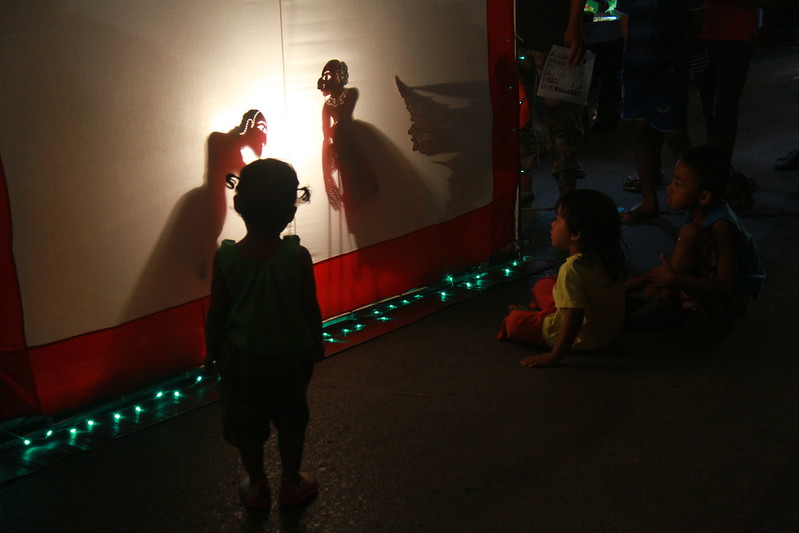
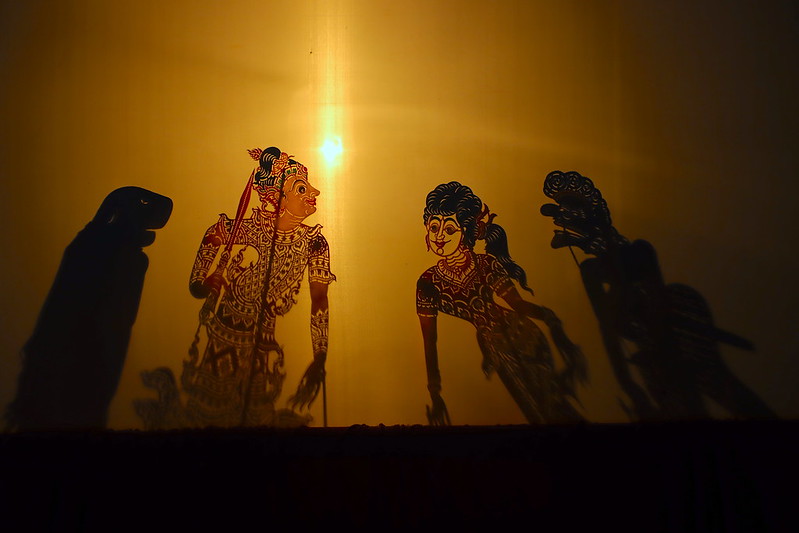
Nang Talung is designed to be performed anywhere. The puppeteers double as narrators, accompanied by a PhiPat orchestra. Originally, Nang Talung had no religious ties, so its characters include Muslims, Chinese merchants, and Buddhist monks. It is a shared cultural treasure across southern Thailand.

Nang Yai: The Royal Tradition
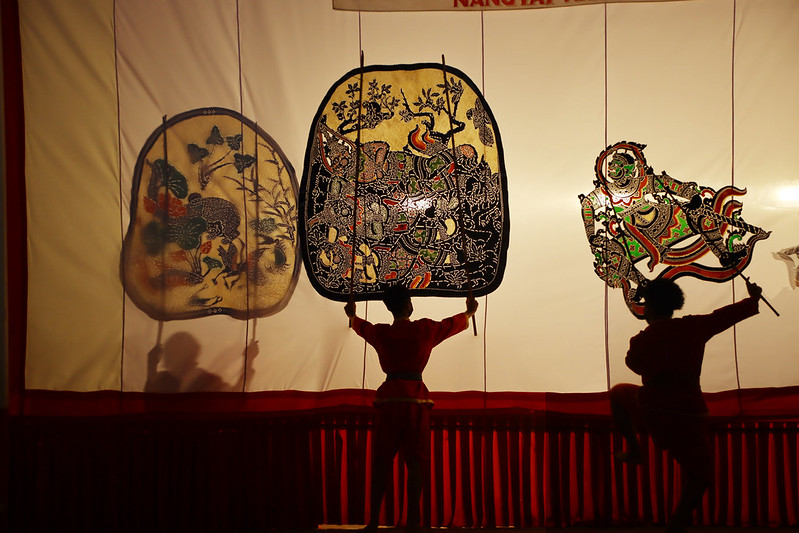
Nang Yai (หนังใหญ่, literally « Great Theatre ») is believed to have appeared in the 18th century during the Ayutthaya period. However, the first concrete evidence of performances dates back to the Ratanakosin era (Bangkok) under the reign of King Rama I. Nang Yai features large puppets made from buffalo leather.

Same Same, But Different
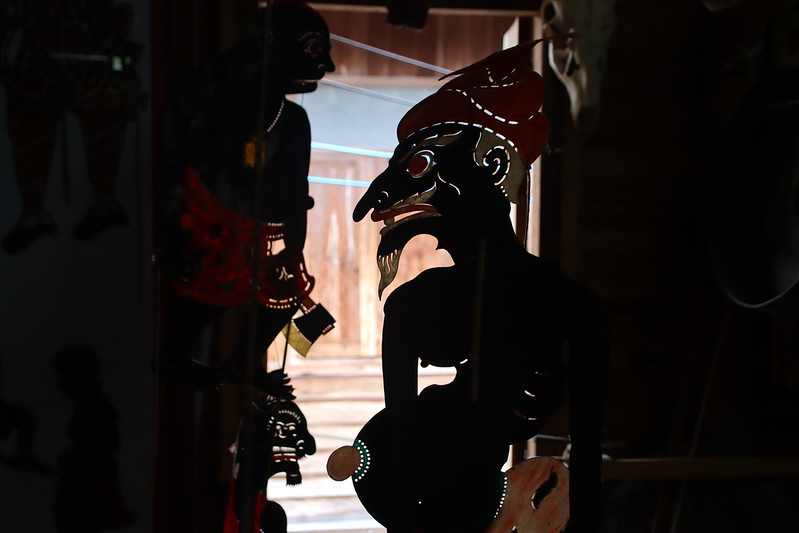
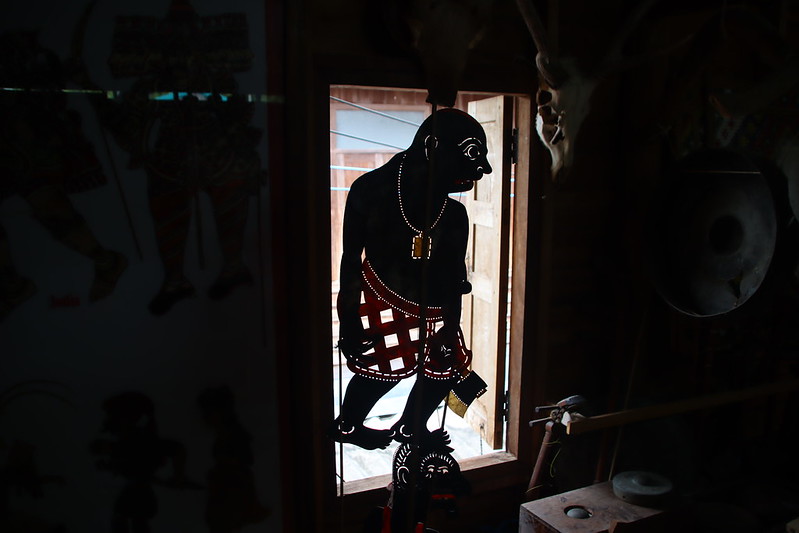
The first difference between Nang Yai and Nang Talung lies in their size. Nang Talung puppets have movable limbs, while Nang Yai puppets are static.
Can we even call them puppets? They are more like giant scenes. They only come to life during the performance, as the puppeteers dance with them in hand, animating the scenes through their movements.
Another key difference: Nang Yai is a royal art, performed in temples to teach religious morals. Nang Talung, on the other hand, is a folk art—free to tell both secular and religious legends, with narrators who don’t shy away from social satire. In this sense, Nang Talung can be compared to Europe’s Guignol theatre.

The Grand Nang
Nang Yai performances are recited by a narrator (who is not a puppeteer), accompanied by a PhiPat ensemble. Like the Khon masked dance, Nang Yai enacts episodes from the Ramakian (Thailand’s version of the Ramayana). There is a clear mutual influence between the two art forms, visible in the dances and costumes of both the puppeteers and Khon actors.

During the reign of King Rama V, Nang Yai performances were held in two temples: Wat Sawang Arom (Singburi) and Wat Khanon (Ratchaburi). Both temples continue to preserve this heritage today.
At Wat Khanon, the revered monk Satthasunthorn (1848–1942) had the idea to create larger puppets—some over 2 meters tall. A total of 313 distinct puppets were crafted, and this collection is still preserved in the monastery. A museum displays the most beautiful pieces. I was fortunate enough to be shown a hidden door, revealing that the temple’s collection actually includes hundreds of puppets, carefully stored away from light (though not, alas, from humidity).

Video Presentation
I’ve compiled a video introducing both types of shadow theatre:
Finally, a performance (last 3 minutes).
The first 2 minutes focus on Nang Yai.
Then, we visit the home of Suchart Subsin, where his Nang Talung puppets await us.
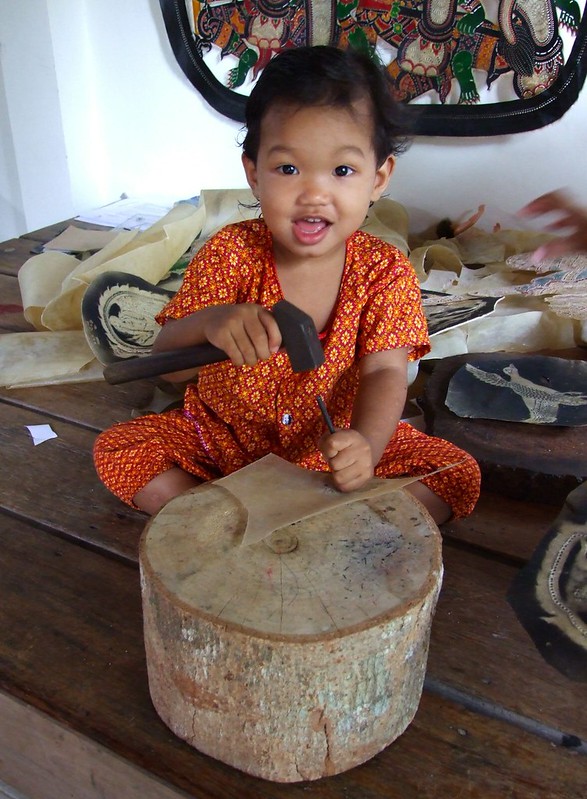
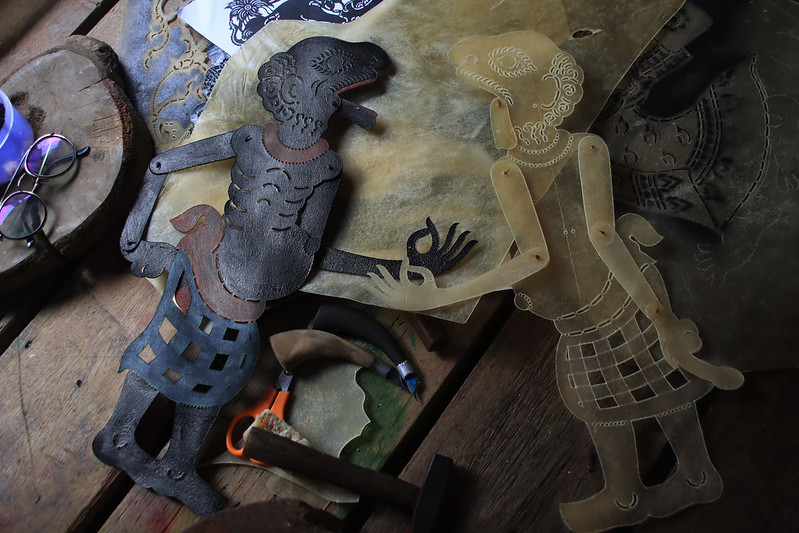
A glimpse into the puppet-making process.
Crafting the Puppets
At Wat Khanon, artisans explain that the choice of leather depends on the character being created. For a hermit monk, for example, leopard or bear skin is used. The craftsman must wear white and observe eight religious purity commandments. Additionally, all drawings and coloring must be completed in a single day.
For less important characters, any cowhide will do.
Since Nang Talung lacks the sacred dimension of Nang Yai, its artisans enjoy complete creative freedom.

Suchart Subsin: A Living Legacy
Suchart Subsin was born in 1938 in Nakhon Si Thammarat. From a young age, he began crafting Nang Talung puppets. Encouraged by his father, he studied under a master puppeteer and a poet. In 1987, he opened a museum in his family home, allowing the public to admire his puppet collection and learn about his craft. In 2006, he was honored with the prestigious title of National Artist for his contributions to folk art.
Today, his son has taken over. Tradition, after all, is passed down from generation to generation—this is how it stays alive. The Suchart Subsin House remains open to visitors, who can learn about puppet-making, explore the history of the art through the collection, and even watch a live performance.



The Characters
Nang Yai
The characters in Nang Yai are drawn from the Ramakian epic. They include:
- A main character (a monk, god, or king).
- A devout character (hands pressed together in prayer).
- A character in motion.
- Landscape puppets (with no human figures).
Nang Talung
Nang Talung also has a hierarchy of characters, but the most popular are those from everyday life. Nai Yodthong, for example, is a womanizer, a braggart who often says foolish things—but turns cowardly when faced with someone stronger.





A Note on Nang Pramothai
There is also a version from the Isan region called Nang Pramothai. I’ll continue my investigation in northeastern Thailand…
All photos and text © Frédéric Alix, 2007–2022
I hope I haven’t made too many mistakes in my explanations. If you have any additional literature or insights, I’d be delighted to learn more!


Votre commentaire