Chengdu, 2007. I thought I was going to see pandas. I had no idea one of them would be invisible — and unforgettable.
I didn’t plan my first visit to Chengdu. I arrived the way I arrived everywhere in those years — by bus, from Laos, crossing borders overland, moving at the pace of shifting landscapes and uncertain schedules. China had been pulling at me since 2006. I came back in 2007, then again in 2009, and each return deepened something I still can’t quite name. A connection, maybe. Or just the feeling that this country is too vast, too layered, too contradictory to ever be done with.


Chengdu: The City That Feels Like a Crossroads
I particularly love Chengdu, though I’m not entirely sure why. Maybe because this city always seems to be searching for its balance between two worlds. It’s a crossroads city, a gateway to the high mountains. Here, you can already feel the pull of the Himalayan ranges, as if the foothills of Tibet were beginning right there. Tibetan culture is present in the city. Chengdu sits between plain and mountain, between inner China and the Tibetan world. And it’s the city famous for its panda conservation and research centre.
The Odyssey to the Panda Base
In Chengdu, I of course wanted to visit the panda centre. But since it lies outside the city, getting there by public transport was almost an odyssey, back in a time when there was no GPS in the palm of your hand to help.
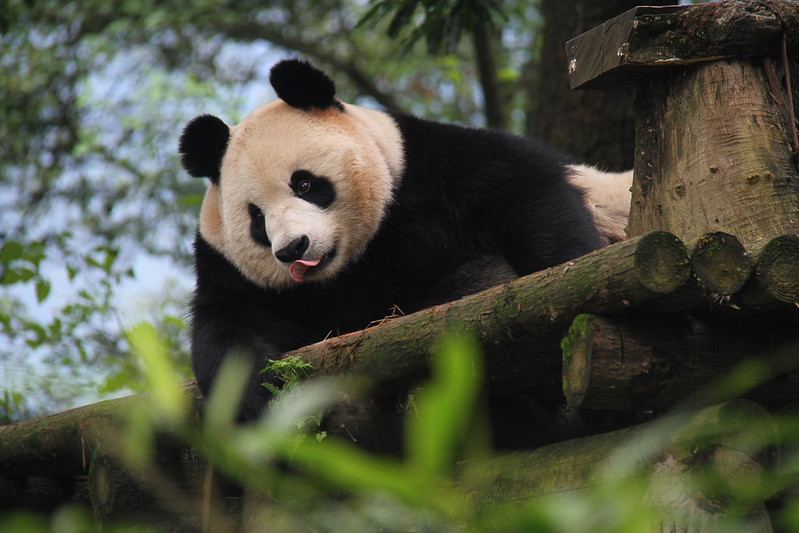

I wasn’t expecting such a striking experience. It’s a single-theme zoo, where pandas are the only stars, with scientific laboratories tucked away out of visitors’ sight. Bamboo-lined paths, a calm atmosphere despite the crowds, and a layout that gives space to both the animals and the visitors. Very quickly, you forget the other people around you and focus on what matters: the giants!
The Giants: Monks in Black and White
My first encounter with the giant pandas remains intact in my memory. There is something deeply endearing about their presence. Their black and white coat, almost surreal, their movements both heavy and clumsy, and above all that disarming nonchalance. Most of them were busy eating bamboo with great focus, sitting like monks absorbed in their ritual. « Inner peace », they seemed to say. Others appeared to be dozing, indifferent to the world, while the younger ones climbed over each other with clumsy energy, creating scenes both comical and touching.

The Panda I Didn’t Know Existed
But what surprised me most that day was an unexpected discovery.
Continuing through the visit, I came across another, more discreet section. And there, for the first time, I saw red pandas. I knew almost nothing about their existence. The contrast with the giant pandas was immediate.
The Foxes of the Himalayas
Red pandas aren’t simply red like an over-steeped cup of tea — they’re small like lazy cats, and agile like circus acrobats. Their warm, glowing russet fur stands out against the deep green of the vegetation. Their long tail, expressive face, and nimble movements through the branches give them a natural elegance I wasn’t expecting. Where the giant panda amuses with its air of an « early-retired bear« , the red panda fascinates with its feline grace, somewhere between a fox, a cat, and a character from a Tibetan tale.

The Lesson Between the Bamboo
Watching them, I learned that they live in the mountainous regions of the Himalayas, in cool, dense forests. They too are threatened, but remain far less known to the general public. Their discreet nature, their remote habitat, and the overwhelming media presence of the giant panda likely explain this relative neglect. Yet their beauty and uniqueness deserve far more attention.


China is the birthplace of pandas: between the constant media presence of the black-and-white giant, and the discreet red panda, like a well-kept secret. One embodies quiet strength, the other an overlooked agility. And yet both remain suspended between human protection and the world’s indifference.
The giant pandas, with their air of detached, greedy monks, and the red pandas, elegant as foxes from a legend, taught me that discovery slips in between two stalks of bamboo, in some quiet corner, exactly when you least expect it.

Garzé region, 2014 — The bus rattled down the cracked asphalt road at 3,000 metres altitude. I kept watching everything, every piece of the landscape, but also the road, because the driver was going fast. Below, the torrent roared beneath hundreds of prayer flags of every colour. The ashes of offerings were still smouldering on flat stones. The driver braked sharply, and everyone got out to stretch their legs — some jumped down to the torrent, others sat in the grass and lit a cigarette. That’s when a Tibetan man shouted « Yi Yi! » I understood nothing, but the excitement spread instantly: every gaze turned toward the slope between rocks and high-altitude shrubs, fingers pointing, faces lit up. I followed their direction, squinting, searching in vain for a shape, a movement. « Yi Yi! » he repeated, as if it were obvious. They tried to show me, but I saw nothing. It was only later that someone explained: it must have been a red panda, that russet ghost of the mountains, as elusive as a legend.

Giant Pandas & Red Pandas — At a Glance
| Criterion | Giant Panda (Ailuropoda melanoleuca) | Red Panda (Ailurus fulgens) |
|---|---|---|
| Size | 1.2 to 1.9 m, 75 to 160 kg | 50 to 64 cm + tail 30–50 cm, 3 to 6.2 kg |
| Colour | Black and white | Blazing russet (like a Himalayan sunset) |
| Habitat | Bamboo forests, central China | Himalayan mountain forests (Nepal, Bhutan, India, China, Myanmar) |
| Diet | 99% bamboo, 12–38 kg/day | 50% bamboo + fruit, eggs, small mammals |
| Conservation status | Vulnerable — ~1,800 in the wild | Endangered — <10,000, declining |
| Behaviour | Solitary, sleeps 10–16 h/day | Active at dawn and dusk, discreet |
| Fun fact | DNA closer to bears than raccoons | Called « ponya » in Nepal — considered messengers of the gods |


Text and photos ©Frédéric Alix, 2026 (photos 2007, 2014)
Sources:
- IUCN Red List (2024) – Giant panda / Red panda
- WWF – Giant panda / Red panda
- Red Panda Network – Official website
 Salaween.blog
Laisser un commentaire