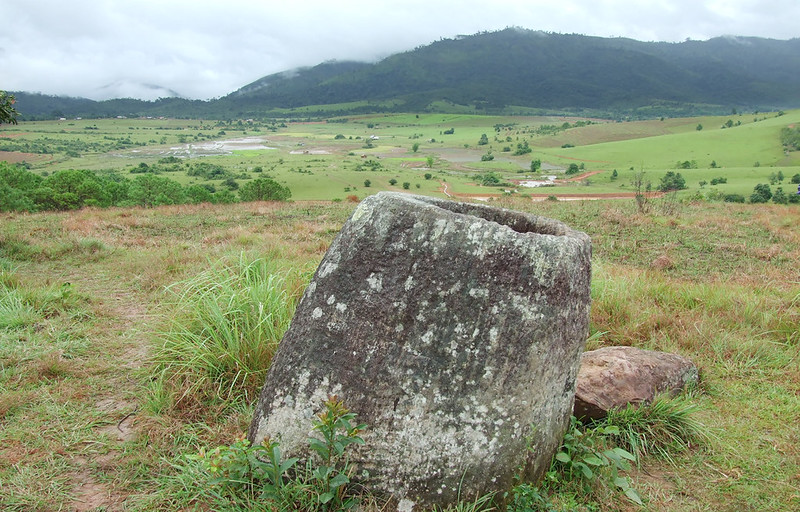
Myanmar, February 2019
I can admit it now: I was scared. Three days after arriving in Myanmar, two days after getting on my little motorbike in Mandalay, I still didn’t know why I had come back to this country I had only just left a few months earlier. A little monkey kept running around in my head, unable to remember why I loved Myanmar so much. Ahead of me stretched the road through Chin State, its endless ridges, its altitude, its unknown — and above all its loneliness, because you don’t meet many people on these roads at the edge of the world. But don’t tell anyone: I still need people to believe I’m a fearless adventurer.
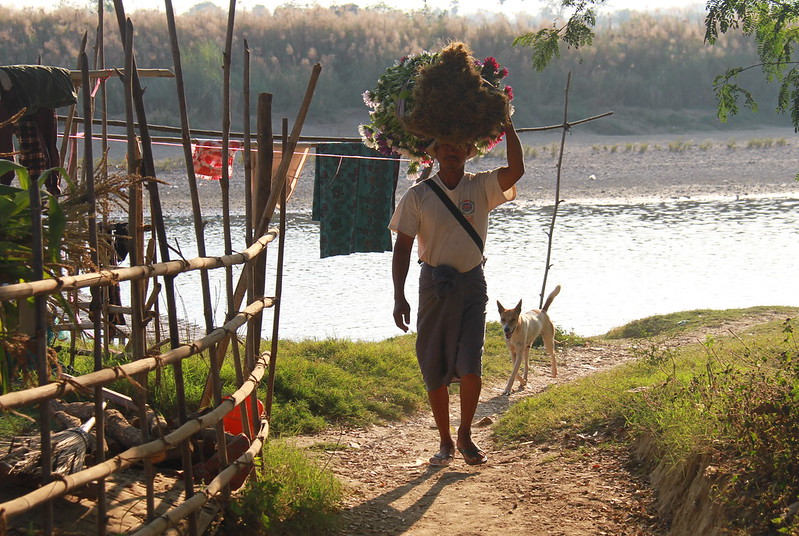
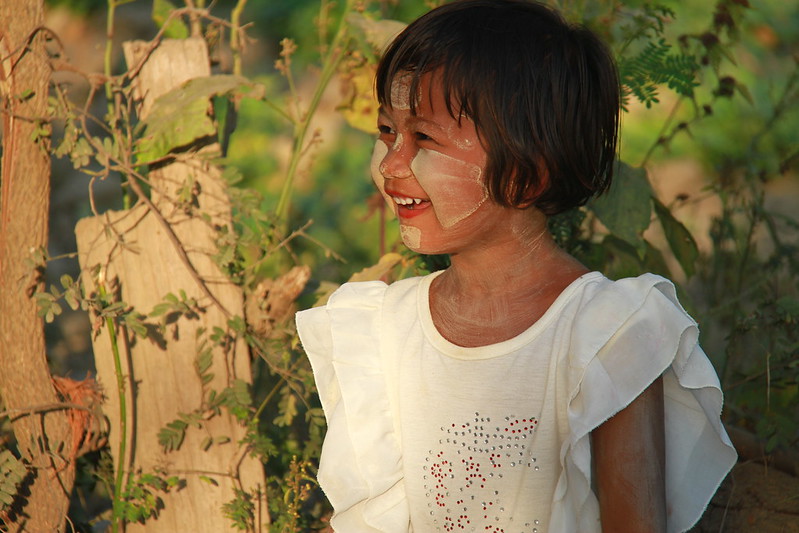
In Gangaw, the last warm valley before the heights, I let my fears rest at the slow pace of my walking. A calm river makes a hundred-and-fifty-kilometer detour there before joining the Chindwin. Like me, this river needed to pass through Gangaw. By the water, people were washing clothes and cut flowers (yes, really, they were washing flowers!), laughing, and pigs wandered around looking like they were smiling. And in the silence of a garden, in front of a house like any other, I met the gaze of an angel.
First villages, first ridges
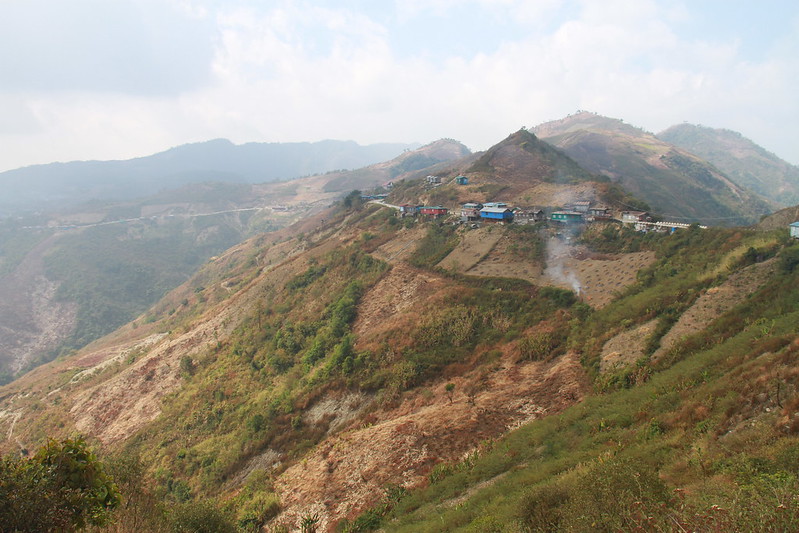
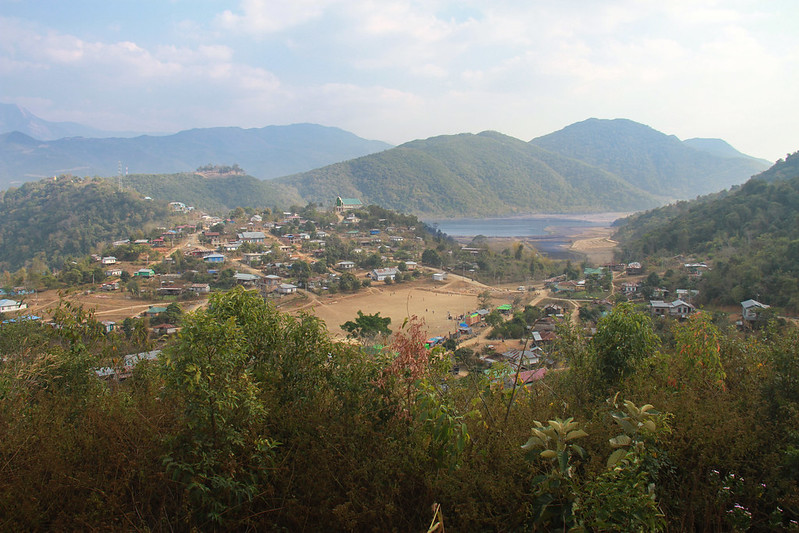
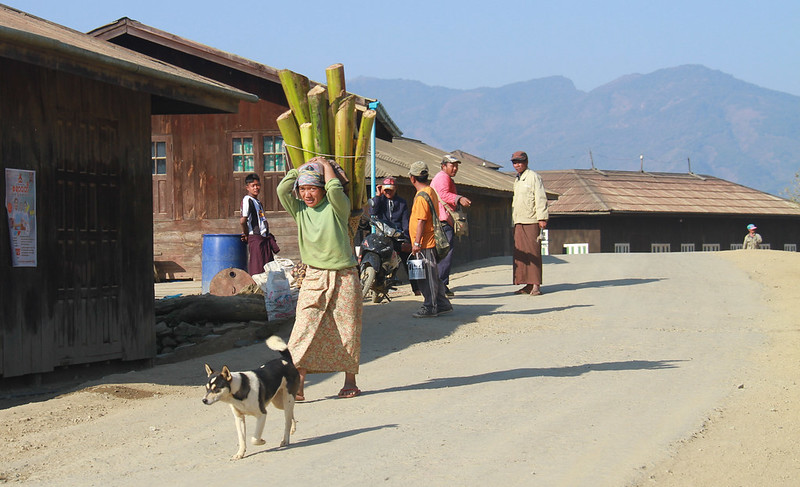
Then the road climbed, and nothing was flat anymore. The houses of the villages perched on the ridges stand on stilts, above empty space. In the center, a church — sometimes two. I regularly found petrol sold in plastic bottles in the hamlets, so I wouldn’t run out of fuel on this endless ridge road, and I arrived in the early afternoon in Hakha, the capital of Chin State.
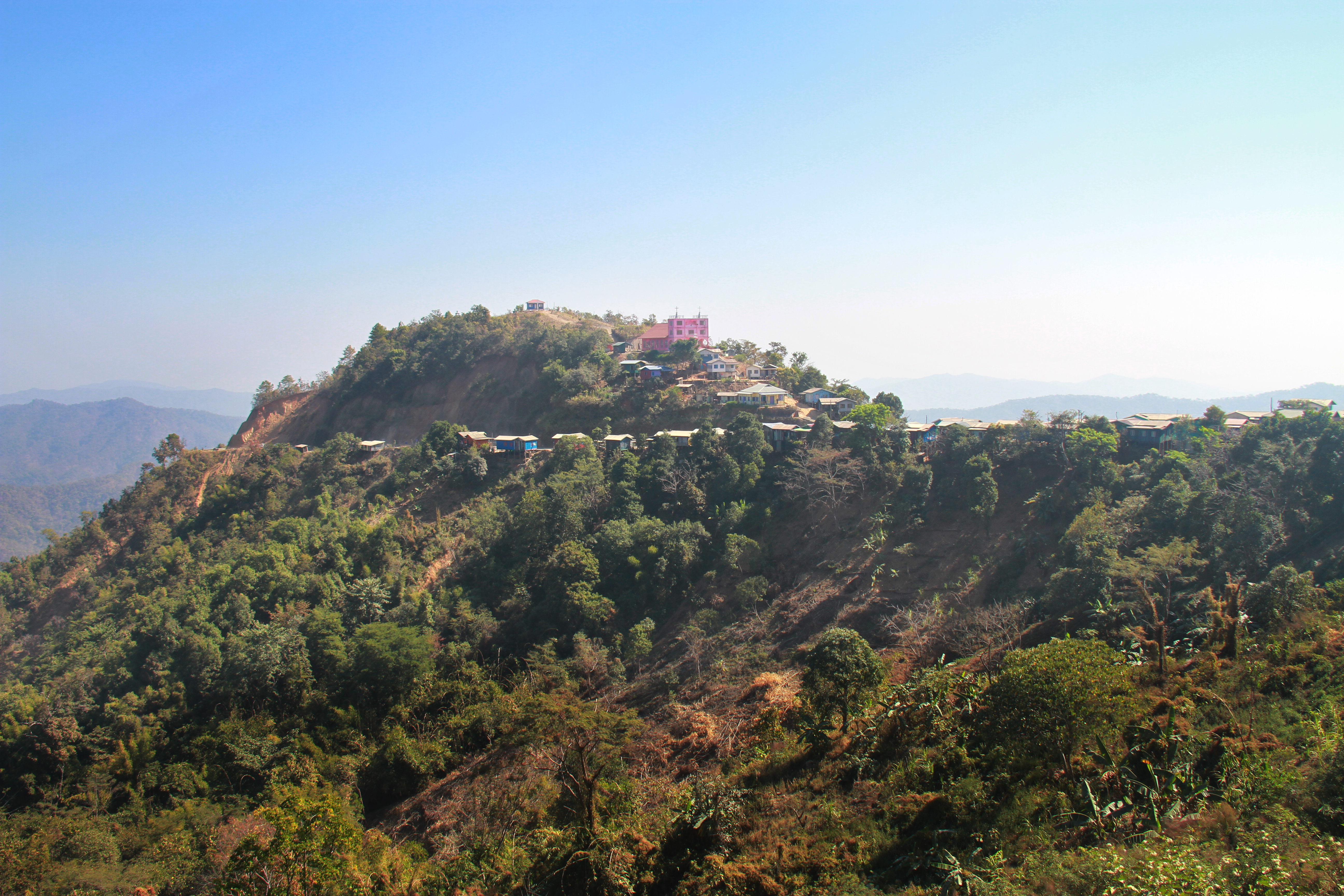
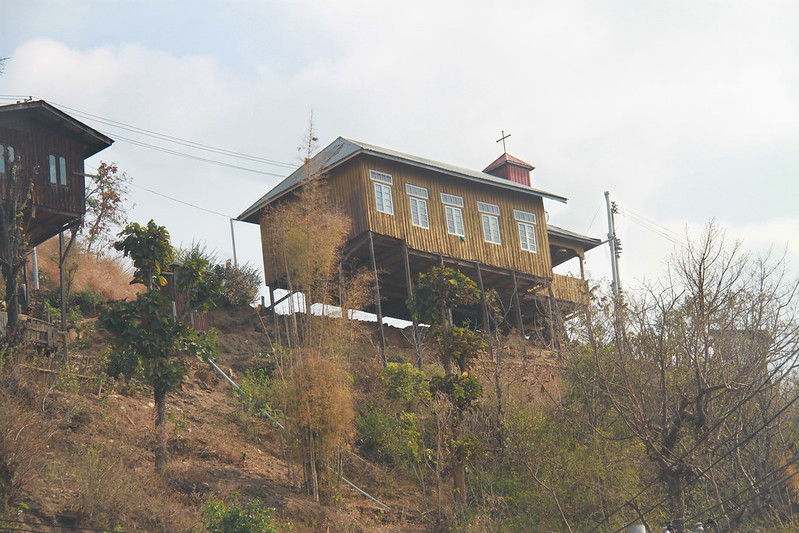


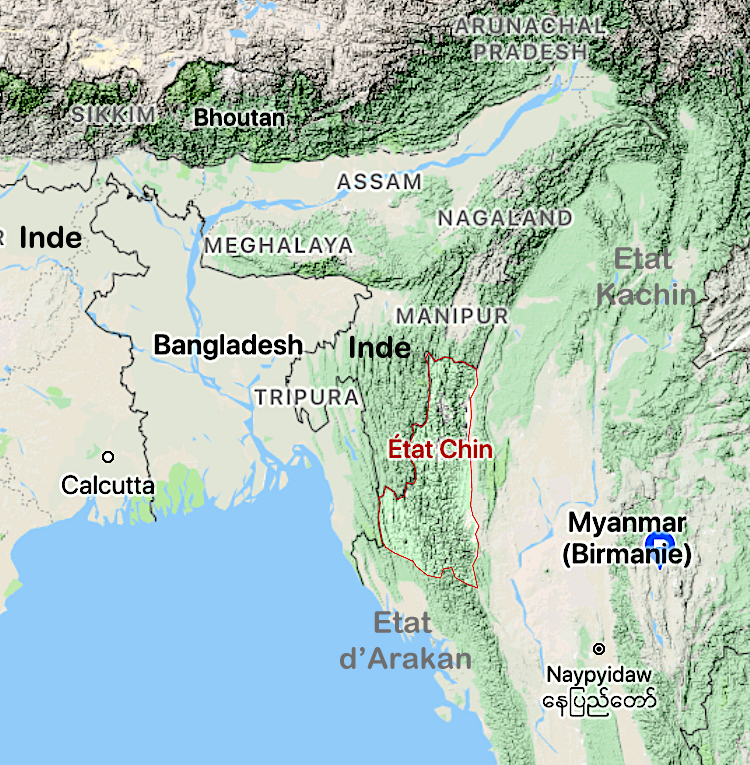
People call them the Chin Hills, but their peaks rise above 3,200 meters. For centuries, this isolated region interested no one — not the Burmese to the east, not the Indians to the west. The British were the first to disrupt their lives, administratively attaching the Chin region to Arakan (further south). American missionaries arrived as early as 1890 seeking to reshape their ancestral cultures. It wasn’t until independence, in 1948, that the rival mountain clans came together, for the first time, under one nationality. Even today, there isn’t just one Chin language, but about ten, and about religions, animists turned Catholic in the south, Protestant in the north. With its 500,000 inhabitants, it is the only state in Myanmar with a Christian majority.
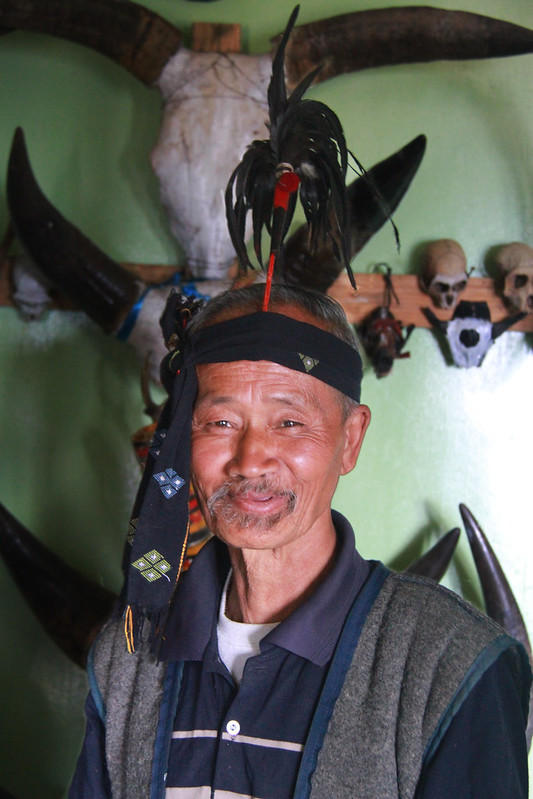
A few years earlier, in Mindat, I had been lucky enough to visit the house-museum of Mister Robert (grandson of a shaman), who told me he owned the most important collection of Chin culture objects. In Hakka, I wandered through the sloping streets looking for the house of Mister Tanguy, who had also gathered an important collection of his own.
Mister Tanguy was sitting in front of his door as if he had been waiting for me. He invited me in, introduced me to his wife and daughter, and then showed me his collection: bows, arrows, drums, ornaments, and countless hunting trophies — skulls and horns turned into totems of a people of animist hunter-gatherers, now Baptists. When it was time to pay for my visit, I took out three thousand kyats. He told me a thousand would be enough.

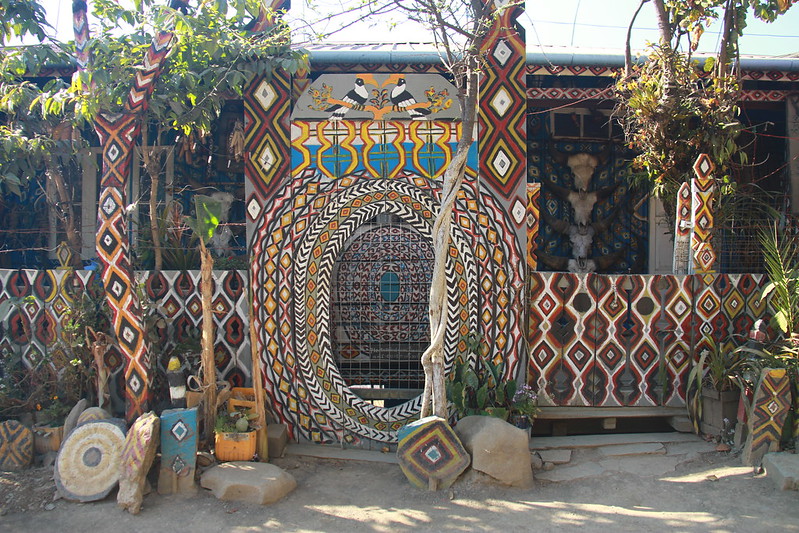


In the evening, singing drew me into a Baptist church where an American pastor had come to preach, his words translated into the local language. I would never have expected to run into an American in this region. And judging by the suspicious look he gave me when I sat down on a chair among the audience, he wasn’t expecting to see a Westerner here either. The singing was beautiful, even if the emotions felt a bit over the top. The sermon, on the other hand, struck me as aggressive, so I slipped away to a restaurant nearby. At my table, several customers soon came to keep me company over beers.
The following Sunday, the whole town shut down for the Lord’s Day — except for one café, where this same evangelist, eyes closed, was asking God to bless his breakfast, carefully avoiding my eyes and ignoring my slightly too innocent « hello. » My cup of coffee, on the other hand, turned out to be the finest blessing of all.
Looking back, I think he believed I was a missionary too, from a different church, and saw me as competition. When I think about it now, it still makes me laugh.
Along the ridges, toward Falam
Seventy kilometers of pure happiness separate Hakha from Falam — a road running right along the ridge, never fully paved, that I would never attempt during the rainy season. In the village of Ramthlo, I counted three churches for about a hundred people. In front of one of them, singing and lively music pulled me in: inside, two female singers and one male singer were leading the congregation into a kind of trance, with an elderly woman standing in the central aisle, arms wide open. The pastor offered to let me say a few words to the congregation. I admit I found a very diplomatic way to get out of it.
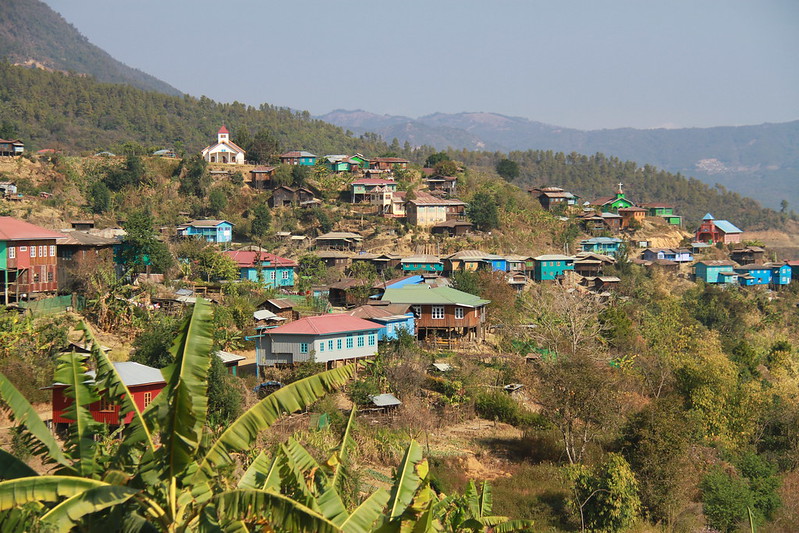

In Falam, I spent almost an hour riding around looking for a place to stay, since the whole town was still in church. I found a very simple room, and my host heated up a basin of hot water so I could wash in the yard that served as a bathroom. Afterward, we sat on the balcony, and he showed me photos of seasonal flowers on his phone. On every door in Chin Country, I noticed, hangs a small sign with the name of the residents and their parish — a detail that matters more than it seems, in a country where people don’t necessarily mix from one church to another.
It was in the late afternoon that I met Suma, a young man who worked for an NGO on family planning in the surrounding villages. He came to join me on the balcony, and we talked for most of the evening. My host, who watched jealously over the safety of his house, came to ask him who he was, and especially which church he belonged to. Suma didn’t belong to the same parish: a polite mistrust settled in between the two of them.
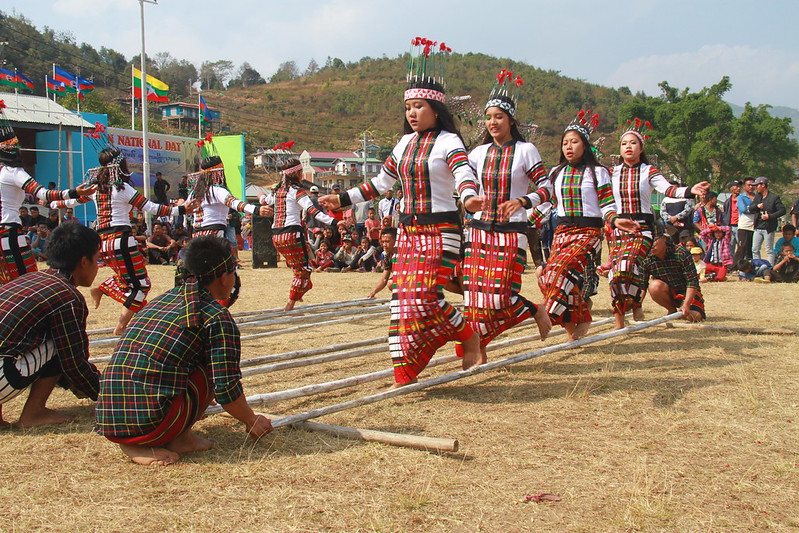
Then it was time to go back down to the main square, at the bottom of town, where the first evening of the Chin National Day celebrations was about to begin: my host was already waiting for us there, impatient, since his daughter was going to dance the famous bamboo dance.

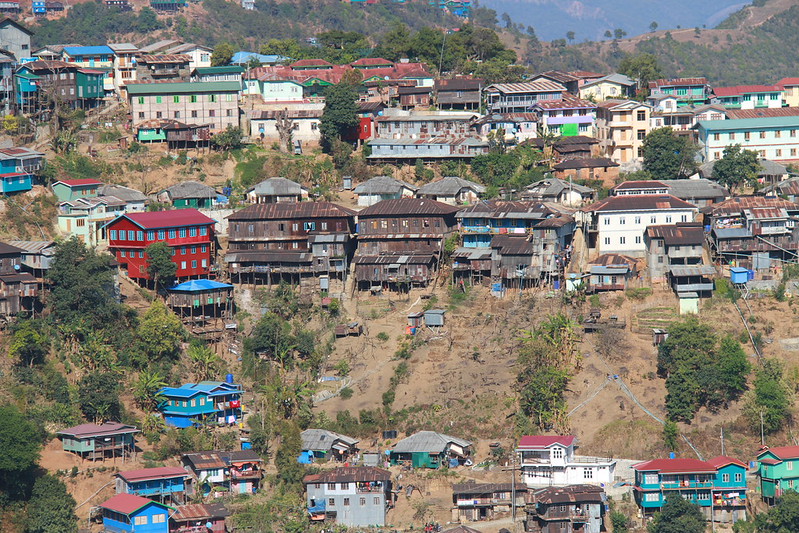
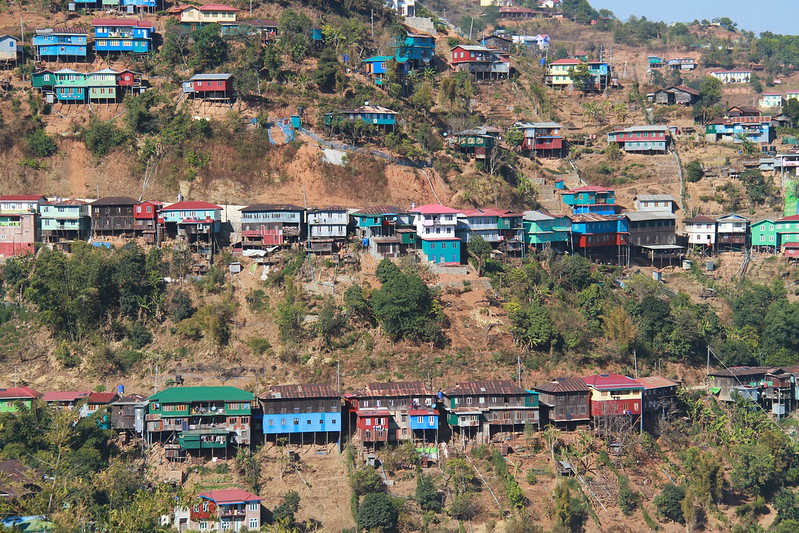
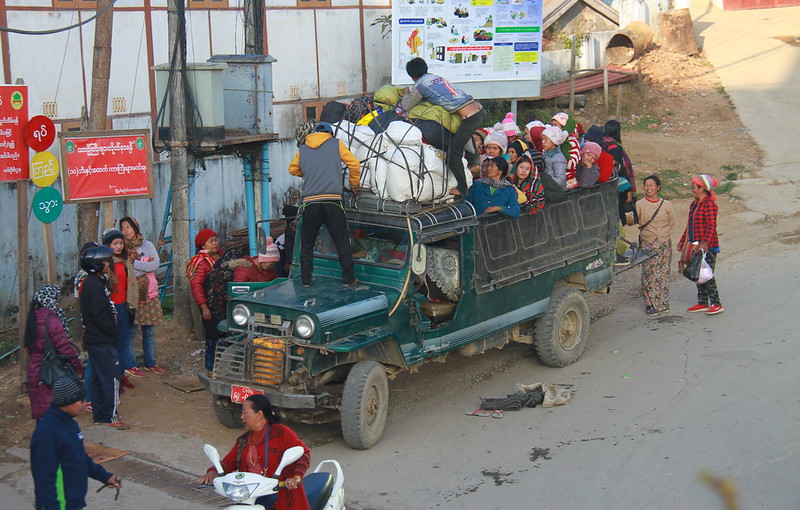
It was Suma who suggested I go down and see the village of Taisun, twelve kilometers away — a rocky track dropping down the mountain that left my wrists aching from constant braking. Founded in the 15th century, the village once had five hundred houses; only a hundred and twenty are left, exile having done the rest. Along the roads, I had noticed large standing stones that I had mistaken for graves: they are in fact memorial steles, on which the name and life of the deceased are carved, with no worship or ceremony attached — simply so that the memory does not fade.



On Monday evening, I met up with Suma again, and he took me up to the top of Falam, where a small Buddhist temple, built by the Burmese, looks over the town. « To mark a Buddhist presence in these Christian mountains, » he explained. I noticed the irony of it: this temple, a symbol of Burmese power, stands on a hilltop, while Chin culture respects the high places without putting up monuments on them. « No one ever comes to feed the monks who live there, » Suma added. « For them, living here is a punishment. »
We sat up there in the dark, completely alone: it never occurred to the people of Falam to climb up here and watch the lights of the town scattered across the mountainside. There was something magical about that moment, two outsiders sitting on top of a Chin hill, lost in the night under the stars, as if the world had no more limits.

The road gets tougher, toward Teddim
After Falam, the track showed its other side. The last twenty kilometers were buried in dust, my motorbike bouncing over the stones of a road drowned in powder, taking me two hours to get through, under the threat of a storm that, luckily, never broke. I arrived in Teddim covered in a thick layer of brown dust, just in time for a late bowl of soup. At the next table, a father and his two sons were talking with what sounded to me like a Burmese accent — proud of my amateur linguist’s ear, I asked them where they were from. From here, the son answered, in perfect English. My career as a linguist ended as fast as it had begun. Still, he added, the ZoMi and MiZo clans live in Teddim, and their language has nothing to do with the one spoken in Hakka or Falam. Phew — at least I had managed to notice that their language was different from the ones I had heard so far, so my talent for linguistics still had a future.

Rih, on the edge of India
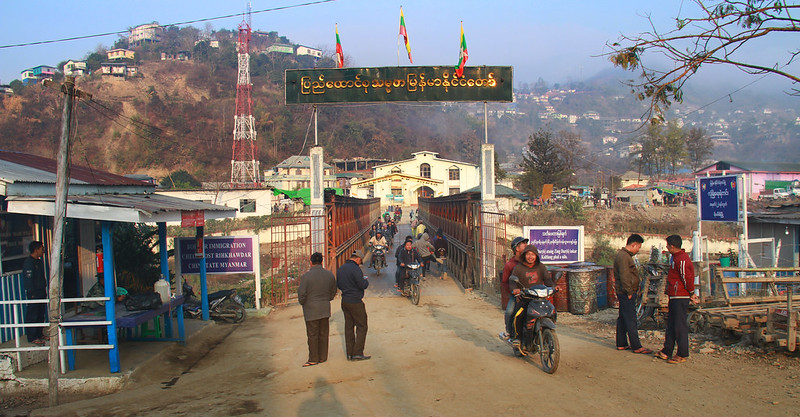
The hardest road I have ever ridden. Thirty kilometers of rocky track dropping down one hill and climbing back up the next, and more than three hours later, I reached Rih’khawdar, a border town beside a simple stream separating Myanmar from India. The border closed at 6 p.m., but that didn’t stop Indian workers from jumping over the barriers to get back home. I was drinking a beer at the bar next door with the customs officer, and we raised our glasses together while watching the border crossers go back and forth. At the guesthouse, I made friends with Burmese traders of Indian descent who exchange Burmese cashew nuts for Indian cigarettes and alcohol, preferring this loose border to the one at Tamu, further north, which is more closely watched.
This line of water, which officially kept me from going any further, has nothing ancient about it: placing the border here was a British invention. It split the Mizo people (or Zomi — mi meaning the people, zo meaning the mountain) in two, between India and Myanmar, following the flow of the water rather than the people themselves. On one side, the Indian state of Mizoram; on the other, clans who would later join their mountain neighbors to form Chin State.



The Unity Festival
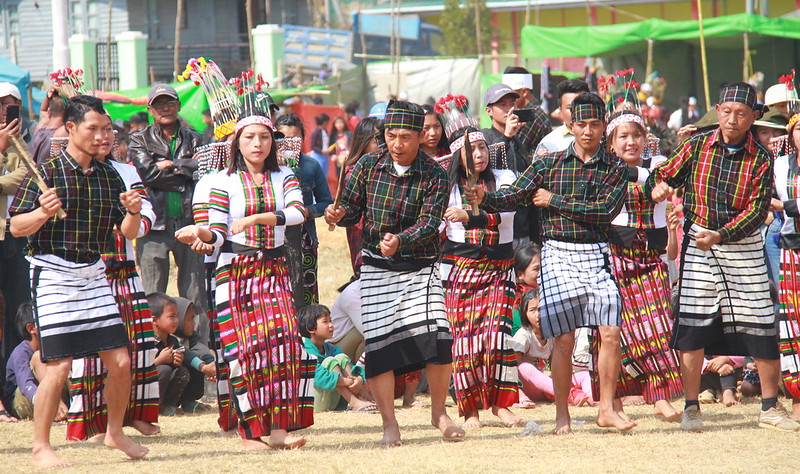
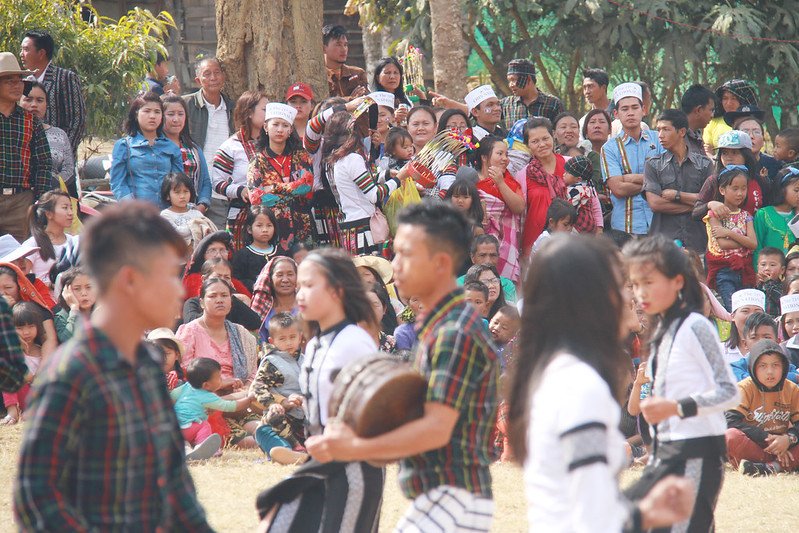
On February 20, the anniversary of this 1948 union, I attended the festivities by Lake Rih. I quickly realized I was mostly the main attraction myself: the only foreigner for miles around, asked again and again to pose for photos with everyone. I did manage to use my « deep respect for their culture » as an excuse to escape trying on a traditional costume.
The dances, though, told the whole story: gestures borrowed from farming or from tiger hunting, circles turning around an animal-dancer to the sound of gunshots, and the pride of the Mizo people, the bamboo dance.
I got back on the road toward Teddim, then toward the Kalay plain, where milder temperatures were waiting for me. The little monkey in my head had finally gone quiet — replaced by the memory of an angel in Gangaw, a collector in Hakka, a song in Ramthlo, a beer shared at the border. The fear hadn’t disappeared along the way. It had simply turned into stories.
Text and memories © Frédéric Alix, February 2019, Chin State, Myanmar.
Cultural Notes: Who Are the Chin?
People talk about the Chin as if they were one people, but they are really a federation of clans that history brought together under a single name.
About ten different languages are still spoken there today, different enough from each other that someone from Hakha and someone from Teddim cannot understand each other right away — something I found out myself when I mistook a Mizo man from Teddim for a Burmese man.
The word « Zo, » found in Zomi or Mizo, means mountain; « mi » means people: literally, the people of the heights. Yet the Zo only represent a part of the Chin state’s diversity. The others include the Asho, K’Cho, Daai, Mara, and Matu, each with their own languages, traditions, and histories, bound together by geography and circumstance rather than a single shared identity.
This shared identity only formed late, under the combined pressure of geographic isolation, British colonization, and Christian evangelization. Christianity, brought by American missionaries at the end of the 19th century, reshaped the religious map deeply: Baptist in the north, around Hakha and Falam, Catholic in the south, around Mindat and Kanpetlet — a form of Christianity layered on top of, rather than replacing, an older animist base that can still be seen in spirit worship, hunting trophies, and the memorial stones raised for the dead.
The border that separates Myanmar from India today, at Rih, was never drawn by the Chin people themselves: it is a legacy of British administration, which followed the direction of the rivers rather than the families living there, splitting the Mizo of the Indian state of Mizoram from their Zomi cousins who stayed in Myanmar.
I have never been to the Indian side of this border; I have only read that it was not easy for the Mizo to fit into a modern India that is mostly Hindu and fairly strict. A little further north, a similar story plays out with the Indian state of Nagaland, also split between India and Myanmar — as if this whole border had been drawn without much thought for the people living on either side of it. This is why, every February 20, this « Unity Festival » does not so much celebrate an ancient nation as a recent — and still partial — political reconciliation, since it stops right at the border.


Historical Notes: Key Dates in Chin History
- Before the 14th century — The Chin Hills stayed largely outside the major Burmese kingdoms; the chronicles of the Bagan kingdom (849–1287) say almost nothing about them.
- 14th century — Burmese kings claim authority over the region but leave it largely self-governing, since they cannot really control it.
- 1885 — The British annex Burma; the Chin Hills are attached to the Arakan division, and Mount Khonumtung is renamed « Mount Victoria. »
- 1890 — The first American missionaries begin evangelizing the Chin clans, who will end up permanently split between Baptists and Catholics.
- 1947 — At the Panglong Conference, which prepares the way for Burmese independence, the Chin delegates do not ask for an autonomous state, unlike the Shan or the Kachin.
- 1948 — Independence of the Union of Burma. A « Chin Hills Special Division » is created, separated from Arakan; the same year, the border drawn with India splits the Mizo from the Zomi.
- 1960s — The Ne Win government bans the traditional facial tattooing of Chin women by law, in the name of modernizing the country.
- 1974 — Official birth of Chin State, with Hakha as its capital.
- Until 2016 — Foreigners can only visit Chin State with a special permit and under the escort of an official guide.
- Since 2016 — The region opens up to independent travelers; the roads, however, remain what they have always been.
Thank you for reading this far.
Before we part, I’d like to leave you with a promise: two more stories from the Chin world are coming soon.
- First, the mysterious women with tattooed faces, whose inked skin carries centuries of identity and resistance.
- Then, the Bamboo Dance, a mesmerizing ritual where rhythm and tradition weave together in perfect harmony.


Laisser un commentaire