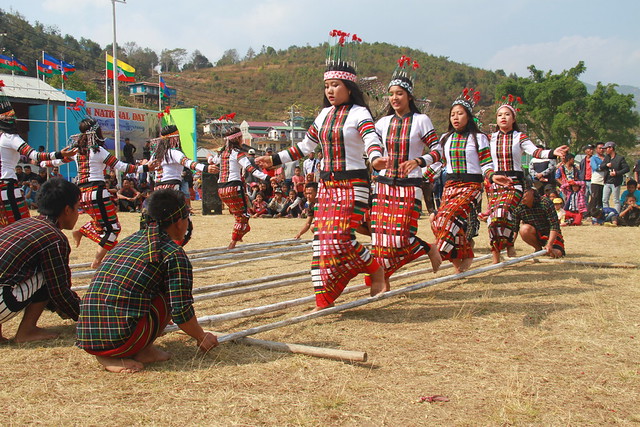
Two percussionists open and close a pair of bamboo poles by striking them together in rhythm. A dancer hops over these moving poles. This is the basic form of the Bamboo Dance, the pride of the Mizo people.
The Bamboo Dance is sometimes said to have been invented by Spanish colonists in the Philippines, although there is no evidence to support this claim. In the Philippines, it is known as Tinikling.
This dance is found in several Asian cultures, particularly among the Mizo people, who live in the highlands between the Indian state of Mizoram and Chin State in Myanmar.
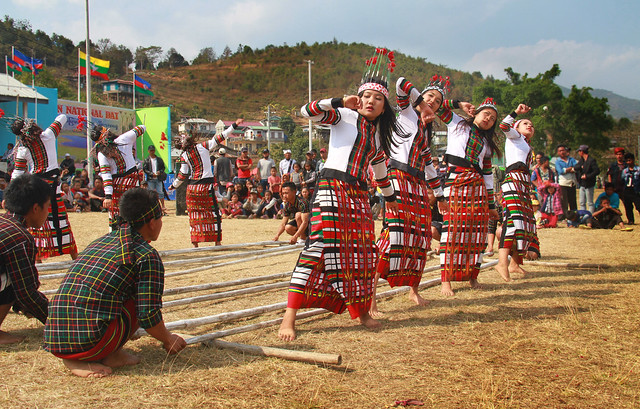
Among the Mizo, there are not just one but four pairs of bamboo poles, operated on the ground by eight percussionists. The dancers perform in two groups of four. According to Mizo tradition, the dance even dates back to the first century CE, a deeply rooted belief, although no formal evidence confirms it.
A Hypnotic Choreography
Visually, Cheraw is a dance in which boys sit facing one another on the ground, each holding two long bamboo poles. In front of them, another bamboo pole lies horizontally on the ground. They strike their poles against the one on the ground to produce a deep sound, then clap them together in the air to create a sharper, higher-pitched sound.
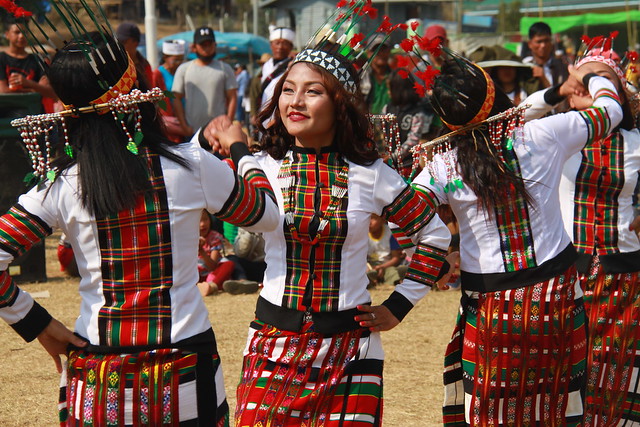
The poles open and close rhythmically, creating a musical pattern. The girls, dressed in traditional costumes, jump and glide between the open poles, then step over them as they close. As the dance progresses, the rhythm accelerates, testing both the agility of the dancers and the precision of the percussionists. The hollow, dry bamboo poles are carefully selected for their perfect resonance.
A Rite of Passage from Death to Rebirth
Cheraw was originally performed during funerals or memorial ceremonies for the deceased. It may have symbolized the soul’s passage into the afterlife or a form of spiritual rebirth, in harmony with the animist beliefs of the Mizo tribes. These rituals were intended to honor the ancestors and facilitate their transition into another world.
The dance was also associated with agricultural cycles. Cheraw could celebrate the rebirth of nature after a period of rest, such as the end of the rainy season or the beginning of sowing, marking renewal and expressing gratitude to the earth and its protective spirits.
With the arrival of Christianity and modernization, these rituals gradually evolved into a more festive tradition, becoming part of cultural celebrations such as Chapchar Kut. Nevertheless, their essential values—unity, respect for natural cycles, and spiritual connection—remain at the heart of Cheraw.
My video among the Mizo (click to watch)
A Living Heritage
Cheraw is an integral part of Mizo cultural heritage.
On 12 March 2010, in Aizawl, Mizoram, 10,732 dancers and percussionists took part in the largest bamboo dance ever performed, earning a place in the Guinness World Records.
Within this captivating rhythm, the sound of the bamboo poles clapped together in the air is higher-pitched than that of the poles struck against the ground. The dancers do not even need to look down—they can hear whether the poles are open or closed.
Gongs, drums, and xylophones accompany the music. Cheraw is performed during festivals, and its movements imitate birds or trees swaying in the wind.

My Experience
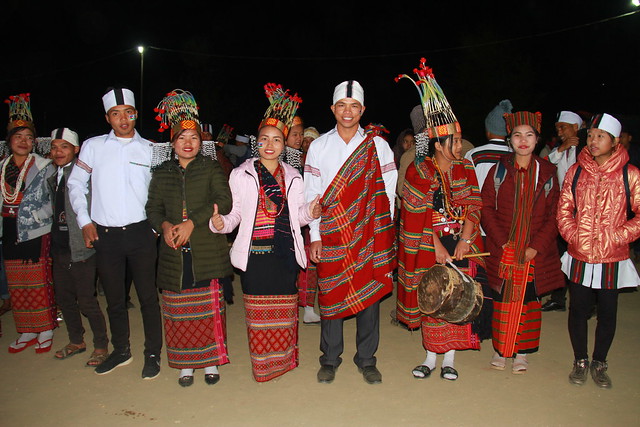
I had the opportunity to watch Cheraw twice in 2019 during Chin National Day, celebrated every 20 February in this mountainous state in northwestern Myanmar.
I filmed the first video in Rih-khwadar, only a few hundred metres from the India – Myanmar border. This is where the Mizo people live, a community arbitrarily divided by a border drawn by the British in the nineteenth century.

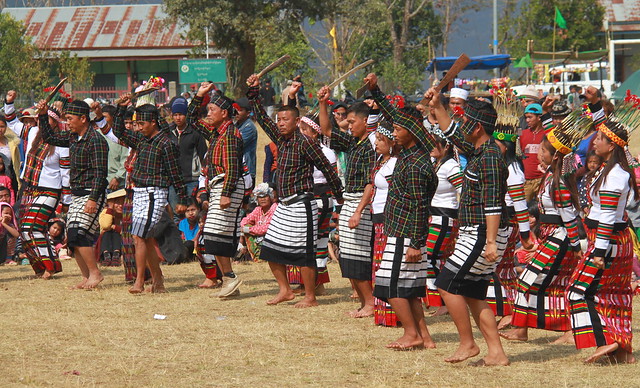
The second video was filmed in Falam two days earlier.
The Falam Chin are not part of the Mizo people, but they also perform their own version of this dance. Although the principle is exactly the same—four pairs of bamboo poles struck by eight percussionists, above which two groups of four dancers perform—the rhythm is completely different and is accompanied by singing.
The Bamboo Dance among the Falam (click to watch)
Another variation crosses the bamboo poles to form a moving grid on the ground. The dancers hop around in circles within this checkerboard pattern.
Generally, the roles are divided between men, who strike the rhythm, and women, who dance. Occasionally, however, a man joins the dancers.
No Single Inventor, but Multiple Origins
The Bamboo Dance appears to be an indigenous tradition that developed in agrarian societies, where bamboo symbolizes resilience and collective harmony. Its presence across different cultures can be explained either by ancient cultural exchanges or by parallel development in societies sharing similar environments and ritual practices.
The Bamboo Dance has no single inventor. It emerged in several Asian cultures, from the Tinikling of the Philippines to the Cheraw of Mizoram, as well as among the Karen of Myanmar and Thailand, where it is often associated with agricultural or funerary rituals.
In the Philippines, a Spanish colonial origin is sometimes suggested, but this hypothesis remains debated and unproven.
The Mizo claim that the dance dates back to the first century CE and symbolizes the passage between life and death.
Its widespread presence suggests that it arose independently in several regions rather than being the result of a single centralized invention.
Text, photographs, and videos by Frédéric Alix, February 2019, Falam and Rih-khwadar, Chin State, Myanmar.
As always, this article remains open to further contributions. If you have documents or information that could enrich my research, I would be delighted to hear from you.
I hope to have the opportunity to witness more Bamboo Dances in the future and to share them with you here.
The first version of this article was published here in 2019. It is one of three articles about the Chin people, alongside the story of my solo motorcycle journey through Chin State and an article about the Chin tattooed women.
BIBLIOGRAPHY
- Wikipedia, article « Cheraw (dance) »
https://en.wikipedia.org/wiki/Cheraw_(dance)
- Wikipedia, article « Tinikling » (Philippines)
https://en.wikipedia.org/wiki/Tinikling
- Humans of Northeast India (humansofnortheast.com)
https://humansofnortheast.com/bamboo-dance-cheraw-traditional-dance-of-mizoram/


Laisser un commentaire