I’m continuing my little investigation into the female spirits of northern Thailand. This time it is the shrine of Mae Nang Kaeo, on the mountain pass between Chiang Mai and Chiang Rai, between Doi Khun Lao and Doi Mae Tho, where the road crosses the ridge (a Thai collection of northern legends confirms this is the place where the story ends).
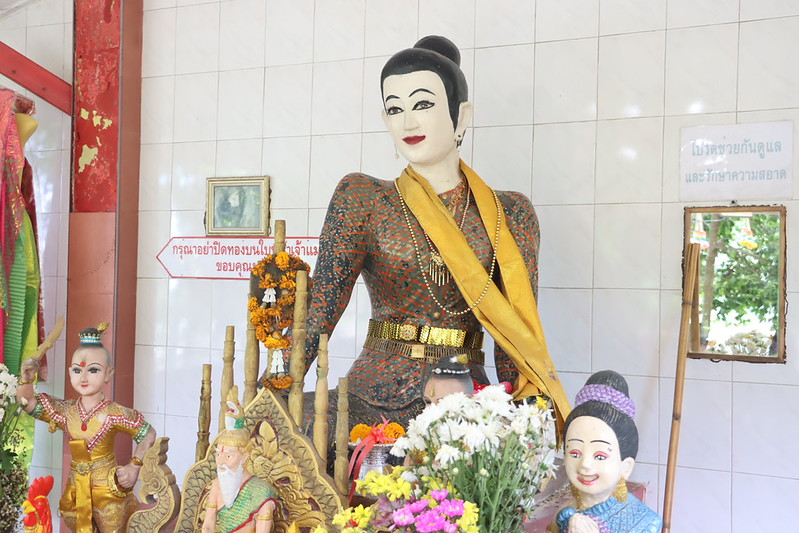
The Legend
The legend tells of a girl from Kengtung, the great Tai Khün city in what is now the Shan State of Myanmar. She fell in love with a merchant who had come from Chiang Mai. Before going back home, he promised her he would return the next year to marry her and take her to Chiang Mai. Not long after, she found herself pregnant (Ghostwiki, 2012).
But there are other versions, and they are darker. In one, the merchant was already married, and he had never intended to come back and marry her. When he learned that the girl was on her way to Chiang Mai, he asked his men to « take care of her », and she died murdered on the mountain pass.In another version still, the man was not a merchant at all, but a handsome Buddhist monk who left the monkhood and became her lover. In every version, the ending is the same: she died on this ridge, between the two cities, and her spirit stayed there. That is why the mountain took her name, Doi Nang Kaeo, and why her shrine stands there today. (Ghostwiki, 2012)
According to the Thailand Cultural Encyclopedia (ฐานข้อมูลสารานุกรมวัฒนธรรมไทย), Nang Kaeo’s family had come from Chiang Tung (Kengtung) to settle in Chiang Rai during the reign of King Mengrai. This is the only reference to a historical period that I have been able to find.
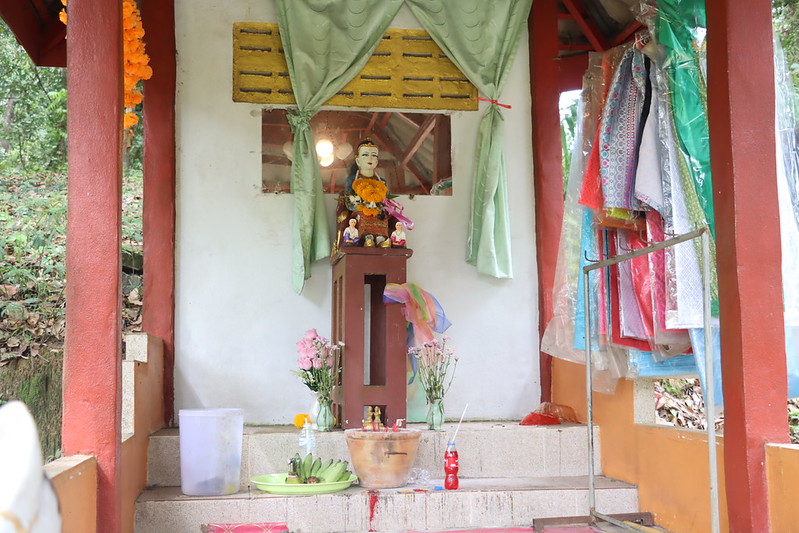
A Lanna Story
A girl from Kengtung, a lover from Chiang Mai, the legend itself is a memory of the old Lanna world.
But the two lovers were not from the same people. The Tai Khün of Kengtung are a subgroup of the Tai Yai, the Shan. The Tai Yuan of Chiang Mai are the Tai who settled in the valleys of Lanna and mixed with the indigenous Lawa (Wikipedia). So the legend of Nang Kaeo is also the story of two branches of the Lanna world meeting, loving, and failing each other, on the watershed between their two cities.
What I saw there.
Around the shrine, the big trees have been « ordained », buat ton mai, the Buddhist ordination of trees. Monks wrap saffron robes around the trunks and chant over them, so that the trees become « monks » and cannot be cut. This Buddhist ordination is itself a religious syncretism: the spirit cults were there before. The guardian spirits of the communities have their trees wrapped in cloths of all colours, these cloths symbolise nature, but here is a monk’s robe.
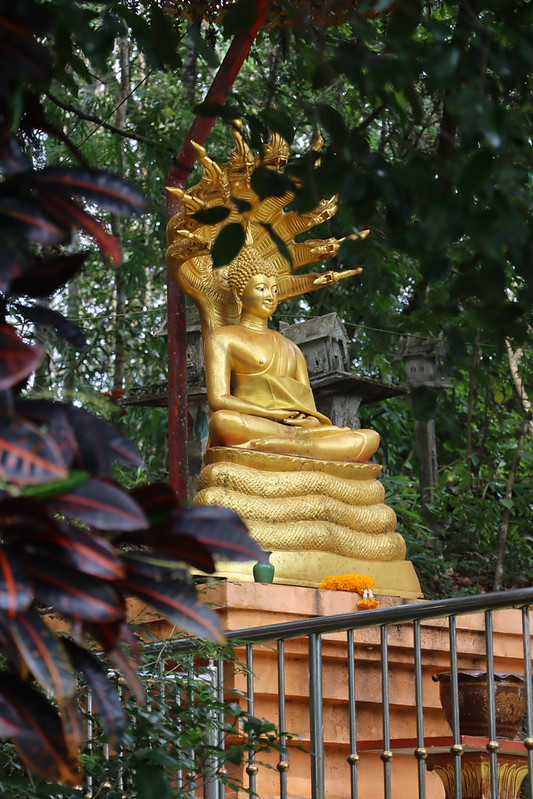
There is also a statue of the Buddha, set slightly back from the shrine itself. Its role, I think, is to reassure the visitors who come to honour the spirits but who also fear them: the presence of the Buddha, the Compassionate, is there to remind the spirit not to play any bad tricks.
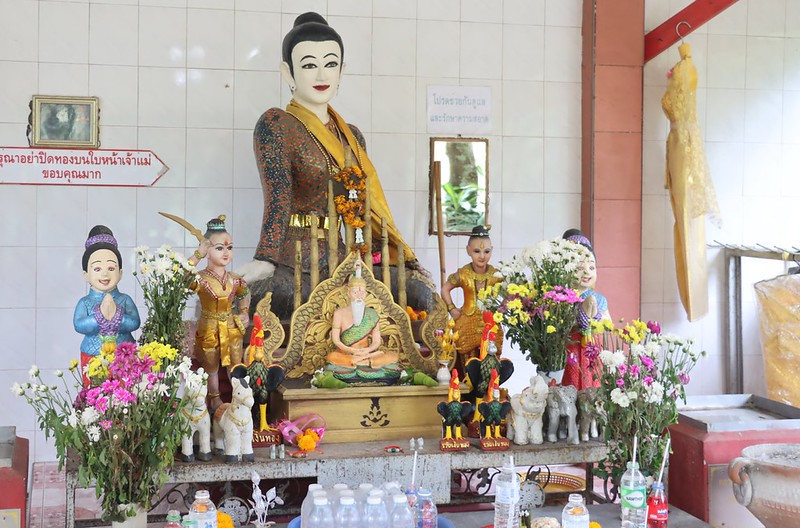
I saw travellers stop their cars and trucks to pray at the shrine and ask protection for the road. Drivers also honk as they pass, the simplest mark of respect.
A few hundred metres higher up the road, three chedis stand in the forest. I don’t know whether their presence has anything to do with Chao Mae Nang Kaeo. I will keep asking.
The Case of the Red Phalluses
And I saw the red phalluses. At first I thought they were linga. But a linga always has its female counterpart, the yoni, the receptacle at its base. These had only the male symbol. They are offerings of fertility and vital power to the female spirit, the colour red for blood and life. It reminded me of the phalluses I saw in Bhutan, painted on the walls of houses and hung in the temples of the « Divine Madman » Drukpa Kunley: there, they protect the house from slander and bring fertility. Same symbol, same logic, the phallus as a guardian and a giver of life, standing guard at the door of the spirits.

I later found that the phalluses had been documented before.
The version of the legend given in the Thailand Cultural Encyclopedia adds a last scene, and it explains everything. Exhausted and ill, Nang Kaeo collapses beside a spring and dies. But before dying, she shapes a vulva in the mud where the water emerges, and she demands that every man who uses the spring leave a phallic offering. Those who refuse, the story warns, risk misfortune. So in this version, the red phalluses are not an offering that devotees invented later, they are her own demand, made at the very moment of her death.
Yet the same article records a later chapter. In 1977 and 1979, members of the Tai Yai (Shan) community protested against the phallic offerings, which they considered degrading to Shan women. In 1979, local authorities and Buddhist clergy from the two districts discussed the issue and decided to redirect the cult towards Buddhist devotion. It would be from that time that the Buddha statue dates, installed near the spring to watch over the spirit, the image known as Phra Phuttharup Si Song Mueang, and the new shrine formally inaugurated in 1980.
There are still several questions I have not been able to answer.
Who takes care of the shrine today? Who places the red phalluses there today, and have any of them been removed recently? A photograph published in Matichon Weekly shows more phalluses than I saw during my visits in August and October 2026. And what about the three chedis standing further up the road, in the forest? Are they connected to Mae Nang Kaeo, the remains of an old temple, or part of another tradition?
If you know this place, have visited it, or have any leads that might help answer these questions, I would be very interested to hear from you.
Once again, I leave the place with more questions than certainties.

My view, for what it’s worth.
With Nang Kaeo, we have one more legend of a woman who died as a martyr, a pattern we find in the « Nats » of Burma, (and in many saints of Christendom). And here is the striking thing: in Lanna, most of these powerful spirits are women. They are feared, they are honoured, they are negotiated with. The story of Nang Kaeo is a Lanna story in the broad sense, history places it in the Lanna era. But what history has blended together, I believe, is older than Lanna: the spirits are the legacy of the Lawa, the people who lived in this region before its Buddhicisation. So I would place this tale, whose plot history sets in Lanna times, alongside the stories of the great Lawa spirits : Phu Sae and Ya Sae. Same family, same age-old layer of the land.
text and photos ©Frédéric Alix, 2026
BIBLIO
Watakan. (2012, 12 janvier). ตำนานเจ้าแม่นางแก้ว, ตำนานดอยนางแก้ว [Légende de Chao Mae Nang Kaeo, légende de Doi Nang Kaeo]. GhostWiki ผีไทยพื้นบ้าน.
https://ghostwiki.blogspot.com/2012/01/blog-post_7000.html
Sukkhata, P. (2018, 22 février). “ล้านนาศึกษา” ใน “ไทศึกษา” ครั้งที่ 13 (19) เจ้าแม่แห่งล้านนา จาก “นางแก้ว” ถึง “จามเทวี” [Études du Lanna dans les études tai, 13e conférence (19) : Les déesses du Lanna, de Nang Kaeo à Chamadevi]. Matichon Weekly.
‘ณัฐชา’ ชี้ข่าวลือรัฐประหาร สะท้อนความกลัวของกองทัพ แนะคิดดีๆ ก่อนยึดอำนาจ เพราะ ปชช.ไม่เหมือนเดิมอีกต่อไป
Thailand Cultural Encyclopedia. (s. d.). [Entrée consacrée à Doi Nang Kaeo].
https://db.sac.or.th/thailand-cultural-encyclopedia/detail.php?id=26912


Votre commentaire