Wednesday, September 30, 2026. The weather is uncertain. Rather than walking in the forest, I decide to walk through the villages near Saraphee. I take my motorcycle and head to my first stop: Wat Don Chan. This is my field journal.
Wat Don Chan
Wat Don Chan is known as a place that welcomes and educates disadvantaged children. Since the 1980s, the temple has been developed for this purpose by its former abbot, Phra Khru Pramote Prachanukoon.
I wanted to learn about its social work. But as soon as I arrived, something completely different caught my attention.
The entrance

The entrance is not guarded by the traditional singha lions, but by ten-meter-tall giants with elephant heads: the khotchasī (คชสีห์), a combination of the Thai words for “elephant” and “lion.” This Hindu mythological creature is neither Ganesha nor Erawan. It combines the strength and courage of the lion with the power, stability, and majesty of the elephant. It is an extraordinary guardian, belonging to no established local tradition, yet not entirely unique.
Rahu

Then my attention was drawn to the statues of Rahu, the giant who devours everything. According to legend, the Sun and the Moon betrayed him after he drank the nectar of immortality. Vishnu beheaded him, but his immortal head has taken revenge ever since by swallowing the stars, causing eclipses. Curiously, this purely Hindu figure, absent from the Buddhist canon, is everywhere in the temples of the region.
Ganesha’s cleaning
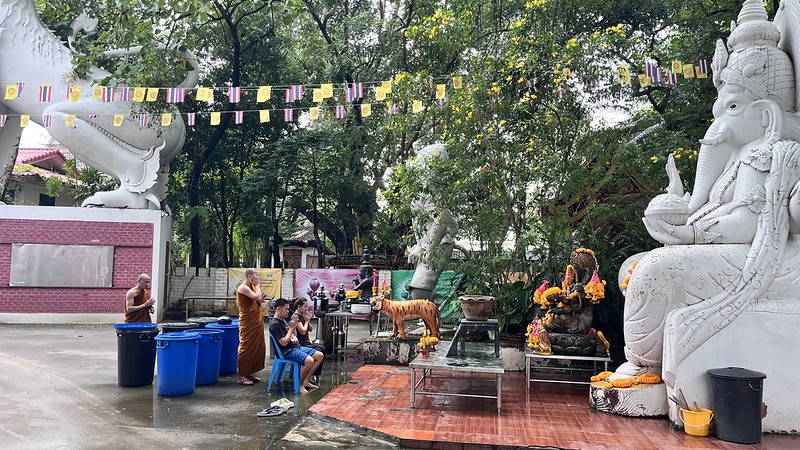
I noticed blue barrels filled with water, behind two plastic chairs facing giant images of Ganesha, two or three meters high. I did not have to wait long: a couple sat down, and two monks began chanting. One of them then took a bucket and poured several containers of water over the couple for a full minute. They stood up completely soaked. It was probably a purification ritual before Ganesha, the Hindu god of wisdom, who removes obstacles and protects people from misfortune. I could not find a name for this sacred-water bath before Pra Phi Ganet’ (Ganesha). Although it is reminiscent of Songkran, the Buddhist New Year, this was not a community ritual linked to the calendar, but a personal act.
Dying in order to be reborn
My surprises were only beginning. As I approached the Viharn, the building where visitors can pray and meet the monks, I saw five red cloths covering bodies lying on the ground. The red color reassured me a little. If the shrouds had been white, I would have thought the bodies were really dead. Still, I made sure they were breathing before I started filming. Four monks were chanting, seated at the four corners of these people pretending to be dead.


The four monks handled cloths covered with sacred inscriptions and drawings. They were probably pha yan (ผ้ายันต์), talismanic cloths bearing yantra, protective formulas, and diagrams. The monks held them and moved them around the participants, sometimes in one direction and sometimes in the other.
I spoke with a young woman who was waiting for her turn in the ritual. She explained that it was about “washing away her bad luck.” Several other people I asked confirmed that laying someone down like a corpse represents a symbolic death: the death of an earlier period of bad luck, illness, or difficulty. When the person gets up, they are symbolically reborn in a new condition.
This ritual seems to belong to the family of Sado Kroh (สะเดาะเคราะห์) ceremonies, which are meant to drive away bad luck, and Sib Chata (สืบชะตา) ceremonies, which are meant to renew or extend a person’s destiny. In the Lanna tradition, Sib Chata is associated with protection, long life, and restoring threatened vital energy.
Some rituals in other temples go even further: participants are placed in real coffins.
After rising from this symbolic death, the “newly reborn” people sat in front of the Buddha statues. They placed white cotton threads on their heads. The threads were connected to one another and attached to the central image of the Buddha. This is sai sin, the sacred ritual thread. This part of the ceremony belongs to the Lanna rite of Sib Chata, or the renewal of destiny. The thread symbolically connected the newly reborn people to the Buddha, the monks, and the protective power of the prayers. After leaving their old condition behind, they were placed again within a network of blessing and protection.

A female spirit in the temple
My visit was not over. Under a large roof, about a hundred statues were displayed like a dusty museum. To enter this hall, I had to pass an old monk who pretended not to notice me. Farther inside, three girls were sitting in front of another old monk and seemed to be telling him about the problems in their lives.

I became interested in the statues—there were four representations—of a female spirit called Phra Mae Chao Sikhī (พระแม่เจ้าสิขี). I had never heard her name, and nobody has been able to tell me about her since. She seems to be unknown. However, the sign in front of her statues, which displayed her mantra, described her as a very powerful spirit. Phra Mae Chao Sikhī is said to be able to take many forms and grant wishes. The text recommends offering a pig, a chicken, a duck, or a fish, as well as five flowers, if a wish comes true.


Female spirits are very common in Lanna culture. However, their presence inside a Buddhist temple is rare. They are often connected with forest legends, and their shrines are more commonly found in caves, near springs, or beside sacred trees. But here, she has found a place at the heart of the temple.
During the less than an hour I spent at this temple, I did not see anyone worshipping this spirit.
In the end, I had come to learn about the temple’s work with orphans and disadvantaged children, but I saw no orphans and read nothing about this work. Instead, I witnessed rituals that, although connected to Buddhism, do not come directly from the Buddha’s teachings.
My impression is that Wat Don Chan serves as a sanctuary for orphaned gods and rituals.
East Saraphee
I continued toward the villages farther south. I parked my motorcycle in front of Wat Sri Kham Chomphu and continued my visits on foot, walking about ten kilometers through the different villages.

I visited Wat Sri Kham Chomphu, Wat Suphan, and Wat Chaiya Sathan, and stopped in front of several sacred trees.
A spirit shrine inside the temple
I was surprised to discover that the shrines called Ho Suea Wat (หอเสื้อวัด) were located inside the temple grounds.
I thought that spirits attached to the land had to be honored outside the temple walls. What I saw that day showed me that there is no general rule of this kind.

The word Suea (เสื้อ) means neither “clothing” nor “tiger” here. In the Lanna vocabulary, it refers to a power that protects, covers, and watches over a place: the protective spirit. Ho Suea Wat is therefore the shrine of the wat’s guardian spirit.
In pure Buddhism, the worship of spirits is forbidden. Only the Buddha’s teachings offer protection. However, in Lanna, legends tell us that spirits, originating in the local form of ancient animism, converted to Buddhism during a visit by the Buddha himself after his death. Their presence in a shrine—even in a corner of a monastery—is therefore locally accepted.
The community’s guardian spirits
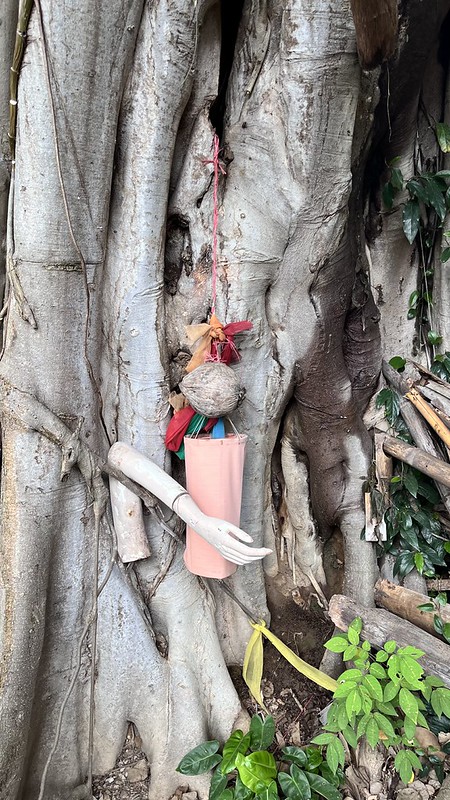
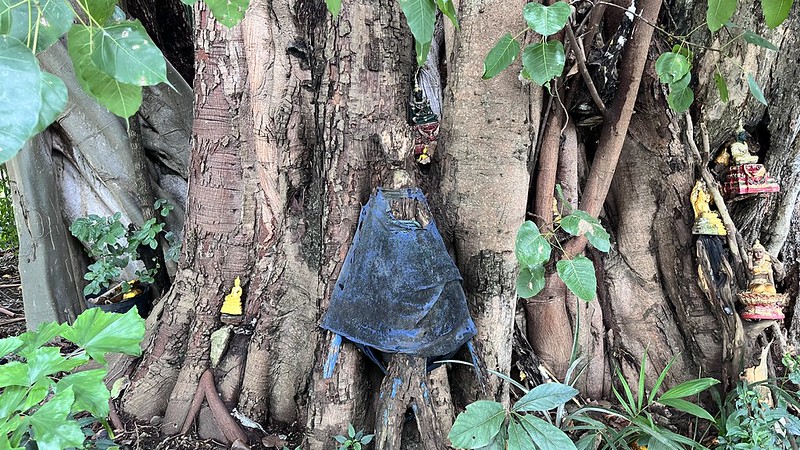
As I crossed the villages, I saw several large trees that were homes for the community spirits. There was no conflict with Buddhism there, because we were outside the temple. At the entrance to Ban Thepharam village (บ้านเทพาราม), I saw the very impressive San chao pho Hung Khao (ศาลเจ้าพ่อฮุ้งขาว). It is the home of a spirit called Hung Khao (ฮุ้งขาว). He is the “protective father,” a title given to a male guardian spirit, a former chief, a local hero, or a protective supernatural power. He protects the entire village. Small Buddha statues had been placed in the tree. And, unusually, Hung Khao has his own statue in the shrine house. Few guardian spirits are actually represented in this way.

It is worth noting that, according to the local information sign, the temple I had left was founded during the time of Wiang Kum Kam, before the founding of Chiang Mai. The temple later disappeared into the vegetation and survived as ruins in the middle of the rice fields.
The story of an ordinary temple
In 1869, the monk Phra Kavila, an herbalist skilled in traditional medicine and certain magical practices, turned this abandoned temple into a retreat for the rainy season. When he returned to lay life, probably to resume his work as an herbalist, he left the temple in the care of his disciple Phra Aphiwong, an ascetic from the forest-monk tradition. These monks traveled from cave to mountain, beyond the borders, searching for wild places suitable for meditation. During one of these pilgrimages, Phra Aphiwong fell ill and died at Doi Phu Pha Pun in Myanmar. His disciple, Phra Khammoon Sittiko, succeeded him and built a real brick viharn. The temple became Wat Sri Kham Chomphu, named after a pink-flowering tree that had been cut down to make room for the new building. In 1958, Phra Ai Surintho became his successor. In addition to beautifying the temple, he worked for the village: building roads, bringing electricity, creating a clinic and a water supply, and building a new school, renamed Wat Sri Kham Chomphu Community School in 1971. So, although this temple is like a thousand others in Lanna, its history, its slightly unconventional form of Buddhism, and its buildings make it a perfect example of a village temple. (summarised from an official explanatory panel inside the temple)


text and photos : ©Frédéric Alix, 2026


Votre commentaire