
I must admit I had doubts when I was invited by Payap’s « Peacebuilders » to join a « homestay » somewhere in the mountains northwest of Chiang Dao. In recent years, several of my Thai friends have gone to the mountains as if on safari, meeting the indigenous hill tribes. They brought back dozens of portraits of themselves dressed in colorful costumes. And when I asked, « But what did you learn from the local people? », the only answers I got were clichés about their naivety and their so-called « authentic » way of life.
But I trusted the Peacebuilders. They wouldn’t fall into the same tourist traps, and besides, Dr. Rey had written ethical guidelines to frame our visit. So I was happy to take part in these two days of immersion in a local community, alongside participants from diverse backgrounds.
Our group included one Thai, four Myanmarese, two Filipinos, two Nagas, one American, one Eritrean, and me, from Switzerland. We left Payap University on Saturday, November 11, 2023, at 9 a.m., made a stop along the way, and arrived at the Lisu village of Khun Khong at 1 p.m.
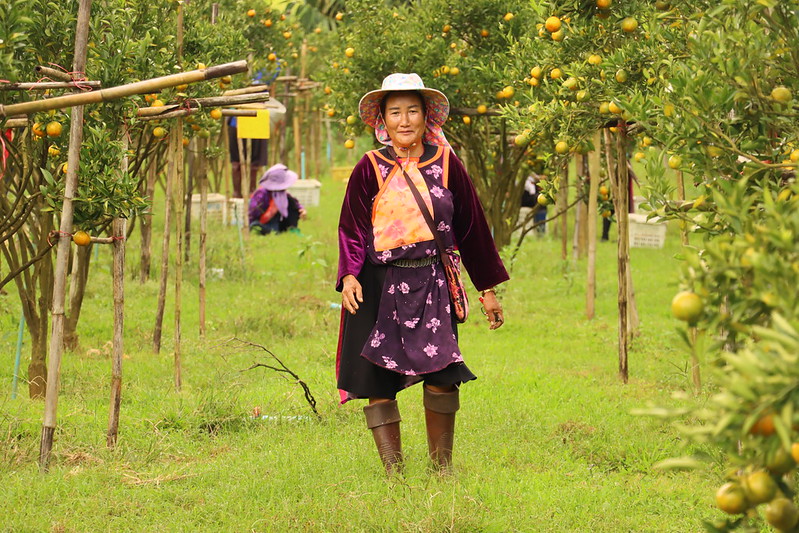
Arrival
The homestay overlooks the Lisu village of Khun Khong (literally, « source of the Kong River »). The village houses are built on the mountain slopes, while the huts for visitors (us) are at the summit, offering the best view. Is this a privilege? I don’t think so: the Lisu people know the mountain protects them from wind and rain. The summit isn’t the safest place in the area. But visitors love the view. The family that developed this homestay even built a road to reach the summit, which wasn’t previously accessible by large vehicles from the village.
P’Koi, the only Thai in our group, receives a warm welcome from P’Noom, our Lisu host. As they exchange respectful words in Thai, P’Noom looks at each of us with a kind gaze and a hint of a smile. He must not often see such a diverse group.
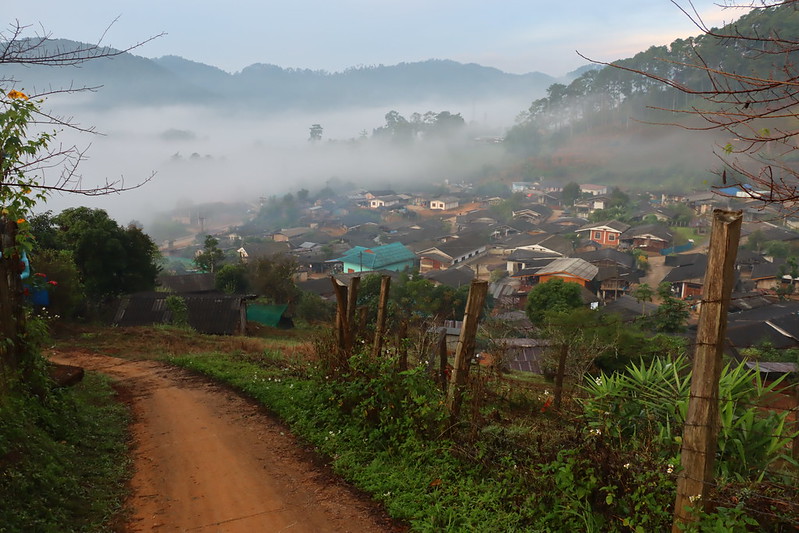

First Impression: Freedom
The air is fresh, filled with the scent of burning wood and damp earth. You can hear children playing, chickens pecking, and, maybe it’s just my imagination, but I think I hear pigs squealing.
My first impression upon arriving « up there on the mountain » in this region inhabited by the Lisu people is a sense of freedom. Here, the rules of the plains and cities seem to have been replaced by the rules of local communities. Life’s rules can be broader when an entire community commits to helping each other. I see children playing alone in the village, no problem, since all the villagers keep a protective eye on them. Chickens roam freely because everyone knows which animal belongs to whom.
Because if the « hill peoples » go down to work in the plains and cities, they know they can return home to find their freedom and a form of security. It’s not me saying this, but James C. Scott in his study Zomia, which I read a few years ago while studying these peoples who live in mountainous regions.
However, since the roads have been improved, paved, and widened, people from the plains now go up to the mountains more easily and quickly. And like colonizers, they want their urban rules and demands to be respected. Some of these weekend tourists demand that farms not be noisy early in the morning (since they’re there to rest). They want paths and facilities to meet city safety standards, and some insist their dietary habits be respected.
Dr. Rey Ty, in the document he gave us before we left, noted: « Show sensitivity to cultural differences and avoid behaviors that might be offensive or disrespectful. Do not impose your own cultural norms as superior, correct, or the best. »


Learning to Visit Without Prejudice
Dr. Rey had given us a clear instruction: to be attentive observers.
« Learn and practice participant observation: immerse yourself in the context, engage discreetly, without disrupting. »
We hadn’t come to the Lisu to teach them the ways of the plains, but to learn from them. So I decided to forget everything I thought I knew about the Lisu and observe this village with fresh eyes: a respectful, humble immersion, centered on listening and learning.

Visiting and Observing
We settle in, and all I want to do is go down to the village and walk around. But I have to wait a bit because our host is taking us to visit a tangerine plantation.
The plantation belongs to a young Lisu villager from the region. He rents the land from the state since it’s inside a national park. The young entrepreneur greets us with a wai and a smile, inviting us to pick tangerines ourselves if we want to buy some.
We start harvesting with our bare hands. I’m not skilled and end up tearing the branches. Then we see the local pickers at work: they use small pruning shears. Several of us watch how they do it, then borrow shears for our own harvest.
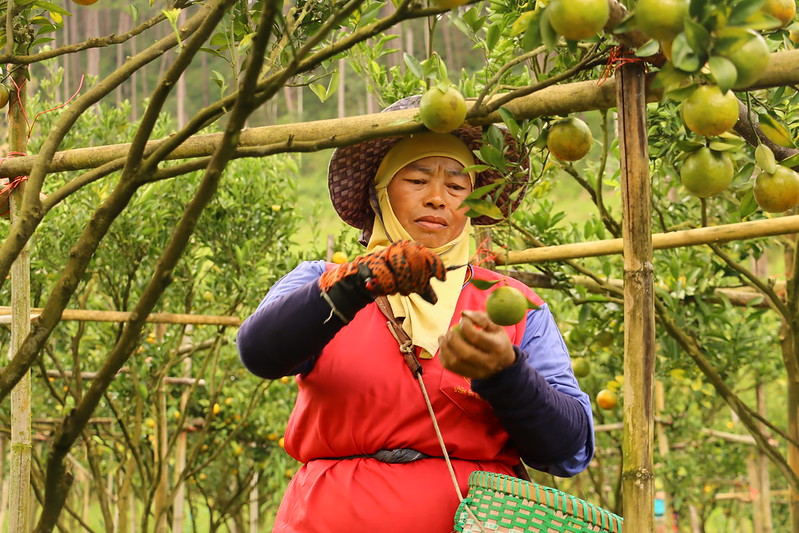
The group of pickers are Lisu women from neighboring villages, with only one man among them. They’re amused to see me walking around with my camera. I hear someone say to the woman I’m photographing, « Your photo will be seen all over the world, » and another adds ironically, « He’s taking your picture because you’re the prettiest. » (I can’t guarantee my translation is perfect, but I don’t think I’m far off.)


Finally, the Village
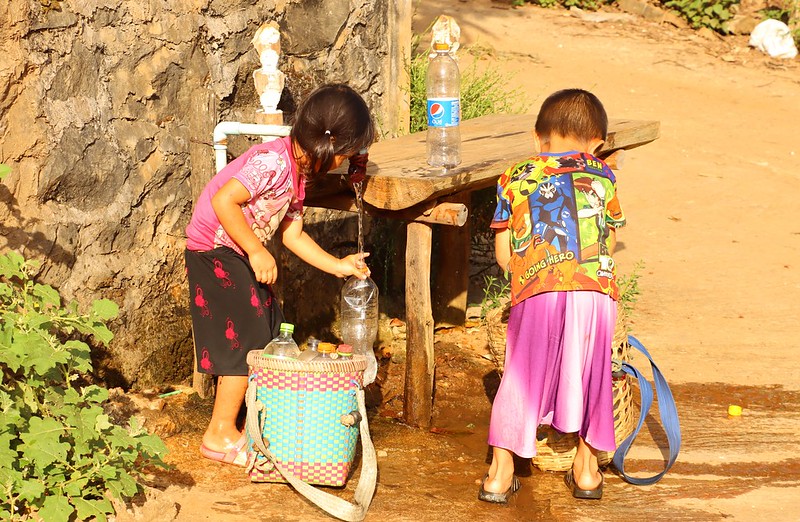
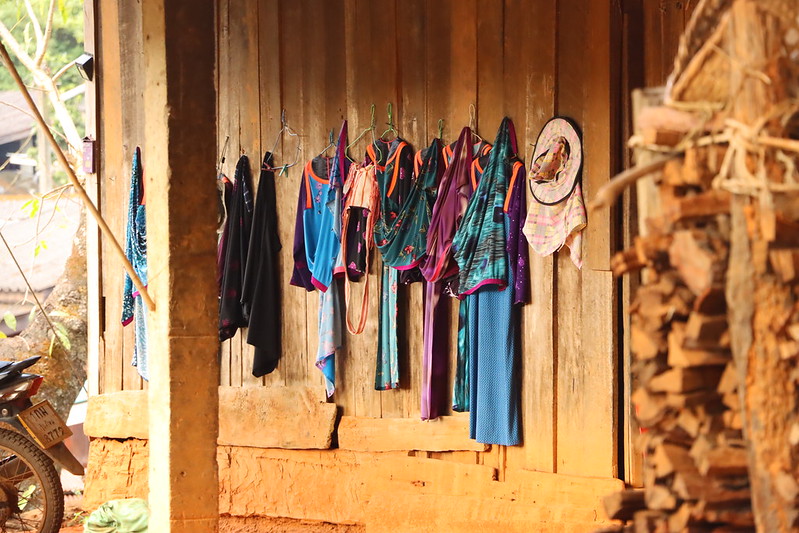
Later, I go down to walk alone in the village. Few people are visible, but I feel observed. The community watches over everyone’s safety, especially when an outsider (like me) walks through. Several houses have pigpens, some have small vegetable gardens, and some dry crops on the front porch. Many houses are made of wood, and several have Chinese symbols on either side of the entrance, a reminder that the Lisu people originated from southern China. Clothes hang on hangers in front of the houses, most in Lisu colors and patterns. I notice two children filling plastic bottles at a community tap, and I realize not all houses are connected to running water.


Supporting the Local Economy

Dr. Rey reminded us that our stay was also about contributing to the local economy of the villages we visited. The program included several opportunities to support small businesses and local initiatives: markets, grocery stores, and even the organic café run by young villagers. The goal, clearly stated in his orientation, was to increase economic opportunities and livelihoods for the local community.
Yet, it was a simple scene in the village grocery store that marked me the most. As we lingered in the shop, I saw a villager approach, pretending to want to buy something. But his attention was clearly on our group. He watched us, and what he saw seemed to amuse him. We weren’t doing anything special, just looking at products, occasionally asking questions, and showing interest in what was for sale. Our presence was passive, but our curiosity about local products still created a first point of contact. Without even trying to force an encounter, we became interesting enough to spark a villager’s curiosity.
I then realized how Dr. Rey put this idea of supporting the local economy into practice. Everywhere we stopped, I saw him spending freely, not to buy souvenirs or overeat, but by systematically choosing local products: fruits, vegetables, and even « homemade snacks. » At each stop, he wanted to leave with something, and I literally saw him empty the grocery store’s stock. He wasn’t just consuming. He bought to support local businesses, then shared his purchases with the group and the people we met.
Supporting the local economy isn’t just about financial transactions. Buying is a form of relationship. By showing interest in the products, buying them, and talking about them, we demonstrated our appreciation for local goods and created opportunities to connect with the villagers.


Consent for Taking Photos
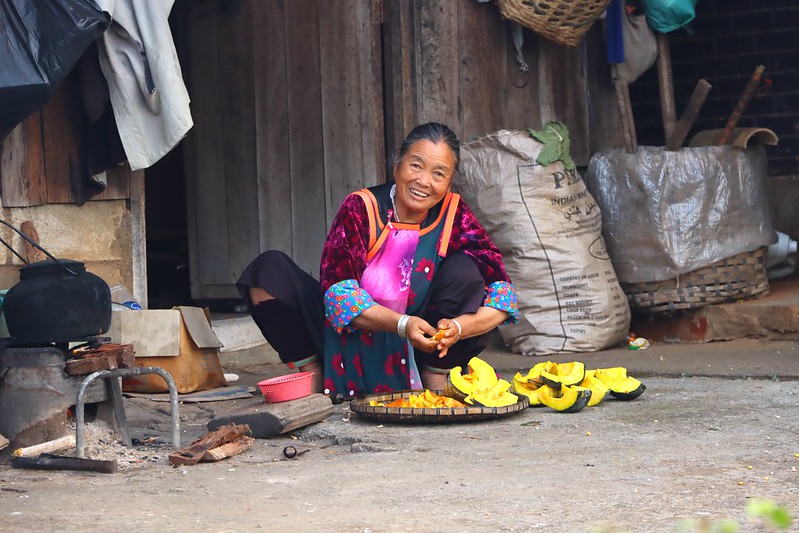
One of the rules for our trip was to ask for consent before taking photos. So when I saw a village woman sitting in front of her house cutting vegetables, I started by smiling at her and showing my camera. Those who didn’t want to be photographed reacted immediately. I could then point my camera, and when the woman smiled, I understood that was her way of giving consent.
I heard a man behind me say to her, « He’s interested in what you’re doing » (or at least, that’s my interpretation). And she replied with something like, « I wonder what could be so interesting. »


A Multidimensional Exchange
In the evening, we shared our first impressions. I found this moment particularly instructive: we had all experienced the same two days, yet each of us seemed to have seen a different village.

Some talked about how the Lisu had adapted their farming and villages to the challenging mountain environment. Others emphasized the hospitality of our hosts and the connections made despite language barriers. The discussion also turned to the new business run by the young generation, the farms, and the small markets. For some, these initiatives showed that it’s possible to preserve cultural identity while developing new economic activities. Participants from the Philippines or Myanmar naturally drew parallels with the indigenous communities they know from their own countries.
I realized then that our diversity wasn’t just a characteristic of the group, it also changed the way we looked at what we had experienced. We were in the same village, but we didn’t all take the same story away from it.

Returning Is Always a Surprise
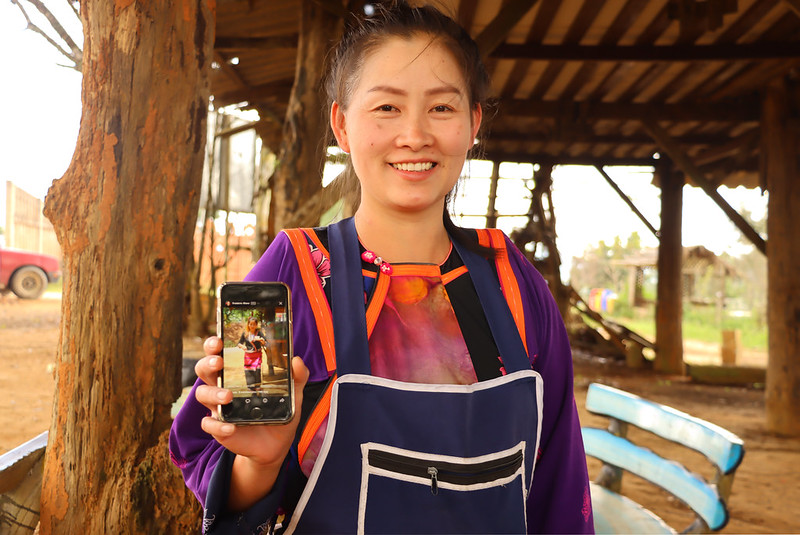
On the second morning, our host took us to a small roadside market at the top of a hill. I had been here before, in 2015. I remember perfectly seeing a cabin serving coffee and stopping there. I also remember taking photos. So I quickly searched my photo archives (thanks, pCloud), and found the picture of the girl who, dressed in her Lisu costume, had brought me my cup of coffee. I showed the photo to P’Noom. He looked carefully and said, « She’s over there! » and took me to the girl in the photo, who was standing in exactly the same spot as eight years earlier. I showed her the photo. She looked amused and said she had been prettier eight years ago. She thought she had aged a lot. I assured her she hadn’t changed. She agreed to let me take a new photo.
Immersion
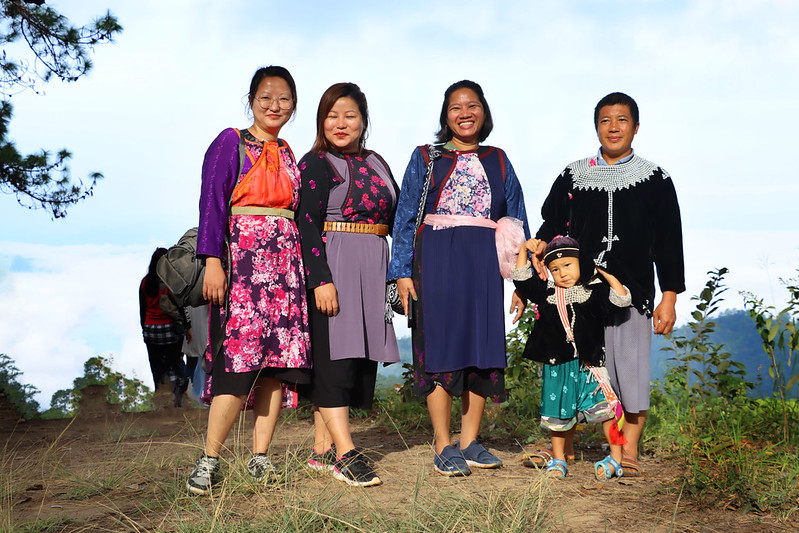
Three girls from our group borrowed Lisu clothes from our host. As it turned out, the clothes fit them perfectly. We walked through the forest and reached a well-known viewpoint offering an exceptional view of the region. A man approached the three girls, speaking to them in the local Lisu language. When he realized they were foreigners, he laughed at his mistake. It must be said that two of these three girls were from another hill people, they were from Nagaland. Still, this anecdote proved that our small group had successfully immersed itself in the local world of the Lisu.
Akipu Café

On Sunday morning, before leaving this beautiful region, our host took us to Akipu Café. This café, with a style similar to others sprouting up across the region, is run by a group of young Lisu. Its name, Akipu, means in the Lisu language « the spirit of the Lisu people will rise again ». A declaration of hope for their community’s future.
Everything there is locally produced: the coffee, of course, but also the fruits and vegetables served as delicious small dishes. The goal, clearly stated in the café’s very name, perfectly aligns with that of our weekend: to increase economic opportunities and livelihoods for the local community. By supporting this project, we were directly contributing to this vision, all while enjoying a moment of sharing around local specialties, something no one managed to hide their enjoyment of.


In the End
This stay not only allowed me to meet the Lisu of the Vieng Heng region but also taught me how to be a « good tourist. » The ethical rules defined by Dr. Rey before our departure stayed with me throughout these two days. Some seemed unnecessary, others too strict, but all of them helped establish a fairer relationship between the local people and the outsider that I am.
November 11-12, 2023 – LISU VILLAGE HOMESTAY, EXPOSURE, IMMERSION, AND ETHNOGRAPHIC OBSERVATION
A BIG THANK YOU TO THE DEPARTMENT OF RELIGION, CULTURE AND PEACE STUDIES, PAYAP UNIVERSITY, CHIANG MAI
Text and photos: © Frédéric Alix, 2023


Laisser un commentaire