Sri Lanka, Matale region, Wednesday 4 February 2026 (National Day)
The main reason for my stay in Matale was the Aluviharaya temple, where the Tripitaka was written down for the first time. But beyond my love of history, it was nature that called me here. Scrolling through Instagram, I had fallen for a picture-perfect waterfall, with a bridge crossing right over it. With no private vehicle, I looked for a way to get there. I was told about a bus to Rattota, or a motorbike driver who could take me for 3000 rupees.

I wake up early, but I linger in bed. A coffee. Samee, the homestay caretaker, tells me breakfast is ready. I hadn’t dared hope for a real meal. The other guest leaves his room, trying to catch a bus to Jaffna. Samee walks him to the bus station. I sit down at the table: several curries, some naan, an egg. Rich, generous. I wasn’t expecting this.
I check my map: the waterfall I wanted to see was wrecked by Cyclone Ditwah. The bridge is gone, and so is the road. No way across, no way to swim. A brief disappointment. I ask Samee for advice. He’s free today. « We could go to that waterfall, and even further to see the view. 5000 rupees for everything. » Not a second of hesitation. Let’s go.
Samee locks up the house, it will sit empty while we’re gone, and we climb into his tuk-tuk. We drive a few kilometres. In town, traffic has piled up. Today is National Day: flags hang everywhere. Samee turns to me: « Would it bother you if my wife came along? » Quite the opposite. I’d be glad to meet her. « She’s thin, she won’t take up much room, » he adds. A small detail that says a lot about his thoughtfulness.
We stop by his place. His family home is lovely, tucked into a pocket of flowering greenery. His father is watching the parades on TV. His wife is getting ready. He shows me his rice field, hidden behind an orchard. A green oasis, mountains in the background. I love these moments when someone shows me something simple. It feels like someone opening a safe to show me something precious. Everyday landscapes always move me more than postcards.

We climb in. Sure enough, his wife only takes up half the seat. We stop to fill up on petrol. Samee adds a plastic bottle as a backup. I watch him pay 2000 rupees. I think to myself that his profit margin must be tiny. Already, I’m planning to give him more than the agreed price.
Hindu Gods for Buddhist Heart
Along the way, we stop at a small kovil (Hindu temple). Samee asks me to wait. He goes in to pray, quickly. It’s not a tourist stop, just a personal gesture. I had thought he was Buddhist. He confirms it: « I’m Buddhist, but I always pray to the Hindu gods before a trip, for protection. » In Lanka, you don’t have to choose. You add on.
We pass through Rattota, a small town. If I had followed the first advice I got, I would have got off the bus here. We turn right, then head down toward the river. A scene of destruction. The river tore through everything on 27 November last year, when Ditwah struck the island. Bridges swept away, houses collapsed. Samee and his wife show me the spot where they used to have picnics. « It will take time for the landscape to feel gentle again. » And yet, life has already come back. Just last week, the whole road up to the top of Riverstan was repaired.
The Wrath of Ditwah
Then, the waterfall. Local people are celebrating National Day. At the end of the path, the bridge only exists on Instagram now. In real life, all that’s left is a twisted frame and torn ropes. The water is muddy, far from the blue of the photos. I wander around taking pictures. I tell myself that, in the end, this destruction is a symbol of life pushing back. The island’s indigenous people believe in the forces of nature, it’s as if nature wanted to do a great cleaning. But at what cost? The old spirits are not gentle.
We sit on a low wall in front of a stall. I drink an herbal tea. I watch the woman preparing drinks, her precise movements. I’m curious about the herbs and dried berries she sells. I want to know everything. I buy a few things before leaving. Contributing, even in a small way, feels essential.

Planting Hope
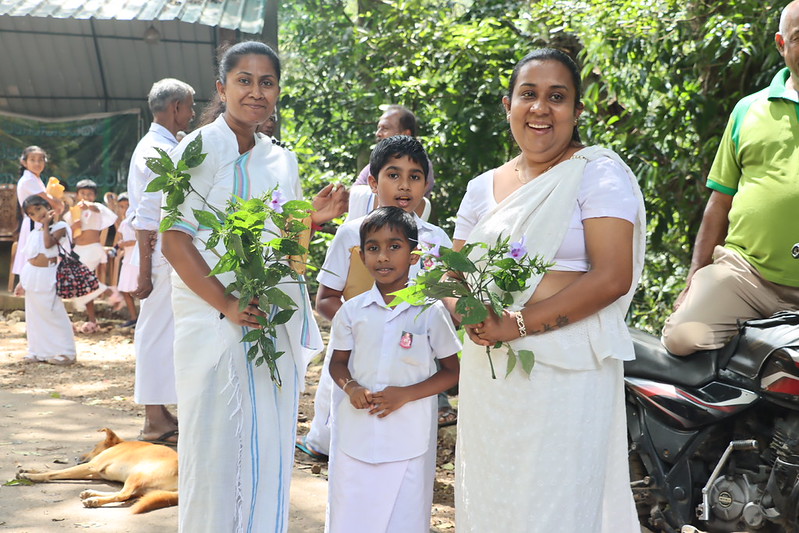
On the way down, a woman from the community invites me to join the villagers action to plant a tree. A national initiative after the disaster. I join the line of villagers, each of us holding a small tree. We walk down toward the river. I plant my tree symbolically in the sandy soil, under kind eyes. The community leader comes to greet me. We take photos. Everyone smiles. « A foreigner helping us rebuild, » they say. I feel proud. Moved, too. I wash my hands in the river. The cool water, the touch of the earth. I connect with people. Laughter, a few words exchanged, smiles that need no language.

We keep going. We cross a tea plantation, green leaves shining in the sun, a lovely view over the valley. We stop for chapatis, cooked over a wood fire, eaten in a small house by the road. Motorbikes pass by the dozen — everyone is out today, it’s a holiday. The higher we climb, the thicker the clouds get, until they swallow the road. Some young people are taking photos with their motorbike parked in front of a stream rushing down the rock. I borrow one of the bikes for a photo — it makes everyone laugh, me first of all.


Riverstan’s Secret
Samee points to a peak we can’t see. « That’s where we’re going. » Riverston. At the top, fog rules everything. We climb on foot: the rock is wide, a river flows beneath our feet, invisible, as if coming from nowhere. We can only guess where the cliff’s edge is. One step too far, and it would be the void. We never get the view we were promised. Another trick from the spirits of Lanka, keeping the view for themselves today. It doesn’t stop me from feeling happy, standing up there in the blankness, next to a couple who gave me the gift of their day.

We loop back down, on the other side of the mountain, toward the childhood villages of Samee and his wife. Stories from their youth, shared memories.
On the small road, three motorbikes nearly crash into us. One of the riders shouts « Elephant! » Samee, in a reflex, starts to turn back — until we realize it was a joke. Because anyone who knows elephants knows how destructive these animals can be when they move in a group.
Asking the Spirits for Passage
Further down, under the canopy of tall trees, we stop in front of an animist sanctuary tree. A Buddha statue watches nearby. You have to tie small branches onto a rope. « To ask the spirits for protection, » Samee explains. This sanctuary used to sit at the heart of the village below. But the village disappeared when the dam was built. A large lake, a dam about ten years old. Samee explains that you must ask the spirits’ permission to cross the Riverston pass. Once again, I think to myself that on the island of Lanka, beliefs simply add up. And I think about the storm that cut the road in several places. Weren’t these very spirits behind the landslides?


Digging for Amethysts
A little further on, we run into an uncle of Samee’s, by chance: he made his fortune in gemstones. Mines everywhere. I had no idea this region was so rich. Here, people still dig through the soil looking for amethysts. The road stretches on, another dam, a stop with monkeys and motorbike riders, laughter, shouting. Further along, Samee buys some Hoppers. We eat them on the road; I get them all over myself, but it doesn’t matter.
Finally, we head home. Samee drops me at the homestay and goes home with his wife. I’m alone, but not lonely. I rest. A little hungry, but too tired to go out. I need nothing more. The day has been so rich. My body is exhausted, but my heart is light. I lie down, at peace. The stress, the hunger, the thirst… all gone. I fall asleep.
The next day, I try to pay Samee more than what he asked for. He refuses completely. « We had a good day together, that matters more than money, » he tells me.
Text and photos: © Frédéric Alix, 2026

To learn more…
Cyclone Ditwah
In late November 2025, Cyclone Ditwah struck Sri Lanka, causing floods and landslides across roughly twenty districts, including Matale. Bridges swept away, roads cut off, several hundred people dead or missing, over a million people affected. Three months later, the region was still healing — but life, National Day, motorbikes, and smiles had already returned.


Three peoples, one valley
Around Matale, three of the island’s main communities meet: the Sinhalese, mostly Buddhist, whose temples and gestures of devotion I pass all day long; the Tamils, Hindu, many of them descended from workers brought over by the British in the 19th century to grow tea in the central highlands; and the Vedda (or Wanniyala-Aetto), the island’s first inhabitants, whose animist beliefs — spirit worship, sanctuary trees, asking permission before crossing a mountain pass — still shape local practices, even among practicing Buddhists and Hindus.
Precious stones
Sri Lanka has been one of the world’s great gemstone sources since ancient times. Legend has it that the Queen of Sheba received a Ceylon ruby as a gift from Solomon. Sapphires, rubies, amethysts, garnets: the town of Ratnapura, further south, remains the historic trading capital, but small-scale mining stretches far beyond it, including the hills around Matale, where small family plots still dig through the earth in search of amethysts.
The dam and the drowned village
The Kalu Ganga dam, at Pallegama, is part of the larger Moragahakanda–Kaluganga project, launched in 2007 and completed in 2018. Around 800 families from the villages of Pallegama and Rambukoluwa had to be relocated to make way for the reservoir — a recent displacement, barely a decade old, just as Samee described. The animist sanctuary we pass on the road survived the flooding of the village: moved higher up, it keeps watch, as if the spirits themselves had migrated to higher ground.

Aluviharaya and the Tripitaka
In the 1st century BCE, the Sinhalese kingdom went through a devastating twelve-year famine, made worse by an invasion from southern India. Fearing that the Buddha’s oral teachings might be lost as monks scattered, King Vattagamani Abhaya allowed them to be written down: it was at the Aluviharaya cave monastery, on talipot palm leaves, that the Tripitaka (or Tipitaka) was first put into writing. The text would survive, against all odds, two later destructions — by the Dutch in the 17th century, and by the British in 1803.


Laisser un commentaire