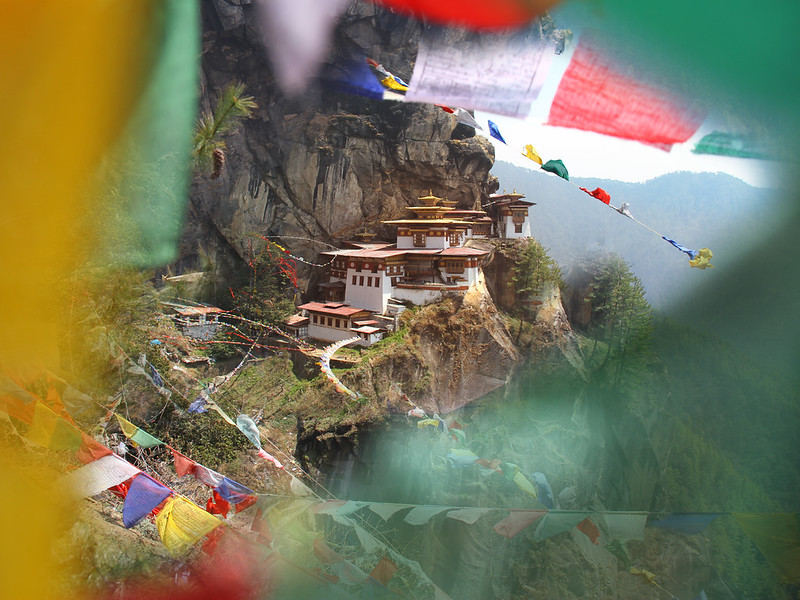
Nima points his finger at a tiny speck clinging to the mountain, high up, almost unreal: the Taktsang, the “Tiger’s Nest”, Bhutan’s most famous monastery. The story of an ascent to 3,120 metres, where every step is a constant negotiation between breath, vertigo, and a faith in oneself that grows with the climb.

Prologue: Six Months Under the Himalayan Sky
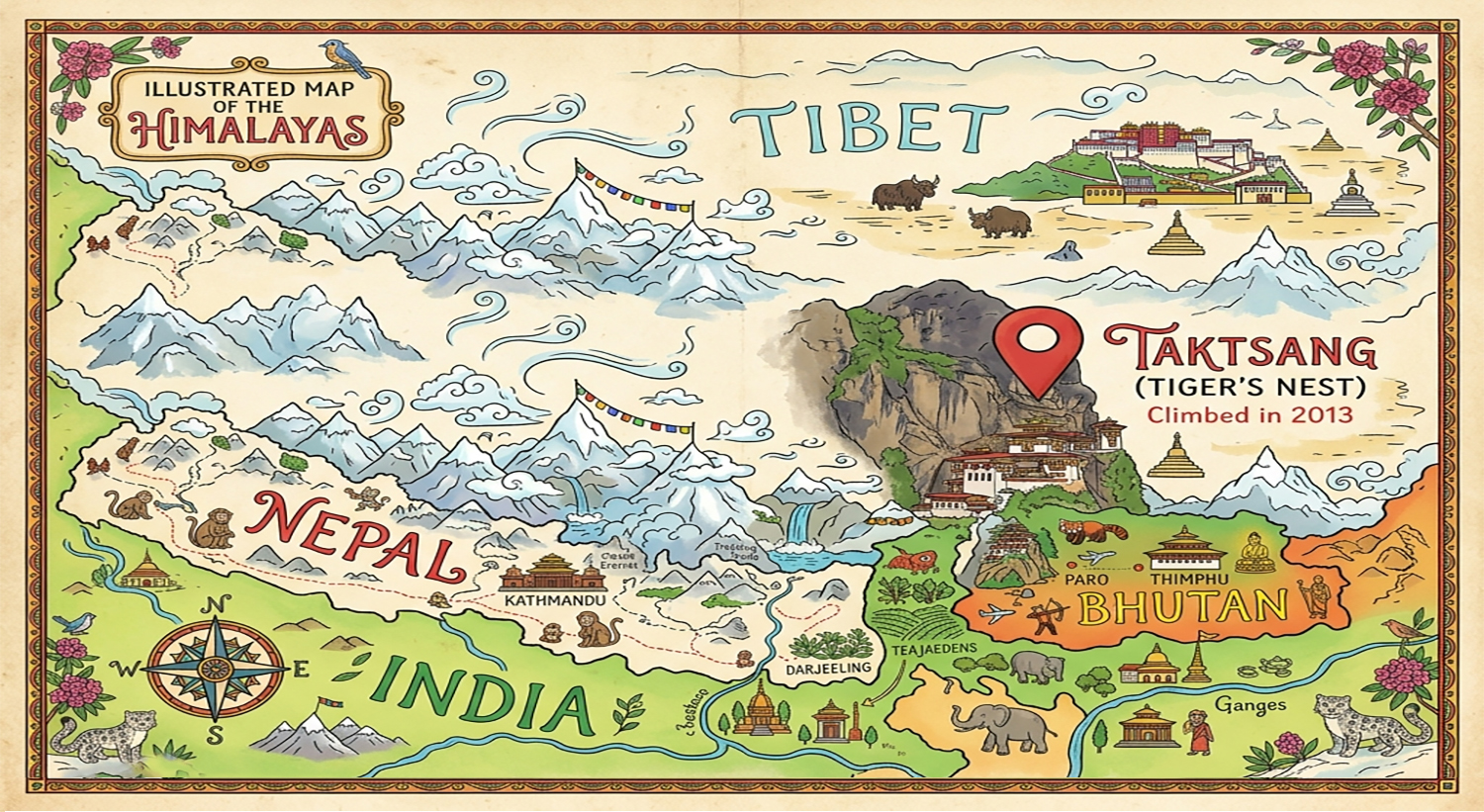
In 2013, I was working as a teacher at a language institute in Thimphu, the capital of Bhutan. This small Himalayan country, nicknamed the « Land of the Thunder Dragon », imposes strict rules on foreigners: no travelling alone, permits required for every outing. Tourists are accompanied by guides who never leave their side. And work permit holders, as was my case, are confined to the city where they work. For a freedom-lover like me, it was a daily frustration. And, after weeks of negotiations, I obtained an exceptional permission: to visit the Taktsang monastery, or Tiger’s Nest, the ultimate symbol of Bhutan, clinging to a vertiginous cliff at 3,120 metres above sea level.
On 14 April 2013, I was able to fulfil the dream of climbing up to this solitary monastery perched on the cliff.

The Dawn of an Ascent
I wake up before my 7:15 alarm. The excitement of the previous evening has kept me awake. This morning, only one thing matters: Taktsang. At 9am, Nima Wangchuk, my taxi driver, is already waiting for me outside the institute. He says « Good morning », and that is the entirety of the conversation we will have all day. The rest of our communication is done through gestures and smiles. A luxury: a day where I have nothing to organise, nothing to plan. Just to climb. Everything has been arranged for me by the couple who employ me.
The drive to Paro takes an hour and a half. Nima stops to buy water. The overcast sky seems to be clearing. He parks his car at the end of the gravel road. We get out. Then he points it out to me, up there, towards the mountain: at 3,120 metres altitude, the monastery, clinging to the cliff, far, very far away. « How are we going to get there? » I wonder, my heart pounding. Around us, black cows graze on the sparse grass growing at 2,500 metres, dogs watch me, and vendors shout as I pass: « shopping shopping»

Then he points it out to me, up there, towards the mountain: at 3,120 metres altitude, the monastery, clinging to the cliff


The Ascent: Between Suffering and Wonder
The walk begins — or should I say the ascent. After half an hour, I have already taken off my jumper; I am in a t-shirt. The heat increases, and with it, my breathlessness. The altitude-related dizziness (re)takes hold of me. To be honest, I should have acclimatised by now, having lived in Thimphu at over 2,350 metres for several weeks.
We cross an elderly Thai couple coming back down, the woman is injured. Further along, a group of 20 to 30 Thais walk slowly. They complain about the heat, the steep path, and that they are hungry. Some walk with small portable fans. I am breathless and unable to utter a sound, but I smile at this group of grumblers on their journey.
Every Step Is an Act of Faith… in Oneself
This ascent reminds me of Mount Popa in Burma (ah! I haven’t told you that story yet) or the highlands of Yunnan. But here, every step is an act of faith. I don’t say that lightly, it’s not a figure of speech: you have to believe in your own abilities when you climb 600 metres of elevation gain, which is a bit like climbing 180 to 200 floors on a mountain trail that becomes a little less welcoming with every step. I stop often to take photos — that’s the excuse I use to allow myself a rest.
We stop near a giant prayer wheel. The hungry walkers devour their packed lunches. Those who rode up on horseback must leave their mounts here. Not everyone will continue, in any case. The view of the monastery is already magnificent. Nima and I press on. The landscape is breathtaking: sheer cliffs, prayer flags fluttering in the wind, and that sensation of standing on the very edge of the world.

Several stops along the way, at the giant prayer wheel or beneath the prayer flags — nature prays for us.


The Sanctuary and Its Mysteries
At the entrance to the temple, Nima adjusts his gho (the traditional garment — Bhutanese are required to wear it to enter sacred sites as well as local and national government buildings), while I look for the office where I must present my permit. Even perched at the roof of the world, one must show one’s credentials. The guards insisted that bags be left outside. I slipped my wallet into my pocket and left my camera and iPhone on a large flat stone near the guard. I was searched to make sure I had not hidden a camera, and I was finally allowed to enter the monastery.
Inside, magnificent Tibetan Buddhist statues. It reminds me of the temples of Kham (eastern Tibet), where I had been free to photograph. Here, it is forbidden. Bhutan superstitiously protects its sacred images. We removed our shoes to enter the devotional halls. Nima prays fervently before every image. A monk sits near a window, seemingly balanced on the ledge, backlit; but he watches me with a suspicious, almost hostile look. The wooden floor creaks beneath my feet, I have the impression it is sloping, and I think to myself it would be a shame if the monastery chose today to collapse and fall from its clifftop perch.


The Return: Sacred Ground and Holy Cows
The descent is harder than expected. My muscles burn, and I am afraid of twisting an ankle. The slope seems steeper — perhaps it is the vertigo of facing the void — and the pebbles rolling under my trainers are not exactly helping me stay balanced.
Nima stops to collect some earth from beneath the cliff and water from the (holy) stream. « A complete pilgrimage ». For the Bhutanese, every natural element of this mountain place, vibrating with the chanting of monastic psalms, is sacred.


Back in Paro, the nearby town, I confess I am rather hungry. The restaurants are closed. Eventually, after asking around, Nima finds a place on the first floor of a building overlooking the central square. I order rice with beef. Nima does not want to eat. The meat is so tough I cannot cut it. I don’t like beef, I am usually vegetarian, but I often have no choice. And I must confess that I am too fond of cows to eat them.
Ironically, on the road back, a dead cow lies at the roadside. Nobody approaches it, nobody moves it. Here, unlike neighbouring India where the cow is a sacred animal protected by Hindu law, Bhutan does not sanctify the animal, but it does sanctify non-violence. Buddhism forbids killing, so the country long refused to build slaughterhouses on its own soil. The result: the Bhutanese are nonetheless among the heaviest meat-eaters in South Asia; they import their beef and pork from India and Thailand, thereby offloading their karma onto the butcher in the neighbouring country. A pirouette I find perfectly Buddhist in its logic: do not kill yourself, but eat all the same.
Extreme Pilgrimage
Further along, a pilgrim walks prostrating himself at every step — full body to the ground, hands pressed together and stretched out before him, then rising to begin again exactly where his hands had touched the earth. This is what is called a prostration pilgrimage, a Tibetan Buddhist practice in which one covers dozens or even hundreds of kilometres body and soul as one. I observed scores of them in Tibet, in circumambulations around the sacred mountains, and my knees ached in sympathy. A car of well-to-do Bhutanese stops to make a donation. The man accepts, but without breaking his rhythm, as though absorbed in a devotional trance.
Epilogue: Thimphu in the Dark
Back in Thimphu, Nima drops me off in front of the institute and we say goodbye with a nod. A power cut plunges the town into darkness. I go into Tukten and Tendi’s restaurant — they are also the owners of the language institute. They are dining by candlelight. « A romantic dinner », I joke. Tukten wants to see my photos. Tendi, worried that I might have taken too personal a shot, tells her husband not to look at everything.
Before I leave, Tukten gives me a bottle of arak, a spirit brought from Sikkim, on the other side of the Indian border. Tukten and Tendi are originally from that border region and love to go shopping across the border, bringing back on each trip products that are more refined, or simply unavailable or even forbidden, in Bhutan. The bottle looks like a whisky bottle. I take it away and will drink it in front of the TV.
That evening, exhausted but happy, with a slight headache and still dizzy from the altitude (and the arak), my heart is light. I have touched the sky of Bhutan.
Taktsang, the Tiger’s Lair

Taktsang, I was told before leaving, means « the tiger’s lair. » A name that sounds well on a tourist brochure, but which hides a story you don’t tell to hurried tourists. In the 8th century, Guru Rinpoché — Padmasambhava for those in the know (or for those who enjoy tongue twisters), a kind of second Buddha in the eyes of the Bhutanese, the man who is said to have planted the roots of Tantric Buddhism here — arrived at this cliff on the back of a flying tigress. Nothing less!
The tigress, in reality, was none other than his consort
– in Tantric traditions, the consort is the divine feminine counterpart of a male figure, not a mere wife, but an equal: an inseparable spiritual half, as though Tantrism had invented its own form of gender equality long before the word existed to claim it –
Yeshe Tsogyal, then, transformed into a winged mount for the occasion.
The purpose of the mission: to subdue a demon that was preventing the dharma from spreading through the valley.
Once the beast was subdued, Guru Rinpoché is said to have retreated into a cave to meditate. THREE YEARS, THREE MONTHS, THREE WEEKS, THREE DAYS AND THREE HOURS, neither more nor less.
The building I climbed to in the story you have just read dates « only » from 1692, built around the famous cave. It is worth noting that in 1998, a fire ravaged a large part of the site. Poorly extinguished butter lamps, it is said. It was entirely restored in the mid-2000s.
But we are not going to quibble about the true age of the walls: after having puffed for more than two hours scrambling up the path, I did not merely end up believing in the story of the flying tigress: I ended up hoping she would appear before me to carry me to that high-perched nest on the cliff.
Texts and photos ©Frédéric Alix, 2026 (text), 2013 (photos)
What the camera caught


Laisser un commentaire