Diary of a French Teacher in Bhutan
We were supposed to be two. Herb, my Sino-Malaysian friend, had signed up to teach Chinese at the same brand-new language institute in Thimphu. But Bhutan and China hadn’t spoken in years—the kingdom accuses its giant neighbor of nibbling away at its Himalayan borders, a few square kilometers here, a pasture there, in the disputed northern lands. Herb never got his visa. So I arrived alone in a country where I knew no one, to teach French and German at a school that, as I would soon discover, hadn’t even opened its doors yet.
Cold as a Roommate
No one had warned me that Thimphu’s real challenge wouldn’t be bureaucracy, but the cold. The radiator in my room runs endlessly, yet the chill never fades. The floor is icy, and the water heater in the shower is a daily gamble. Showers become an ordeal. I learn that it’s often colder inside the houses than out. In the mornings, getting out of bed demands a kind of courage I didn’t know I had: I stretch a single hand from under the blanket, and it feels like it’s already frozen in the air before it touches anything. I invent a survival ritual: podcasts in my ears, scalding coffee in my hands, a sudoku grid on my iPhone to delay the inevitable by five more minutes. My skin cracks within a week. Salvation comes in the form of a pot of moisturizer from the corner 8-Eleven (!), while the one I’d brought from Thailand—untouched there—has curdled in my luggage, as if even my personal belongings had given up on acclimating.

The School That Doesn’t Yet Exist
The institute occupies the upper floor of a downtown restaurant, the Mid Point, so named because it sits right in the middle of the city. A giant advertising sign on the ground promises Chinese, French, and German classes at all levels, for a school that, on that day, has neither students nor furniture. Kado is the newly appointed director of this venture, hired by Tukten and Tendi, the couple who own the Mid Point and, by extension, the institute itself. I’d assumed I’d start teaching the day after I arrived. Instead, what’s expected of me is to help Kado set up the institute from scratch. Everything remains to be done, and I quickly realize that my real job this first week is less that of a teacher and more that of an improvising sous-chef.
The Hobbit and the Viking
To keep me from feeling too lonely, Kado moves into the apartment assigned to me. In the mornings, we walk to the institute together, and I catch myself thinking we must look like a Hobbit escorted by a Viking. He’s adorable, devoted, generous to a fault. One evening, after I’d resigned myself to a sad picnic of bread and cheese on the couch, he appears proudly with two bowls of rice and a curry he’d spent an entire hour preparing. Too kind, too present, always there, at all hours, never leaving me truly alone. His constant presence, which I begin—without daring to admit it—to feel as a weight. But how do you tell someone so devoted that they’re doing too much?

Two Temples, One Day
The next day, as if the country had decided to take charge after those first days of improvisation, everything suddenly feels grander, more solemn, and, in the end, harsher. On the same day, within a few hours, Bhutan offers me an honor and two slaps in the face.
Rinchen picks me up in the morning. He’s the one who’d initially contacted Herb to invite us to work here. A friend of the couple who founded the language institute, he runs a travel agency in his daily life and is endlessly kind—anticipating my whims, fulfilling my needs before I even realize them myself. Thanks to him, I manage to adapt to this new life that seems to have fallen into my lap. With him, I feel an odd closeness, almost brotherly, the easy complicity of two strangers who have nothing to prove to each other.
He drives calmly, a cigarette pinched between two fingers on the steering wheel, commenting on the city with amused detachment. He stops in front of a kind of hardware store; curiosity piqued, I want to go in with him, but he tells me it’ll only take two minutes. He comes out with two white scarves in hand (the kind offered to the Dalai Lama) as naturally as if he’d just bought our entrance tickets.
A dozen kilometers north of the city, we climb a winding road through a pine forest, passing rivers where locals wash their cars with great splashes of water. We drive alongside the fortified camp of the Royal Guard, an impressive stone wall against which the soldiers’ families have rigged wooden ladders to climb over faster than using the gate.
The temple, at the top of the hill, is a place tourists normally don’t visit. Rinchen emphasizes this with visible pride, as if he’s opening a door rarely seen ajar.

A Hint of the Matterhorn in the Himalayas
A mountain rises directly behind the temple, almost pointed, absurdly reminding me of the Matterhorn. The day before, I’d started rereading La Grande Peur dans la montagne by Ramuz, a Swiss writer from my homeland, whom I’d never imagined connecting to anything but my native Alps. Yet, facing this Himalayan peak, the book suddenly feels as if it were written here: the same superstitions born of stone, the same fearful respect for the summit. As if I were secretly searching for Swiss roots to graft onto this new country.


Washing Hands at the Phallus
At the monastery’s entrance, a giant stone phallus serves as a ritual fountain: you wash your hands there, drink the holy water that flows from its tip. It’s a little strange to drink water from a phallus, but I comply with the custom, which seems here to carry a weight I wouldn’t dream of questioning. Further in, a half-buried stone, protected by a small wooden structure, is said to predict the future depending on whether it sinks or rises. Locals consult it like a familiar oracle.
In the courtyard, chickens and roosters—offered by grateful families—peck freely. They were given to the monastery for their eggs, never for the pot; here, you don’t kill what lives, you feed it.


The Refusal
This, Rinchen explains, is where all children born in Thimphu are brought to be presented at birth. A kind of baptism, an introduction to the forces of the valley. An idea that would fit right into a Ramuz novel. I understand, without him needing to say it, that he’s brought me here because I’m settling in for the long haul. It’s a genuine gesture of welcome, almost solemn.
An ancient tower, miraculously still standing after the previous year’s earthquake, emits the dull sound of a ceremonial drum for a ritual I’m not allowed to attend. I’d have liked to take a peek, but the doors are closed. Rinchen seems determined to do things properly: he goes in search of a monk to perform a small ritual. But the place feels deserted, silent, almost abandoned at this hour. He finally spots a monk, far off under a porch. The man looks at us for a moment, motionless, then shakes his head. He won’t perform any ritual, won’t utter a single mantra for a foreigner. Rinchen returns to me, visibly disappointed, almost sad, as if the refusal hurts him more than it does me. “There’s nothing more to see,” he simply says, and we leave. The white scarves we bought earlier—the very kind offered to the Dalai Lama—we leave on the entrance gate.

The Gesture That Pushes Away More Than It Blesses
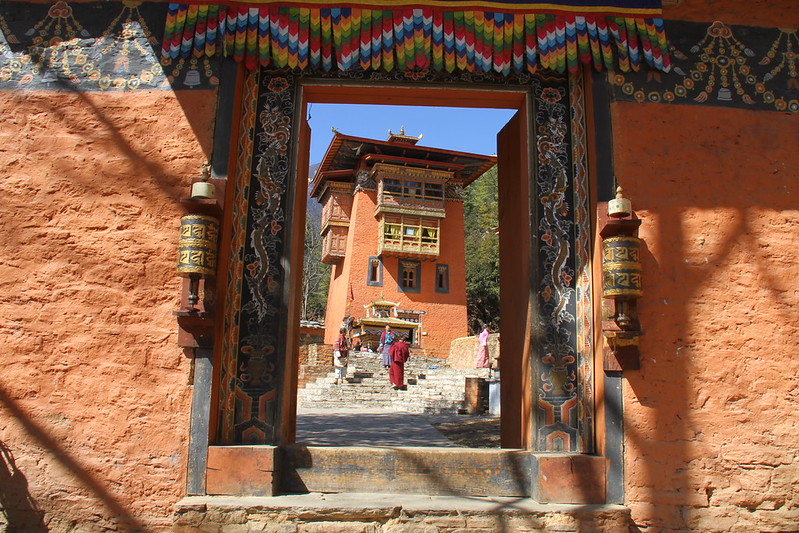
That evening, in a completely different monastery to the east of the city—a magnificent fortress surrounded by prayer wheels, which I spin one by one with even more zeal and seriousness than the faithful who’ve come to pray—everything shifts again, even more harshly. We’ve taken off our shoes before entering the wooden building. In this cold, it’s a trial more intense than anything I’ve experienced in Southeast Asia. In the main hall, I feel the heavy gaze of a monk reciting a mantra, never taking his eyes off me. I admire the central statue: a Buddha with multiple stacked heads, five tiers of faces rising above arms barely visible beneath the fabric. As I take a step toward the area where the faithful sit in meditation, a senior monk intercepts me, his expression openly disgusted, and pushes me away with a sharp flick of his hand. Exactly the gesture you’d use to shoo away a stray dog. Not a word. None needed. The message is crystal clear.
I don’t try to soften this moment or find a convenient cultural excuse. It happened just like that—dry and blunt. On the same day I’d been welcomed to the city as one of its own, a monk had refused to even acknowledge that.

A Sunday, Alone, in the Snow
On the seventh day, for the first time, I wake up alone in the apartment. Kado has moved back to his own place, having realized I can live by myself. It snowed all night; the entire city is white. I set out to walk alone—no guide, no Kado, no one. A luxury I only appreciate now that I’m experiencing it. Around a street corner, children have sculpted a snowman with an unmistakable silhouette: a giant phallus planted in the middle of the road, which passersby sidestep with a seriousness that makes me smile to myself. I also pass impromptu snowball fights, two tourists flanked by their guide, whom I watch without envy, as I wander freely (or so it seems).
What I haven’t told you yet is that my internet access is limited. My local SIM card isn’t set up for data. No Wi-Fi at home. At the office, it’s painfully slow. My days become a discreet hunt for Wi-Fi: a café with a fireplace but no connection, another where two sisters make me coffee with a password that never works, a third where two overly enthusiastic young men make me promise to return.
That evening, I’m a little bored, alone on my Sunday. It’s not a problem. In its own way, it’s exactly what I needed.


A Week, in Short
That’s what my first week in Bhutan looked like: fewer summits and prayer flags than in my dreams (for that, I’d have to wait for the grand tale of Taktsang—Tiger’s Nest), and far more curry, missing Wi-Fi, cracking skin, and awkward silences. A country that welcomes you with disconcerting generosity, introduces you to its temples as one of its own, then reminds you, without warning, that you’ll always be a foreigner who can be shooed away with a flick of the hand.

Texts © Frédéric Alix, 2026 (based on notes from 2013) Photos: Bhutan, 2013
A French Teacher in Bhutan’s Diary
This text is part of a series of memoirs recounting the experiences of a French teacher in Bhutan. The first piece, Bhutan – Clinging to the Mountain, Clinging to My Dream: The Tiger’s Nest, has already been published.


Laisser un commentaire